
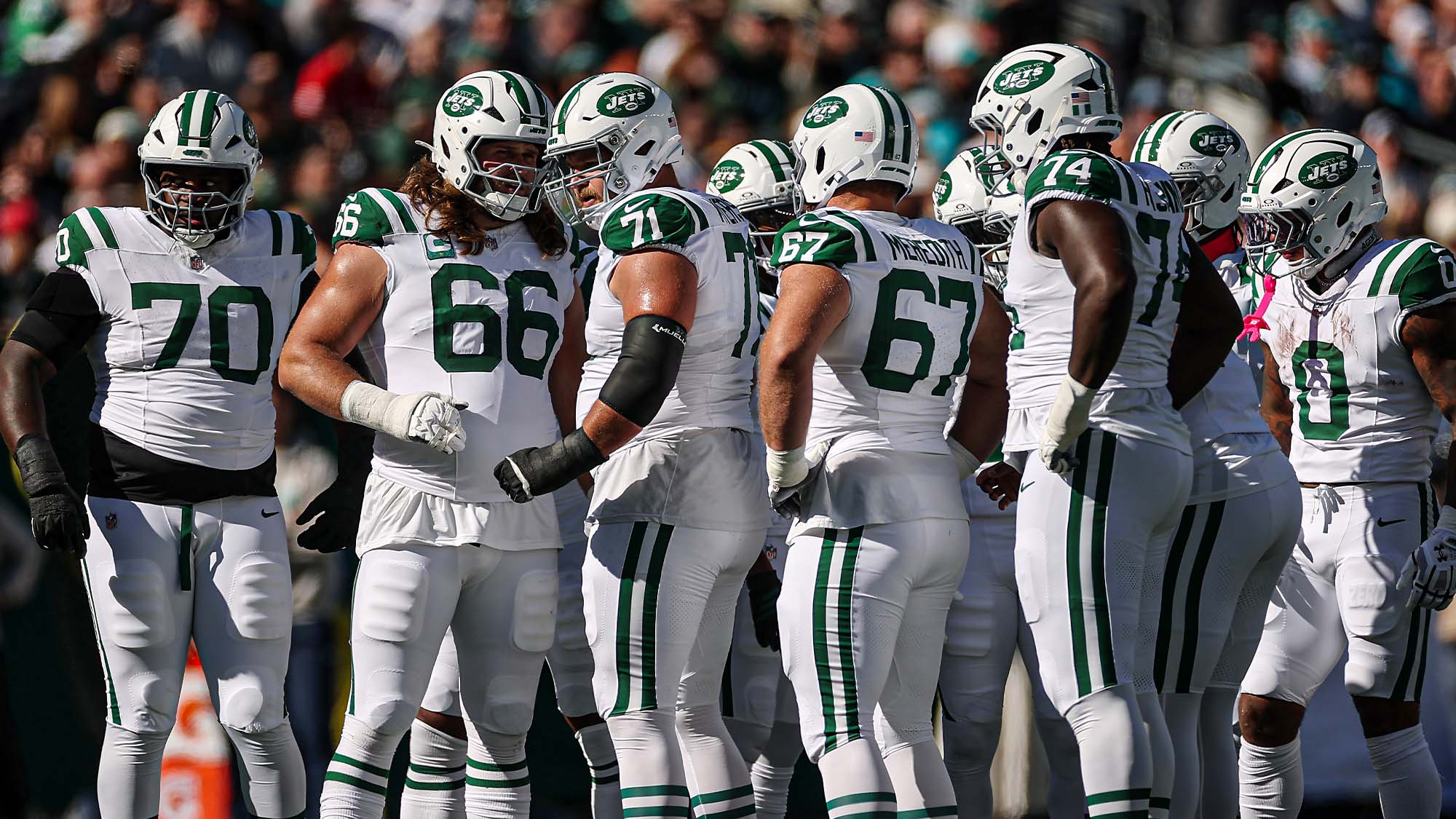
While coaching has deservedly drawn most of the flak for the New York Jets’ 2-5 start, poor player execution is also an ingredient in the Jets’ pie of slop.
The coaches can’t be blamed for every failed play. Sometimes, plays fail because players just don’t execute, and even having Vince Lombardi on the headset wouldn’t have changed the outcome.
From an execution standpoint, perhaps the Jets’ most disappointing unit this season has been the offensive line. After an offseason filled with hype and a hot start through two games, the unit has become more a liability than an asset.
It starts in pass protection, where Geno Smith has been sacked 21 times, the third-most in the league, and lost 177 yards on those sacks, leading the NFL. Now, to be fair, much of that isn’t the offensive line’s fault, as Smith can own a large portion of his sacks. The 36-year-old has struggled to escape pressure and occasionally holds the ball too long. Still, the offensive line has consistently given up quick, unavoidable sacks in high-leverage spots this season.
In the run game, the offensive line has struggled to open holes. Over the last three weeks, the Jets have had to count on Braelon Allen to create most of the team’s rushing production on his own. Since Week 5, Allen has gained 266 yards after contact compared to 32 yards before contact. Without Allen’s incredible hot streak of elusiveness and contact balance, the Jets’ run game would have been a non-factor due to the offensive line’s ineptitude.
Not to mention, the Jets are consistently losing games because of their inability to rush for one yard in critical fourth-down and red-zone situations, which falls on the offensive line for failing to move the line of scrimmage in obvious run situations. Their losses to the Packers, Patriots, and Dolphins can all be tracked back to failed short-yardage and goal-line runs.
So, it’s been a disappointing season for a unit that was widely viewed as one of the Jets’ highest-ceiling groups coming into the year. Thus, it makes sense that the team should consider shaking things up.
There aren’t many alternatives available, as the team’s offensive line depth is questionable, but it’s time for New York to consider one big shake-up: benching starting center Josh Myers.
Myers continues to play every bit like the backup that he was signed to be entering the 2025 season, despite the Jets handing him the 2026 starting job with no competition. Through seven games, he is tied for the second-most penalties among centers with five, while his 10 pressures allowed are tied for the seventh-most. Only two other centers have 10+ pressures allowed and 5+ penalties.
On Sunday, Myers had a critical false start penalty in the fourth quarter, backing the Jets up from third-and-6 to third-and-11 as the Jets attempted to drive for a go-ahead score with under seven minutes remaining. A false start on a center, especially in that situation, is inexcusable.
It also should not go overlooked that Myers is the man in the middle for a Jets run game that is averaging a paltry 0.88 yards before contact per carry on rush attempts between the tackles this season, and the film shows that it often largely falls on him.
Add in his primary communicative role for a unit that frequently botches protections in key spots, and it’s safe to say that Myers has been the unit’s top liability.
There is little hope for Myers to turn things around, as he is playing up to the level that he has performed at for the majority of his six-year career. This is who he is. The Jets admitted as much when they signed him to a backup-level contract in 2025. Why they changed their stance on his value since then is difficult to fathom, as he played up to that contract over a 17-start sample in his first season.
So, what can the Jets do?
Well, the good news is that the impending return of left guard Dylan Parham opens up an avenue for them to consider. Parham, who has missed four straight games with a knee injury after enjoying one of the hottest starts among NFL offensive linemen through Week 3, was a limited practice participant ahead of Sunday’s game, and was ultimately listed as questionable. He is on track to return soon.
Parham has been replaced at left guard by Jordan Meredith, a versatile interior backup who was acquired by the Jets via trade just before the regular season. Meredith has struggled in relief of Parham, but the good news is that he also has experience at center, where he started nine of his 20 career games before 2026.
As the Raiders’ starting center over the first 10 weeks of 2025, Meredith posted a 60.5 overall grade at Pro Football Focus. In nine games, he allowed eight total pressures and committed four penalties, although three of those were for ineligible man downfield (potentially not his fault). Those are subpar numbers for a starting center, but it’s essentially replacement-level production, which is above what Myers is giving the Jets. In fact, Meredith’s 60.5 overall PFF grade over that stretch would be Myers’ career-best single-season grade; his career average is 56.1.
Given Myers’ poor play and the predictability that it will continue, along with his role as the communicative leader for a unit that continuously struggles with protection and run-scheme breakdowns in high-leverage spots, why not shake things up with Meredith?
Perhaps things won’t be any better, but there is at least a chance. Sticking with Myers provides little to no potential for improvement. The “continuity” argument hardly applies, as it was the main motivation for keeping him as the starter in 2026 in the first place, and it has paid no dividends so far.
When you’re 2-5 and fresh off a loss to a team that had never held a lead before, it’s time to start throwing things at the wall and seeing what sticks. Benching a struggling starter who never should have been starting in the first place seems like a good place to start.
