
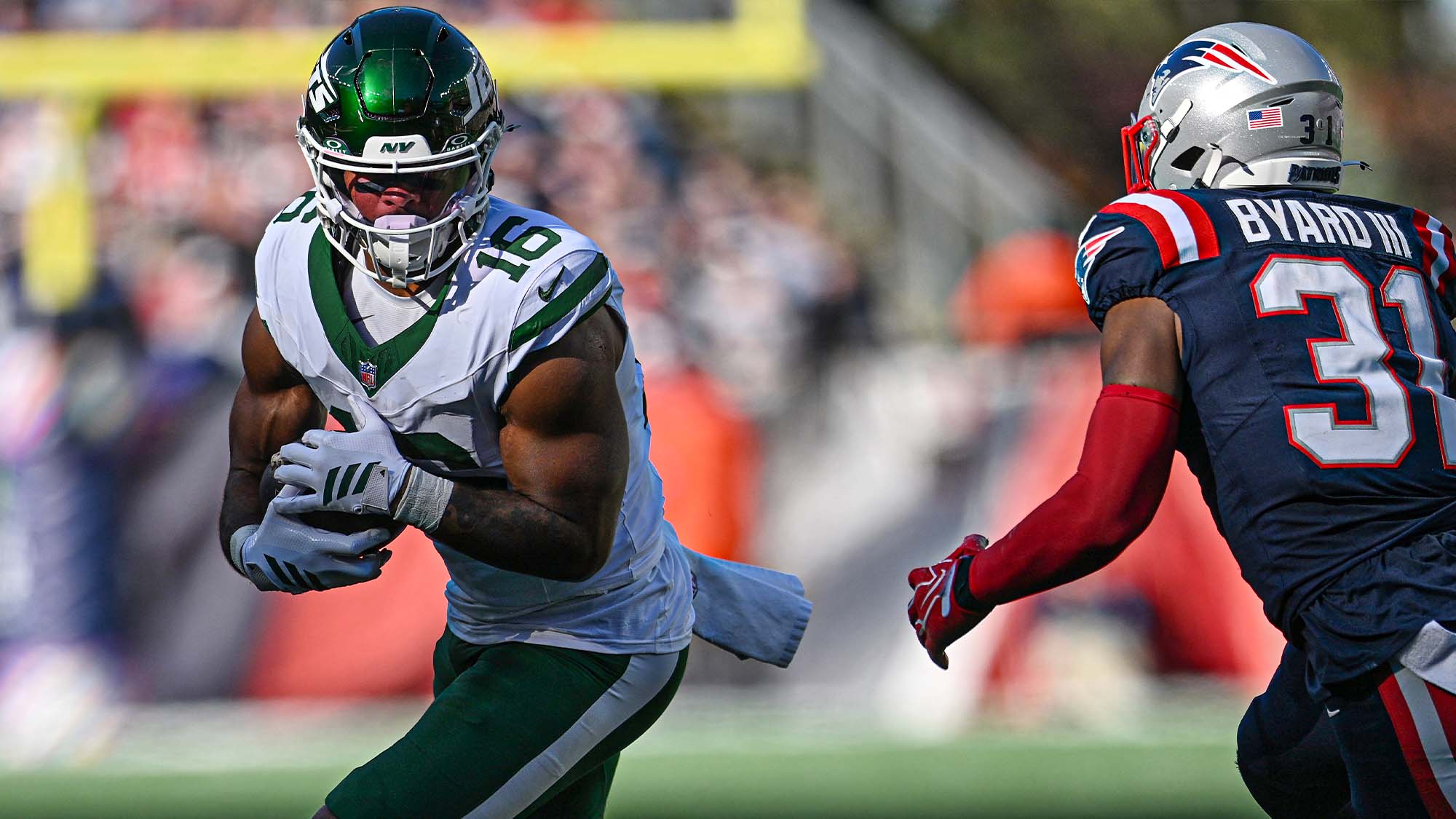
Choosing Kenyon Sadiq 16th overall was not just a surprise, but a statement by the New York Jets.
The Jets didn’t just like Sadiq enough to view him as a first-round pick. They believed he could be one of the best tight ends in football.
Tight ends are rarely drafted in the top half of the first round nowadays. Sadiq became just the seventh tight end chosen in the top 16 over the last 20 drafts (2007-26). That’s why New York’s pick sent such a loud message compared to if they drafted your typical wide receiver or cornerback in that spot.
After all, tight end is considered one of the least valuable offensive or defensive positions. So, in a draft where the wage scale is fixed by draft slot with no regard to position, choosing a tight end in the first round technically makes him a more expensive selection than choosing a player at almost any other position.
Consider this: Sadiq’s rookie contract includes $22.3 million in guaranteed money, which instantly places him 12th among tight ends. The player drafted one spot ahead of him, edge defender Rueben Bain, ranks 36th at his position with $23.8 million in guarantees. The player drafted one spot behind him, offensive tackle Blake Miller, is 39th at his position ($21.9M).
In a vacuum, drafting a tight end with a mid-first-round pick and signing a replacement-level veteran edge defender would cost a team more than the reverse, which explains why tight ends are rarely drafted that high. If you can get a player at a premium position for the same price as a player at a less important position, why not maximize the system by opting for the premium position? This logic is what pushes tight ends and running backs down the draft board each year, and it makes sense.
The only reason to go against that logic would be if you believe that the tight end will be substantially better at his position than the comparable premium-position players will be at theirs.
After all, the logic behind neglecting tight ends in the early first round only applies if the prospects in question are of equal talent at their respective positions. Of course, you’d rather have the 20th-best edge defender than the 20th-best tight end if they are making the same money. But if the tight end is a top-5 guy, then you have a different debate.
Clearly, the Jets thought Sadiq could be a top-5 guy.
The question is, even if Sadiq is a top-5 talent… can he make a top-5 impact?
Kenyon Sadiq’s impact ceiling
Sadiq is in a much different situation than some of the other tight ends who were drafted early in recent years. Take Brock Bowers of the Las Vegas Raiders, for example, who was chosen 13th overall in 2024.
In Las Vegas, Bowers is the guy. The Raiders have built their offense around him from Day 1, allowing Bowers to make an impact similar to that of a premium wide receiver.
Since 2024, among all players with at least 20 games played, Bowers ranks eighth in receptions per game (6.2), 15th in receiving first downs per game (3.5), 17th in receiving yards per game (68.2), and 18th in receiving touchdowns per game (0.44). His 291 targets are 71 more than any other Raider over that span.
Those numbers would justify a wideout being selected 13th overall, let alone a tight end. They represent the elite-level TE production that easily makes a TE worthy of choosing in the early first round.
Sadiq, meanwhile, has been shoved into the corner of a crowded skill-position room.
Through his first seven NFL games, Sadiq has been targeted just 25 times, ranking 25th among tight ends. While it’s the second-highest target total on the Jets, that’s only because he has benefited from other weapons missing time.
On a per-game basis, Sadiq’s 3.57 targets per game rank fifth on the team, trailing Garrett Wilson (7.29), Adonai Mitchell (6.00), Omar Cooper Jr. (4.33), and fellow tight end Mason Taylor (3.60). He only slightly leads running back Breece Hall (3.33).
When the Jets’ entire tight end room has been healthy, Sadiq has been an afterthought. In five games alongside Taylor, Sadiq has seen a measly 13 targets, just 2.6 per game.
In fact, Taylor comfortably out-targeted Sadiq in those games, 18 to 13. The Jets also threw six combined targets to tight ends Jeremy Ruckert and Jelani Woods in those games, which means when Taylor has been active, Sadiq has received just 13 of the 37 targets allocated to the tight end unit, a paltry 35% share.
Nobody expected Sadiq to be featured to the level of Bowers, whose situation is a rare case, but even Colston Loveland and Tyler Warren, chosen 10th and 14th overall in 2025 by the Bears and Colts, respectively, have been heavily involved in their offenses. Since they were drafted, Warren ranks third among NFL tight ends in targets (148) while Loveland ranks 10th (124).
Other teams who have recently drafted tight ends in the early first round have done so with a plan to get those players involved enough in the offense for them to provide the type of impact that justifies their draft slot. The Jets, though, chose Sadiq with the 16th overall pick only to make him a TE2 and gadget player.
It’s not even as if Sadiq provides hidden impact with his blocking; that clearly is not a strength in his game at this point of his career. It wasn’t a strength for him coming out of Oregon, and nothing has changed so far, as the Jets avoid using him as a blocker as much they can.
Sadiq was drafted 16th overall because he had the potential to be a dangerous mismatch weapon as a receiver. Yet, he is out there doing cardio, competing tooth and nail for a small slice of the Jets’ overstuffed target pie.
It’s a good problem for the Jets as a team; their skill-position unit has flashed tremendous promise, emerging as the clear-cut No. 1 silver lining of the 2026 season so far. New York is loaded with tantalizing young weapons for the long haul.
For Sadiq, though, it raises questions about whether the Jets have a plan for him that could make him a justifiable investment with the 16th overall pick. As Omar Cooper Jr. keeps growing, Adonai Mitchell keeps separating, and Mason Taylor keeps securing contested grabs, there will be fewer and fewer throws available for Sadiq.
Again, that’s great for the Jets as a football team; Sadiq may even become more dangerous on a per-target basis if his teammates are demanding so much attention. With Wilson, Cooper, and Mitchell backing defenses off, Sadiq could have extra room to utilize his world-class athleticism underneath.
However, when you invest a top-16 draft pick in a non-premium position, you expect him to make an elite impact for his position to justify that investment. Right now, it’s difficult to envision the path for Sadiq to accomplish that.
As long as Sadiq maximizes the opportunities presented to him, he won’t be a liability or a bust for the team. Moving forward, if he settles in as a “move” tight end who excels with the ball in his hands on designed underneath touches and occasionally sprinkles in a field-stretching catch, he will be a useful offensive chess piece.
But if he continues to play a minor role in the Jets’ offense, both this season and moving forward, the positional value of choosing him 16th overall will be a legitimate question to direct toward general manager Darren Mougey.
