

When analyzing the success of an NFL team, one of the most challenging dilemmas is divvying responsibility between the talent and the coaching.
It’s obvious that coaching plays a larger role in football than just about any other team sport. After all, the majority of players’ on-field actions were scripted for them by the coaches, step by step. Additionally, the clock and game-management decisions of the head coach are often pivotal in determining the outcomes of games.
Given these factors, it’s indisputable that coaching has a substantial impact on each team’s success. The hard part is quantifying precisely what that impact is.
Many attempts have been made to identify the impact of head coaches, play-callers, and coaching staffs across the NFL. A perfect measure will likely never exist.
But as the spiraling, 2-5 New York Jets find themselves at a crossroads—potentially heading down a road where they might have to decide whether to keep their head coach, general manager, both, or neither—it’s worth taking a stab at separating their talent from their coaching.
Is this team more talented than its record indicates, with coaching holding them back? Is the coaching staff receiving too much flak due to being held back by a limited roster? Or do both parties deserve equal blame?
Let’s dive into one particular method of answering these questions.
Whole – Sum of Parts = Coaching?
The phrase “the whole is greater than the sum of the parts” is often used to describe good coaching in sports. Although it is less common, the opposite phrase can be used to describe poor coaching: “the whole is less than the sum of the parts”.
The premise behind this philosophy is that the gap between the team’s final results and the team’s cumulative talent level is where the coaching staff’s responsibility lies. For instance, if a team’s roster looks like it should win 10 games on paper, but they win 8, that -2 gap can theoretically be credited to the coaching staff. The whole is less than the sum of the parts, so there is a good chance that the coaches bear much of the responsibility.
We can reduce this to a simple equation: Whole – Sum of Parts = Coaching.
For the Jets, the whole is known: 2-5. At the end of the day, everything boils down to the almighty win-loss record. That is the end result of the millions of tiny factors involved in a football team. What we’re trying to figure out is the exact role in that record played by two factions: the “sum of the parts”, i.e. the players produced by the front office, and the coaching.
While the whole is easy to understand, the sum of the parts is much harder to quantify. There are plenty of ways to go about it—the eye test, the cap space and draft capital invested in the team, the career statistics of players across the roster, etc.—but to simplify things, we’re going to go with a metric that is endlessly controversial but also tremendous for the purpose of our rudimentary study today: Pro Football Focus grades.
PFF grades are calculated by a team of analysts who watch the film of every NFL snap and grade each player on a certain scale based on their performance on that play. They are intended to separate a player’s individual performance from production that is schemed up for them (like an unblocked sack) or negative effects on their production that are beyond their control (like a great QB pass that was dropped).
The general impressiveness of players’ reps is also a major factor in PFF grades. For the most part, they heavily reward fantastic plays (like a deep contested catch) and give modest credit for plays that might look good statistically but didn’t require much from the player (like an uncovered 50-yard touchdown catch).
The flaws of PFF’s grading system are obvious: subjectivity, outsiders not knowing the play-call and the players’ responsibilities, whether the anonymous graders are qualified, how external factors influence players’ performances, and so on. This is not a perfect measure of execution or talent.
However, the reason PFF grades are ideal for this study is that they are intended to specifically evaluate individual execution, not efficiency or impact on team success. Therefore, it stands to reason that PFF grades are a decent quantifier of “talent”.
PFF delivers an “overall team grade” for each squad. This is essentially an accumulation of the PFF grades generated by all players on the roster. It is not a grade of how well the team plays as a whole. This is why it makes a lot of sense as a quantifier of the “sum of the parts” for a study like this.
So, how do the Jets fare?
The Jets rank 16th in the NFL with a team PFF grade of 75.0. That’s much higher than their .286 win percentage, which is tied for fifth-worst in the league. In fact, their team PFF grade ranks first among the 11 teams with fewer than three wins.
If we slide the Jets’ 16th-ranked win percentage into the “sum of parts” variable and subtract it from their .286 win percentage, that would indicate a significant negative impact by the coaching staff.
- (5th-worst record) – (16th-best talent) = Negative coaching impact
Where does this stack up across the NFL, though?
Using linear regression analysis, we can calculate the “expected win total” for each team based on their team PFF grade. Essentially, we are using the correlation between team PFF grade and win percentage to estimate how many wins a team “should” have based on the cumulative individual execution of their players.
The scatter plot below shows every team plotted by their team PFF grade (X axis) and their win percentage (Y axis). Teams below the red line are underperforming in the win column compared to the expectations of their team PFF grade, while teams above it are overperforming.
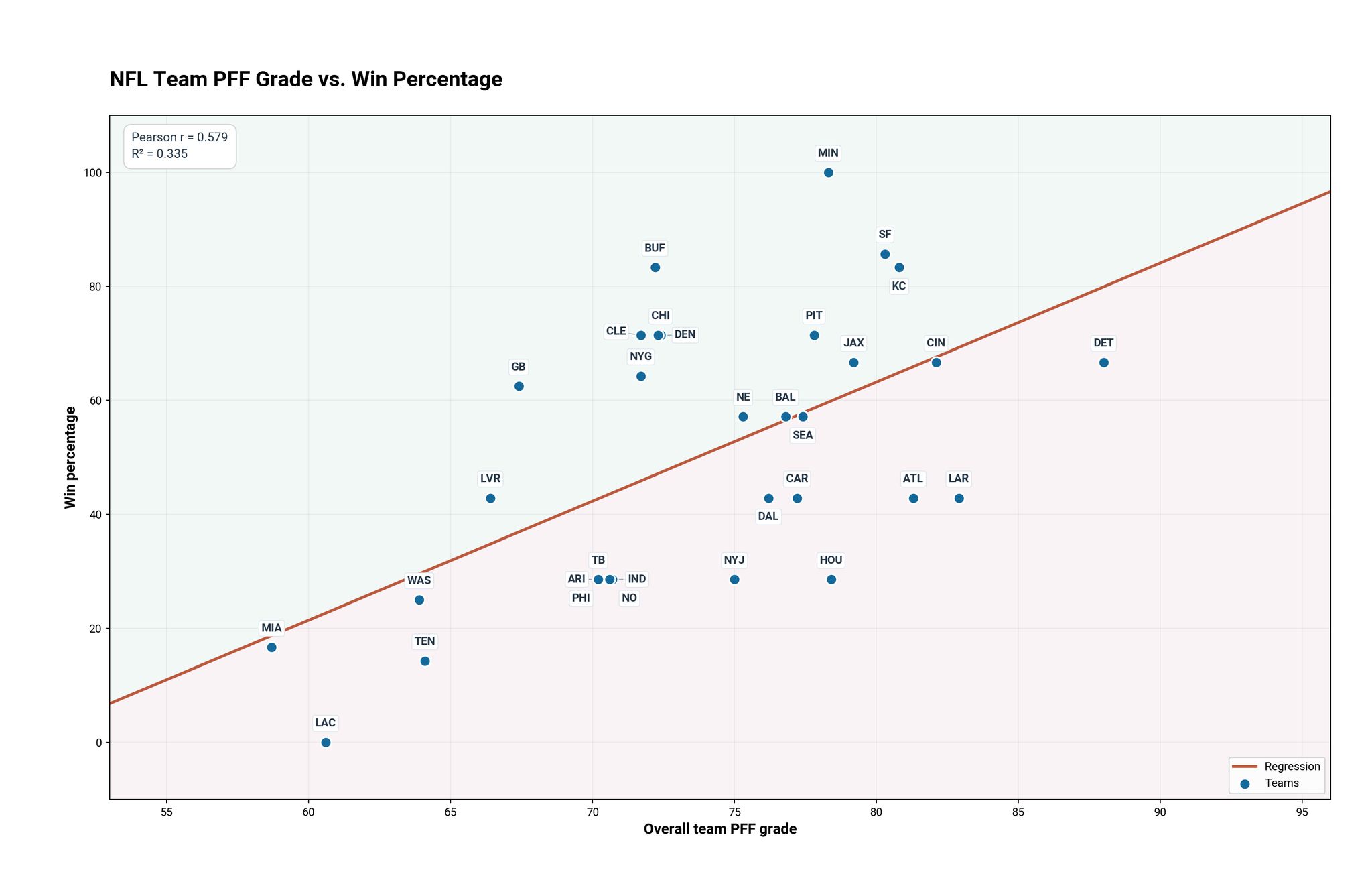
The Jets are among the teams furthest below the line, indicating some of the most significant underperformance. But where does their underperformance rank, exactly?
Let’s take a look at the numbers behind the scatter plot. Here are all 32 teams ranked by their “wins above expected” based on their actual win total compared to their expected win total, as predicted by their team PFF grade.
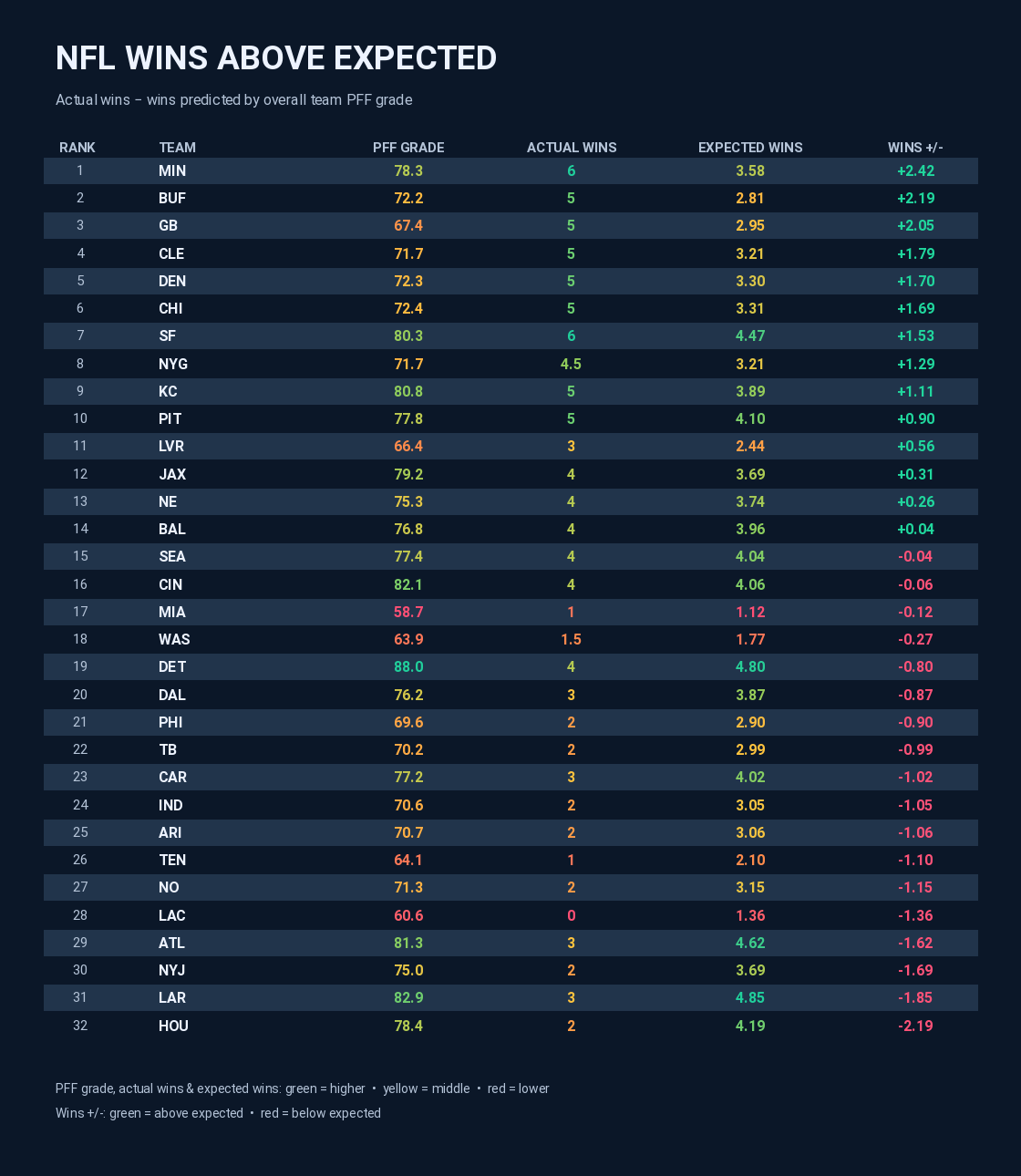
With 2 actual wins compared to 3.69 expected wins as predicted by their team PFF grade, the Jets are currently 1.69 wins below expected, ranking 30th in the NFL, ahead of only the Los Angeles Rams (-1.85) and the Houston Texans (-2.19), two of the league’s most notorious underachievers so far.
This completes our equation:
- Whole (2 wins) – Sum of Parts (3.69 expected wins) = Coaching (-1.69 wins above expected)
What does it mean?
Does this prove that the Jets have some of the worst coaching in the NFL?
Not necessarily. There are plenty of holes to be poked in this analysis. Strength of schedule was not factored in, PFF grades have their own flaws, and it’s a small sample of seven games; flip one play to turn a loss to a win, and the Jets would skyrocket from 30th to 19th on this list.
After all, Sean McVay’s team ranks 31st; nobody in their right mind would claim that McVay is a bottom-two coach (although he has certainly struggled this season). This analysis is imperfect, like any attempt to quantify something that is mostly intangible.
However, it does align quite well with what the eye test has shown this season: The Jets have plenty of individual talent, but they don’t play well as a unit in any phase. They constantly come up small in big spots, and their coaches are frequently outcoached both in terms of scheming and Aaron Glenn’s game management.
When you think about why the Jets have looked respectable enough to compete closely in six of their seven games this season, most of the reasons are anchored in excellent individual talent and execution rather than brilliant scheming or team-wide efficiency. Run through their best moments, and it has a lot more to do with players than the team.
Geno Smith’s elite accuracy. Garrett Wilson, Mason Taylor, and Kenyon Sadiq’s contested catches. Omar Cooper Jr.’s playmaking with the ball in his hands. Braelon Allen’s elusiveness. T’Vondre Sweat and Demario Davis being their usual tenacious selves against the run. Coverage sacks set up by quality individual coverage consistency from the secondary.
All of these things have to do with talent, not coaching. These exact skills are the anchors behind New York’s 16th-ranked team PFF grade.
The Jets’ players are racking up a ton of PFF-grade points for exceeding the expectations of the difficult situations they are often placed in, whether it’s Smith hitting difficult tight-window passes and his receivers catching them, Allen creating his own offense on the ground, Sweat and Davis dominating blockers, or the secondary winning their one-on-one reps with good consistency despite a pass rush that is slow to get home.
Well-coached teams make things easy for their players, which actually hurts the players’ PFF grades, because the players frequently get opportunities for easy production that helps the team win games but doesn’t make them stand out individually.
Think about Kyle Shanahan’s wide-open, schemed-up offense for the 49ers, or Brian Flores’ perfectly schemed blitzes in Minnesota. Both of those teams rank near the top of our wins above expected list, and it’s because their systems work well enough to where they do not require the players to pull off Herculean tasks. This is the type of efficient, stable football that anchors sustained winning, regardless of how impressive the on-paper talent looks.
Another way for coaches to make an impact is by establishing a culture in which their team is prepared to execute in the most important moments, allowing them to win games consistently even if it isn’t pretty. Look at John Harbaugh’s 4-2-1 Giants and Todd Monken’s 5-2 Browns, who rank eighth and fourth, respectively, on our wins above expected list.
Both the Giants and Browns (tied for 20th) actually rank lower than the Jets (16th) in team PFF grade, but since Harbaugh and Monken have their guys ready to make the plays that matter most in flipping losses to wins, their teams keep winning games, while Aaron Glenn’s un-clutch Jets squad keeps squandering winnable games despite their players cumulatively looking better than the Giants’ and Browns’.
No matter how you prefer to explain or quantify it, the Jets have a larger gap between the whole and the sum of the parts than most NFL teams, and that falls on the coaching staff. Ten games remain for Glenn and his coaching staff to climb toward net-zero territory in analyses like this one, but they have an extremely long road ahead of them just to get that far.
For general manager Darren Mougey, though, this analysis is a feather in his cap. His job is to maximize the sum of the parts, and in that regard, he seems to be doing a fine job. Cumulatively, the Jets’ players have shown more flashes than many teams who have multiple more victories. Those missing victories fall on the coaching staff for not maximizing the talent at their disposal.
Toss in the surplus assets that Mougey has racked up for the 2027 offseason (two extra first-round picks and top-eight cap space), and he seems to be sitting pretty in the areas most directly attributable to him. It’s the gap between New York’s on-paper talent and their win-loss record that has the franchise and its fanbase in a gloomy mood right now, and the coaching staff is the likeliest culprit.
