
It used to be easy; with 16 games on the NFL schedule, fans and analysts could engage in halfway-point reflection after eight games.
Now, we have to decide between doing it after eight games or nine games. It’s an unfathomably difficult dilemma to navigate, and I’m not sure whether I will prevail.
Jokes aside, the New York Jets are 2-6 after their first eight games of the 2026 season. While we could hold halfway-point analysis until after next week’s game against the Kansas City Chiefs, especially since Week 9 marks the official conclusion of the first half of an 18-week schedule, this feels like a good point to mark the end of the unofficial first half of New York’s season.
After back-to-back home losses to fledgling AFC foes, the schedule is about to ramp up with games against the Kansas City Chiefs and the Buffalo Bills, separating two distinct portions of the schedule, so this feels like a natural break. Not to mention, the Jets’ playoff hopes all but officially ended after Sunday’s defeat, so this seems like the right spot to reflect on what went wrong to essentially clinch the franchise’s 16th straight non-playoff season.
Without further ado, it’s time to hand out report cards to the Jets’ players and coaches. We’ll grade any player who has logged over 100 offensive or defensive snaps, along with the four main coaches on New York’s staff and the core special teams players.
HC Aaron Glenn: D
Losing closely isn’t much of an accomplishment in the NFL; more games are decided by one score than not. The team’s failure to win those games has consistently been directly attributable to Glenn and his coaching staff for questionable play calls, poor clock management, and a lack of preparation for high-leverage moments.
DC Brian Duker: C
With Glenn calling defensive plays, it’s hard to say how much of the Jets’ defensive performance falls on Duker, but the unit certainly has not looked good relative to the investments that were made in the offseason. They consistently display poor fundamentals in gap discipline and rush-lane discipline, and that could come back to their preparation during the week.
OC Frank Reich: C-
The Jets’ offense has been more competent than most people likely expected, so give Reich some credit for that. But the team continuously loses games because of horrendous production in the red zone, the part of the field that is attributed the most heavily to play calling, so Reich’s predictable and oftentimes archaic approach is still holding the team back. It often feels like the Jets’ offensive talent exceeds their offensive results, and that indicates a negative impact by the coaching staff.
STC Chris Banjo: C-
Banjo deserves some slack after overseeing a historically dominant special teams unit in 2025, but the Jets have now lost two games because of special teams. How much of that falls on Banjo is debatable, but either way, the unit is a liability.
P Austin McNamara: C
McNamara has taken a step back after last year’s performance garnered him All-Pro votes. He ranks 23rd in net yards per punt (41.1) and even sent a kickoff out of bounds in Sunday’s loss to the Raiders.
K Jason Sanders: B
Sanders has made 17 of 19 field goals (89.5%) and 13 of 14 extra points (92.9%), which are solid numbers, although his range is limited, which has affected the Jets’ approach at times. Overall, he’s an average kicker, which the Jets will gladly take after their late-summer fiasco.
LT Olu Fashanu: C
Fashanu has been too up-and-down to be considered a franchise left tackle just yet. While he’s had some strong games, his low points can be very low.
LG Dylan Parham: A-
His sample size is limited due to a four-game absence, but Parham has looked solid in both phases when healthy, and the offensive line has played its best football with him out there.
C Josh Myers: D
If we were grading on a curve, Myers would not receive a D, as he is merely playing like the backup-level player he has always been. But the Jets treat him like a clear-cut starter, and by those expectations, he is one of the league’s most significant liabilities at his position.
RG Joe Tippmann: B
Like Fashanu, Tippmann has been up-and-down, showing stretches of high-level play but also looking lost in a couple of games.
RT Armand Membou: B+
A cold three-game start is dragging down Membou’s grade for now, but since then, he’s started to look like the star right tackle that fans expected him to become in Year 2. If he keeps it up for the rest of the year, this will turn into an A+ type of season for the Jets’ best lineman.
WR Garrett Wilson: A+
Within what he can control, it’s hard to poke any holes in Wilson’s performance this season. He’s been elite in terms of both separating and maximizing his targets. His target numbers have fluctuated, but whenever Wilson isn’t doubled, he gets open, and whenever the Jets throw it to him, he catches it.
RB Braelon Allen: A+
I was among those who were unimpressed with Allen, even by RB2 standards, over his first 24 career games, but he has shut up his critics and then some since becoming the Jets’ starting running back in Week 4. Over the last five games, he has arguably been the best rusher in the NFL. Allen deserves immense credit for figuring out how to maximize his unique physical gifts seemingly overnight.
WR/Returner Isaiah Williams: B
Williams has been a colossal disappointment on special teams after earning All-Pro votes last year, although blame for that can be split between him and the blockers. Offensively, though, Williams has been a surprisingly efficient contributor in a crowded skill-position room, snagging 12 of 15 targets for 169 yards and a pair of vertical-shot touchdowns.
LG Jordan Meredith: D
Even by backup standards, Meredith did not hold up as well as the Jets needed him to across four starts in place of Parham.
TE Mason Taylor: B+
Taylor has not put up gaudy numbers in terms of volume, but he has caught most of the passes thrown his way, including a pair of fantastic contested catches, and his blocking has been solid. He is the Jets’ best two-way tight end.
TE Kenyon Sadiq: B-
Sadiq’s blocking has come along slowly, limiting his snap count and therefore his target total. His involvement in the pass game has not been what you hope to see from a 16th overall pick, but Sadiq shows off his unique talent when targeted; even with just 27 targets, his highlight reel of contested grabs and YAC plays is quite impressive.
TE Jeremy Ruckert: B
As a blocker in the TE3 role, Ruckert has been fine, and he caught all eight of the targets thrown his way.
TE Jelani Woods: D
The Jets seem to be forcing multi-tight end packages a little too heavily via their usage of Woods, whose blocking has been a liability for most of the season. His 18 snaps per game can probably be redistributed among better weapons.
RB Breece Hall: C-
Hall has only played three games, but he wasn’t doing much of note when healthy, which stands out more now that Allen has gone wild.
WR Adonai Mitchell: A
Playing with an accurate QB for the first time in his career, Mitchell is finally showing what he’s capable of when his elite separation is capitalized on. He’s averaging 4.0 receptions for 66.3 yards across four games, generating 9.8 yards per target.
WR Omar Cooper Jr.: A
Cooper went radio silent this past week, seeing no targets, which was strange, but the Jets have too many mouths to feed for everyone to feast each week. Someone is bound to have this type of stat line in every game; last week, it was Garrett Wilson. But with the chances afforded to him, Cooper has been a revelation, catching 12 of 13 targets for 248 yards and two touchdowns, with a 14-yard touchdown wiped off the board. Those are insane numbers for a guy who has played three games plus five plays.
WR Tim Patrick: C
On the roster mainly for his blocking, Patrick had some solid blocks during his time on the field, but his most memorable moment was wiping Cooper’s opening-drive TD against the Patriots off the board for an offensive pass interference penalty.
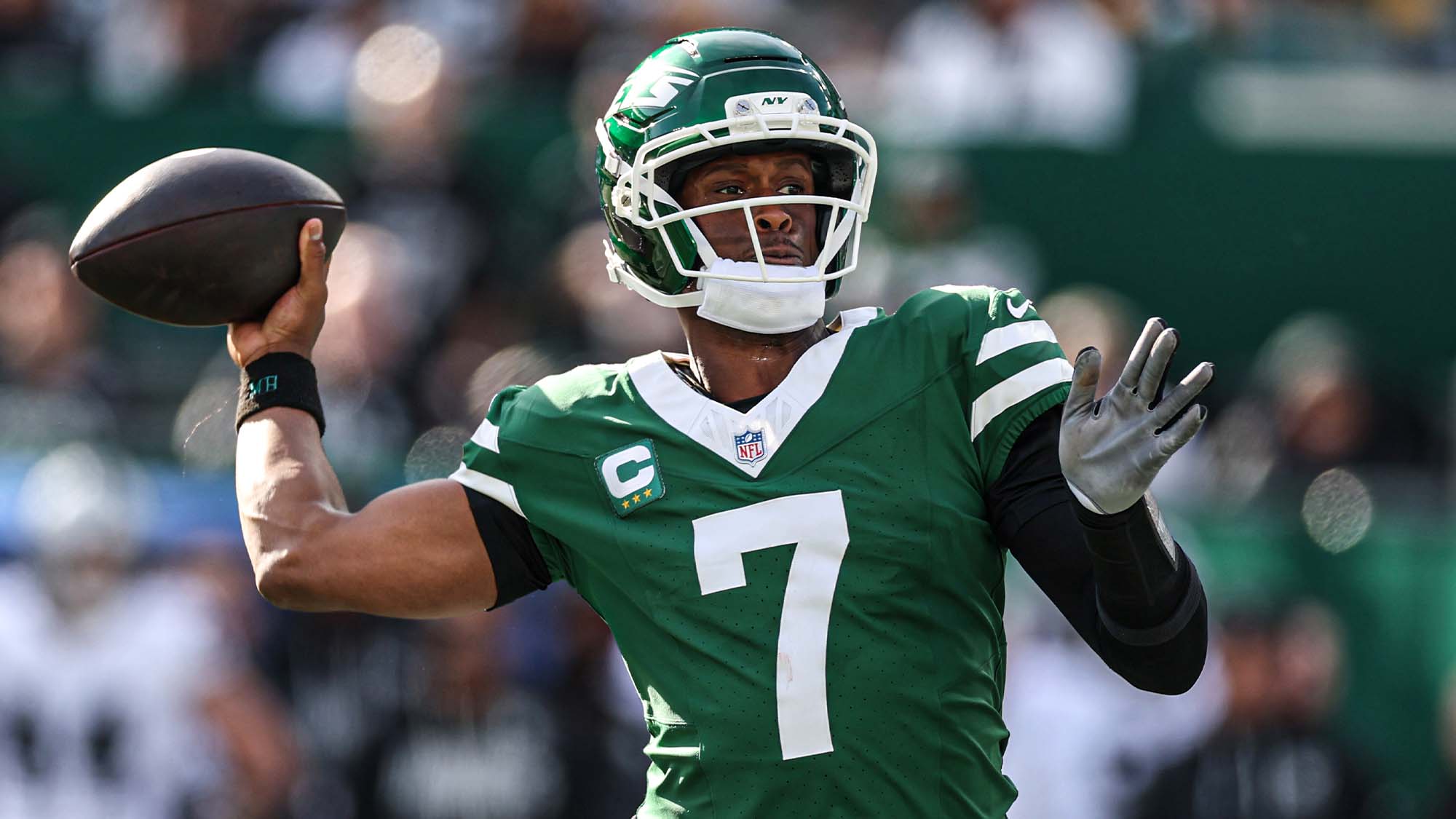
QB Geno Smith: A
Relative to what he is realistically capable of at this point of his career, I’m not sure how you could expect much more from Smith. We know that he isn’t the fastest to get the ball out and that he will struggle to evade some sacks, given his age and the fact that he was never an elite athlete in the first place. But he is taking great care of the ball, consistently finds the receivers who are open, and is throwing with some of the best accuracy in the entire league. We are witnessing one of the best Jets quarterback seasons of all time (which says more about the franchise than him), and that’s a fact, no matter what the team’s record is.
CB Azareye’h Thomas: B
Thomas has been mostly consistent in coverage (30.6 yards per game allowed), impressing with his physicality, but he has struggled with missed tackles (7) and has allowed four short touchdowns, all on in-breakers. It all amounts to decent starting cornerback production. Still only 22 years old, Thomas can build on this over the rest of the year and in Year 3, but he certainly hasn’t been enough of a stalwart to prevent the Jets from trying to improve at this position.
CB Brandon Stephens: B
Stephens has tackled better than Thomas (only two misses) while allowing just one touchdown, but his problem is penalties, committing five to Thomas’ three. Like Thomas, though, his coverage numbers are decent enough overall, with 36.6 yards per game allowed. Both have been middle-of-the-pack starters.
SCB Jarvis Brownlee Jr.: C-
Brownlee has been as-advertised; he is a tenacious tackler but a sieve in coverage. The team must be reluctant to trust second-round rookie D’Angelo Ponds, given that, despite Brownlee’s struggles, they are still starting him over Ponds, even after he was benched in Week 7 for missing meetings.
S Dane Belton: B+
Belton had a stellar start through five games, but he has regressed to the mean recently; he allowed two touchdowns in coverage against the Patriots, took a bad angle over the top to allow a 63-yard game-sealing touchdown against Miami, and missed a tackle on Ashton Jeanty’s key screen play this week. Overall, though, he’s been an above-average starter, which is good value on his $4 million contract. But the Jets need him to get back on track.
S Minkah Fitzpatrick: B
Fitzpatrick has been mostly solid for the Jets, but he has come up small in some big spots, including explosive catches allowed to the Patriots and Bears and being the main player responsible for the Dolphins’ late 63-yard touchdown in Week 7.
EDGE David Bailey: B
Bailey has been extremely active, made some flash plays, and shown a high ceiling, but his consistency as a pass rusher, rush-lane discipline, and gap integrity against the run need work.
EDGE Kingsley Enagbare: B+
Enagbare has not lit the world on fire, but he’s been the Jets’ only competent two-way defensive lineman on a unit filled with one-trick ponies. He sets a sturdy edge and still creates pressure at a good rate.
DT Harrison Phillips: D
Phillips does not offer much at this point of his career. Stopping the run is supposed to be his specialty, but he gets pushed around quite easily, a far cry from last year, when he was a sturdy presence. Against the pass, he is a complete zero.
DT Jowon Briggs: D
Briggs has struggled to build upon the promise he showed in late-2025, coming nowhere close to the same pass-rush production while getting moved around in the run game.
DT T’Vondre Sweat: B
Sweat’s sturdiness against the run was not as advertised over the Jets’ first three games, but he regained his footing over the next four contests until going down with a knee injury in Week 7. Overall, he was a solid presence against the run and a good pass rusher for his size.
EDGE Will McDonald: D
McDonald still struggles against the run, and his pass rushing has been more inconsistent than ever. Perhaps it’s due to his scheme fit, but at the end of the day, he just isn’t winning consistently enough as a pass rusher.
DT Darrell Jackson Jr.: B-
The fourth-round rookie struggled early, but has shown some promise in recent weeks as his snap count has increased.
S Andre Cisco: B
Cisco looked respectable during his stretch as a starter filling in for Fitzpatrick.
EDGE Joseph Ossai: D
We’ll cut him some slack due to the injuries he has dealt with, but Ossai was a major liability during his three games on the field.
LB Jamien Sherwood: D
Sherwood always seems to rack up gaudy tackle numbers and solid PFF grades, but when you watch the games, he rarely makes game-tiling plays in the Jets’ favor and often allows them going the other way; Aaron Glenn chewed him out on Sunday for allowing a touchdown.
LB Demario Davis: C
It’s hard to be too critical of Davis, given his age (37), but the Jets did give him a two year, $20 million deal, so he isn’t completely devoid of expectations. He still looks aggressive, tenacious, and powerful, while displaying the same instincts in coverage, but he’s having the worst tackling season of his career, owning a career-high 16.9% missed tackle rate, with 11 misses in just eight games.
