
Few positions in sports are harder to evaluate than wide receiver.
After all, every ounce of a wide receiver’s production counts on three other parties to do their jobs before the wide receiver even has a chance to touch the ball.
First, the play-caller has to call a pass play, and a successful one at that. Next, the offensive line has to hold up so the quarterback can get a pass off. Finally, the quarterback has to both target the receiver in question and throw an accurate pass.
Only then can the wide receiver do anything to affect the football game. Before that point, if any of those three parties comes up short, the wide receiver can only do as much as you or I.
Yet, in the big 2026, we still use stats like receptions, receiving yards, and receiving touchdowns to compare wide receivers against one or another, as if every wide receiver is playing in the same environment.
Some wide receivers benefit from this type of analysis. If they play with a great quarterback in a pass-heavy offense that prefers to throw the ball outside, they will rack up gaudy numbers annually, like the Cincinnati Bengals’ duo of Ja’Marr Chase and Tee Higgins (this isn’t to say that either is not a tremendous player, but their environment is a great example of an advantageous situation for WR production).
Other wide receivers suffer when evaluated based on traditional stats. Throughout the last five seasons, the poster child for this group has undoubtedly been the New York Jets’ Garrett Wilson.
Your team. Your decisions.
Jet X Game Simulator
Win a lifetime membership
Beat any of the five Legend challenges without simulating.
Play the weekly matchup or relive a classic. Choose a current matchup or classic game, and log in to save Coach Points.
Learn MoreChoose your mode on the Game Simulator page. Full games · Weekly prep · Classic challenges.
How good is Garrett Wilson, actually?
Over his first four NFL seasons, Wilson put together a highlight reel of remarkable catches, slick routes, and open-field moves that could go toe to toe with any other star playmaker in the league.
However, Wilson had to suffer through a carousel of quarterbacks who were inaccurate, gunshy, immobile, had poor field vision, or all of the above. Toss in poor offensive line play and the lack of a No. 2 wideout to prevent double teams, and Wilson was in a brutal environment for accumulating production.
Due to these constraints, Wilson ranked just 25th among wide receivers (min. 20 games) in receiving yards per game (62.8) from 2022-25, which seemed like a far cry from his actual talent and impact via the eye test. His No. 40 ranking in receiving touchdowns per game (0.31) was even more startling.
The 2026 season has gone a bit differently for Wilson. On one hand, he has enjoyed playing with the most accurate (and best overall) quarterback of his career in Geno Smith. Thanks to Smith’s elite accuracy, Wilson is delivering the best per-target efficiency of his career; he is posting career-highs in receiving success rate (54.0%) and yards per target (8.4).
A familiar issue has arisen, though: a lack of targets. Wilson is averaging a career-low 7.9 targets per game, which ranks just 18th among wide receivers and 21st among all players.
As a result of the relatively low target volume, Wilson still isn’t racking up box-score production at the elite clip that would seem to correlate with his actual talent, despite Smith’s accuracy helping him achieve career-highs in per-target efficiency. Wilson is only 20th among wide receivers with 65.9 receiving yards per game, barely ahead of his 63.2 career average.
A few obstacles have led to Wilson’s low target total this year. For one, the Jets have more mouths to feed that any point in his career, as they finally boast a deep, talented array of weapons. However, Smith and offensive coordinator Frank Reich have occasionally been too reluctant to force the ball to Wilson when things aren’t going well; the Jets targeted him three times in a game where they trailed 21-7 at halftime against the winless Miami Dolphins.
Let’s put all of the stats aside, though. Within what he can control, Wilson has appeared to play the best football of his career in 2026, which is saying a lot, considering he did enough over his first four seasons to earn a $130 million contract this offseason.
Wilson is catching seemingly everything thrown his way—including an absurd frequency of highlight-type catches—and winning his routes with remarkable consistency. His impact has been easily visible, even to those who only watch on the television broadcast, and the film is even more tantalizing.
It all begs the question: Is Wilson truly as incredible as our eyes tell us? Or is he only as good as his annual 60-65 yards per game, meaning our eyes are playing tricks on us?
It’s just another round of the endless stats-versus-film battle that will consume sports discourse until the end of time.
Fortunately, though, we have some useful metrics that are designed to capture a happy medium between both sides.
There are some readily available wide receiver metrics that intend to capture a wide receiver’s performance independent of his surroundings, focusing solely on how he performs compared to the expectations of his specific situation. These metrics do a much better job of evaluating a wide receiver within what he can control than the traditional box-score stats.
Let’s see how Wilson stacks up in these areas.
Ranking 2026 NFL WRs in independent metrics
The wide receiver position involves a complex array of skills and fundamentals. Ultimately, though, a wide receiver’s job can be boiled down to three phases:
- Get open
- Catch the ball
- Make a play with the ball
Simple enough.
We’re going to rate and rank 67 qualified wide receivers in the 2026 season based on three metrics that are intended to evaluate those three separate aspects of the wide receiver position.
For “getting open”, we’re going to use ESPN Analytics’ “open score”, which uses NFL Next Gen Stats’ GPS tracking data to estimate how effective a player is at creating separation. It accounts for the expected separation on each play, based on the route called, the defensive coverage, and other variables, so that players aren’t benefiting from catching screen passes (which technically have a ton of “separation” at the catch point) or suffering from being targeted on vertical balls up the sideline (which are almost always contested).
For pass-catching, we’ll use NFL Pro’s “catch rate over expected (CROE)”, another metric that relies on GPS tracking data to help us account for the expectations of the situation. It estimates the probability of each target being caught based on separation, depth, angle, and other variables.
In totality, CROE is a better metric for evaluating a players’ hands than raw catch rate or even drop rate, because it rewards contested catches, doesn’t offer much credit for racking up easy uncontested catches, heavily punishes easy drops, and doesn’t provide as much punishment for more difficult or contested “drops”. When we just look at drop rate, there isn’t enough context; not all drops are equal.
For after-the-catch playmaking, we’ll use NFL Pro’s “yards after catch over expected (YACOE)”. The logic here is the same as CROE. Using GPS tracking data, YACOE estimates the “expected” YAC that a player should gain on each play, and compares the player’s output to what the average player would have been expected to gain in the same situation.
This is a better method than raw YAC or even missed tackles forced, as those categories benefit players who get more screen passes or underneath in-breakers. Using YACOE, players won’t suffer as much if their role isn’t as YAC-friendly.
All three of these metrics will be adjusted for volume, so that low-volume receivers aren’t one-upping superstars through ballooned efficiency on a fraction of the opportunities.
The players will be scored from 0-100 in all three categories using min-max scaling; i.e., the lowest player in each category receives a 0, the highest receives a 100, and the rest of the players are scaled according to those two points.
Then, we average all three scores together to get a 0-100 overall rating that encapsulates a wide receiver’s situation-independent performance across these three crucial areas of the position.
Here are the results.
| Rank | Player | Team | OVERALL | Open Score | CROE | YACOE |
|---|---|---|---|---|---|---|
| 1 | Jaxon Smith-Njigba | SEA | 87.2 | 100.0 | 100.0 | 61.6 |
| 2 | Tee Higgins | CIN | 59.7 | 51.9 | 64.8 | 62.3 |
| 3 | Puka Nacua | LAR | 58.0 | 33.6 | 60.9 | 79.5 |
| 4 | Garrett Wilson | NYJ | 56.0 | 88.2 | 64.8 | 15.1 |
| 5 | Zay Flowers | BAL | 54.7 | 51.4 | 12.5 | 100.0 |
| 6 | Mike Evans | SF | 52.5 | 60.9 | 78.1 | 18.5 |
| 7 | Ja’Marr Chase | CIN | 49.4 | 46.3 | 47.9 | 54.1 |
| 8 | Luther Burden III | CHI | 46.8 | 15.8 | 54.7 | 69.9 |
| 9 | Malik Washington | MIA | 45.6 | 65.5 | 34.5 | 37.0 |
| 10 | Chris Olave | NO | 44.3 | 71.5 | 58.7 | 2.7 |
| 11 | George Pickens | DAL | 42.2 | 56.9 | 50.5 | 19.2 |
| 12 | Jameson Williams | DET | 42.1 | 66.8 | 33.5 | 26.0 |
| 13 | Kalif Raymond | CHI | 40.9 | 51.7 | 48.4 | 22.6 |
| 14 | Christian Watson | GB | 40.3 | 3.9 | 59.4 | 57.5 |
| 15 | Carnell Tate | TEN | 40.1 | 61.1 | 43.4 | 15.8 |
| 16 | CeeDee Lamb | DAL | 38.5 | 55.0 | 34.6 | 26.0 |
| 17 | Malik Nabers | NYG | 38.1 | 61.0 | 49.9 | 3.4 |
| 18 | Tre Tucker | LV | 37.4 | 43.1 | 34.3 | 34.9 |
| 19 | Justin Jefferson | MIN | 37.3 | 37.7 | 40.6 | 33.6 |
| 20 | Demario Douglas | NE | 36.9 | 59.5 | 31.3 | 19.9 |
| 21 | KC Concepcion | CLE | 36.1 | 55.3 | 15.9 | 37.0 |
| 22 | DeVonta Smith | PHI | 36.0 | 45.9 | 44.3 | 17.8 |
| 23 | Chris Godwin | TB | 35.2 | 39.5 | 29.1 | 37.0 |
| 24 | Nico Collins | HOU | 35.0 | 6.5 | 78.1 | 20.5 |
| 25 | Davante Adams | LAR | 34.9 | 10.2 | 51.4 | 43.2 |
| 26 | Drake London | ATL | 34.4 | 42.7 | 4.9 | 55.5 |
| 27 | Ladd McConkey | LAC | 34.0 | 48.1 | 32.6 | 21.2 |
| 28 | Matthew Golden | GB | 33.8 | 65.9 | 8.1 | 27.4 |
| 29 | Dontayvion Wicks | PHI | 33.3 | 31.7 | 37.9 | 30.1 |
| 30 | Adonai Mitchell | NYJ | 32.9 | 49.3 | 40.3 | 8.9 |
| 31 | Tetairoa McMillan | CAR | 32.6 | 41.9 | 51.2 | 4.8 |
| 32 | Amon-Ra St. Brown | DET | 32.3 | 41.5 | 54.6 | 0.7 |
| 33 | Keon Coleman | BUF | 32.2 | 28.7 | 59.0 | 8.9 |
| 34 | Josh Downs | IND | 32.2 | 45.6 | 21.5 | 29.5 |
| 35 | Rome Odunze | CHI | 32.1 | 36.2 | 39.6 | 20.5 |
| 36 | Keenan Allen | IND | 32.1 | 20.1 | 56.3 | 19.9 |
| 37 | Jerry Jeudy | CLE | 31.3 | 53.5 | 23.9 | 16.4 |
| 38 | Jalen Coker | CAR | 30.8 | 55.9 | 18.0 | 18.5 |
| 39 | Ryan Flournoy | DAL | 30.5 | 15.4 | 35.7 | 40.4 |
| 40 | Jakobi Meyers | JAX | 30.5 | 26.8 | 41.3 | 23.3 |
| 41 | Antonio Williams | WAS | 29.3 | 26.4 | 43.0 | 18.5 |
| 42 | Tre Harris | LAC | 28.0 | 37.6 | 31.4 | 15.1 |
| 43 | Kendrick Bourne | ARI | 28.0 | 22.0 | 25.6 | 36.3 |
| 44 | Malachi Fields | NYG | 27.8 | 14.9 | 22.6 | 45.9 |
| 45 | Wan’Dale Robinson | TEN | 26.8 | 30.1 | 26.4 | 24.0 |
| 46 | D.J. Moore | BUF | 26.6 | 40.3 | 25.7 | 13.7 |
| 47 | Parker Washington | JAX | 26.3 | 16.0 | 23.1 | 39.7 |
| 48 | Khalil Shakir | BUF | 25.9 | 19.9 | 17.3 | 40.4 |
| 49 | Terry McLaurin | WAS | 25.8 | 36.7 | 27.8 | 13.0 |
| 50 | Makai Lemon | PHI | 25.5 | 56.9 | 19.5 | 0.0 |
| 51 | Kayshon Boutte | HOU | 25.0 | 21.9 | 46.2 | 6.8 |
| 52 | Devaughn Vele | NO | 24.7 | 17.5 | 42.2 | 14.4 |
| 53 | Cooper Kupp | SEA | 23.8 | 16.1 | 35.6 | 19.9 |
| 54 | Rashod Bateman | BAL | 23.5 | 30.6 | 29.6 | 10.3 |
| 55 | Denzel Boston | CLE | 23.4 | 13.6 | 6.5 | 50.0 |
| 56 | Emeka Egbuka | TB | 23.4 | 43.8 | 8.5 | 17.8 |
| 57 | Jordan Addison | MIN | 23.2 | 23.9 | 16.8 | 28.8 |
| 58 | Germie Bernard | PIT | 21.6 | 13.6 | 38.8 | 12.3 |
| 59 | Stefon Diggs | WAS | 20.4 | 34.3 | 19.4 | 7.5 |
| 60 | Laquon Treadwell | IND | 20.1 | 19.7 | 20.9 | 19.9 |
| 61 | Michael Wilson | ARI | 16.3 | 0.0 | 42.0 | 6.8 |
| 62 | Courtland Sutton | DEN | 15.8 | 11.6 | 19.4 | 16.4 |
| 63 | Jaylen Waddle | DEN | 15.8 | 36.5 | 0.0 | 11.0 |
| 64 | Xavier Worthy | KC | 15.6 | 22.5 | 18.7 | 5.5 |
| 65 | Xavier Hutchinson | HOU | 14.2 | 21.8 | 12.6 | 8.2 |
| 66 | DK Metcalf | PIT | 13.4 | 14.0 | 3.7 | 22.6 |
| 67 | Rashid Shaheed | SEA | 11.9 | 17.0 | 14.7 | 4.1 |
Well, one thing’s for certain: Jaxon Smith-Njigba is in his own stratosphere right now. There is no discussion to be had about who the NFL’s WR1 is.
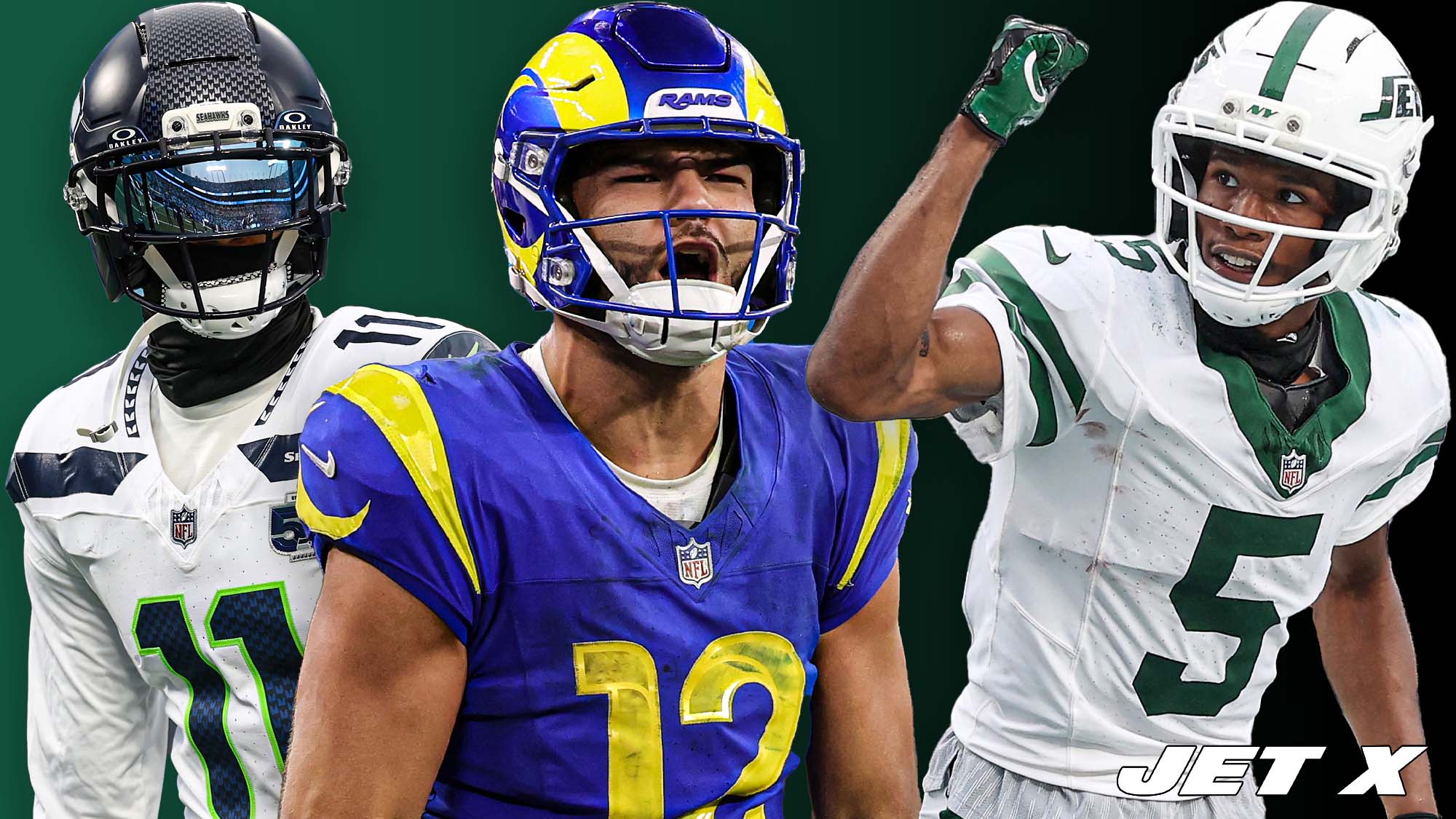
Back to Wilson, though: These metrics do a fantastic job of making up for the flaws of box-score analysis and properly quantifying the eye test. He checks in as the league’s fourth-best wide receiver in this analysis, trailing only Smith-Njigba, Tee Higgins, and Puka Nacua.
Wilson’s success on this list is thanks to his individual execution in terms of both separation and pass-catching.
As for separation, Wilson’s open score (82), courtesy of ESPN, is tied with Mike Evans for second-best in the league behind Smith-Njigba (87), and since our analysis is volume-adjusted, Wilson scores much higher than Evans because he has run over twice as many routes. That gives Wilson an 88.2/100 score for separation in our analysis, second-best.
In terms of pass-catching, Wilson has the eighth-best CROE of the 67 players on this list at 9.2%. Since he has maintained it at a high volume, he has a whopping 5.8 total receptions over expected, which is the category used as the basis of our analysis to adjust for volume. It gives Wilson a 64.8/100 score, ranking fourth-best behind Smith-Njigba, Evans, and Nico Collins.
The only area where Wilson comes up short is the YACOE department. He has been credited with just 1 total yard after catch over expected, placing 47th out of 67 and earning him a measly 15.1/100 score. That isn’t too far behind the group average, though (26.1), as a couple of wideouts are so far above the rest of the pack that a min-max scaling model means most of the group is well below 50.
Wilson’s low YACOE makes sense. According to Pro Football Focus, he has only been credited with forcing two missed tackles in eight games this year, a big step back from his first four seasons, when he forced 70 in 58 games (20.5 per 17 games).
However, Wilson’s role this season has not been very YAC-conducive, as his targets have mostly come on vertical or out-breaking routes outside the numbers, with few screens or underneath in-breakers. His route diet has limited his playmaking potential after the catch. Still, YACOE is supposed to account for that, so it’s fair to say Wilson is capable of better in this area.
Even with the subpar YAC production, Wilson’s elite efficiency as a separator and pass-catcher are enough to make him one of the league’s top-five wide receivers when focusing solely on metrics that are designed to evaluate wide receivers based on how they perform within what they can control, relative to the expectations of their situation.
That seems like a much fairer way to evaluate wide receivers than the box score, and through this analysis, the numbers finally deliver the same conclusion as the eye test: Wilson is a premier talent at the position.
