
“You will own no thoughts, and you will be happy.”
It’s ugly out there, folks. The unwritten rules in the digital sports media space are both harsher and more plentiful in New York Jets land.
Fifteen years and counting.
The Jets fan simply wants a winner. They want to identify and hire a genuine football leader and feel that success is just one leader away.
In a lot of ways, they’re right. These days, the value of coaching has increased to an unprecedented degree, with strategic smarts paving the way.
In some ways, that idea creates a one-dimensional conversation — no matter the topic — which isn’t beneficial for anyone. It doesn’t help Jets fans, nor does it help the organization.
At the heart of the Jets’ woes is a familiar topic — one that rears its ugly head from a number of angles and in a number of areas. It’s something fans often attribute solely to offensive football, yet that’s not the best way to think about it.
This New York Jets’ horrific stretch boils down to one identifiable issue: No matter the year, coach, or roster, this organization has yet to fully realize just how drastically different the game of football has become.
Why the Bailey-Reese convo looms large
How an organization thinks is critically important to its future. Front office philosophies aren’t just crucial to potential success; they often offer important public insights.
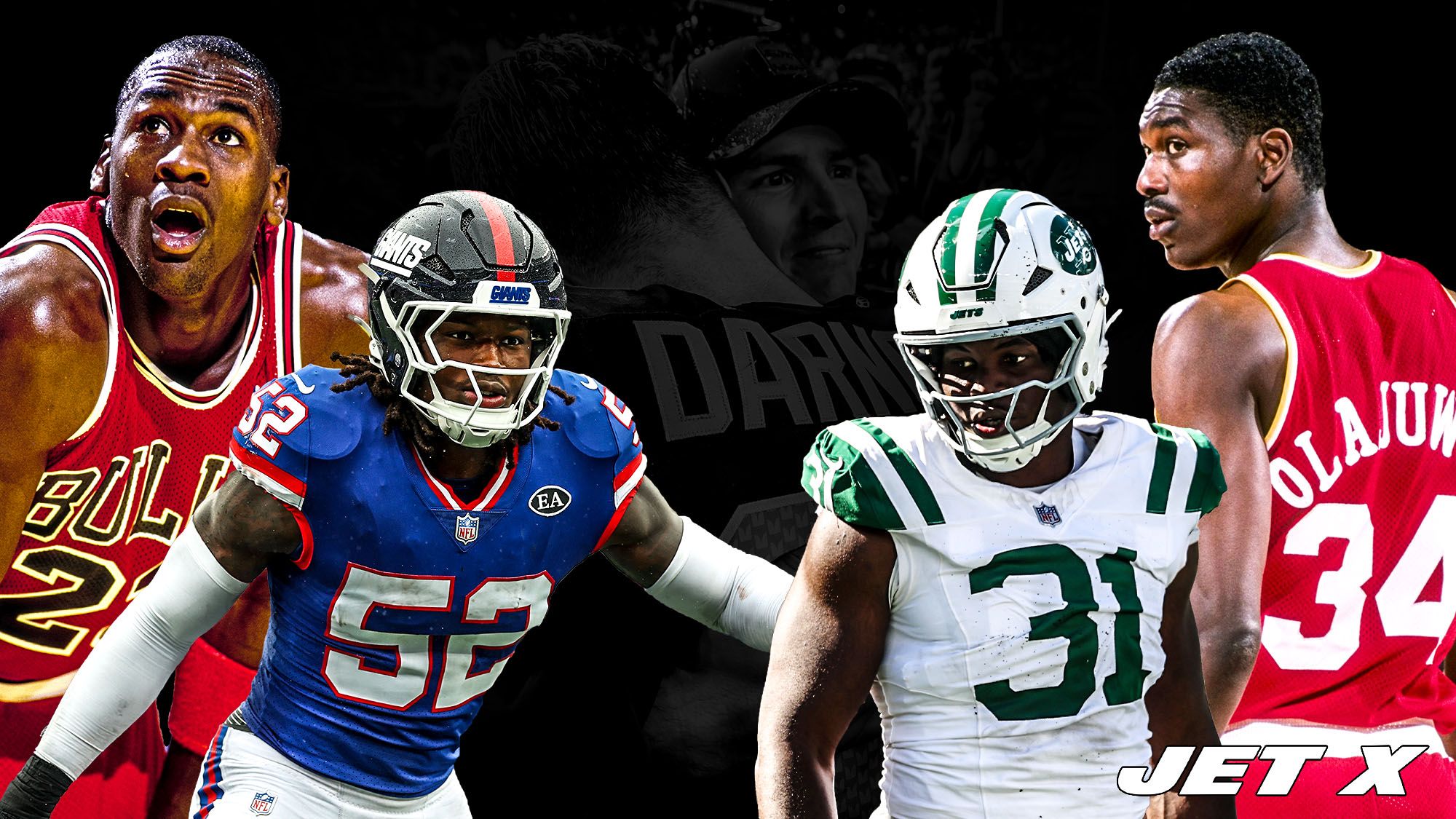
New York Jets rookie David Bailey is coming off his best game as a pro. Not only did his pass-rushing stats hit the mark, but his all-around game was impressive.
New York Giants rookie Arvell Reese is currently leading the race for the NFL Defensive Rookie of the Year and is even earning consideration for NFL Defensive Player of the Year. To say he’s been much more than a young “project” who may not have been ready to “plug-and-play” from the get-go is one of the top understatements of the decade.
The common narrative, at this very moment, is quite simple: Both the Jets and the Giants hit home runs with their first-round picks in the 2026 NFL draft because both Bailey and Reese are stars.
This overwhelming sentiment, coupled with the Jets’ cloudy coaching situation involving Aaron Glenn, means one thing, as far as the unwritten rules are concerned: There’s no point in revisiting the Jets’ decision at No. 2 in the draft; the Jets universe has much larger fish to fry.
On the one hand, yeah, it’s true: What currently plagues this Jets organization most is its coaching. Those who cannot see that or choose to ignore that very idea are skipping in a football locker room while whistling “Stranger in Paradise.”
On the other hand, the decision to choose Bailey over Reese signals a troubling sign about the organization’s overall savviness.
Outdated philosophies
You have heard it numerous times: Edge rusher is a premium position. The allure of pass rushing still holds incredible shine in football lovers’ hearts, so when a choice between edge rusher and off-ball linebacker is presented, choosing the edge rusher is always the better choice.
That’s no longer true.
Now, granted, when stacking up an edge defender (not edge rusher) against an off-ball linebacker, the edge defender, pound for pound, probably garners more value. However, that was never the scenario facing the Jets this past April.
The choice boiled down to edge rusher vs. rare unicorn. And it’s the rare unicorn who has become football’s undoubted premium breed.
Why is it that the Seattle Seahawks defenders never have high sack numbers? During Seattle’s 2025 Super Bowl season, Leonard Williams, Uchenna Nwosu, and Byron Murphy II led the team with 7.0 sacks apiece. This season, the current leader in the clubhouse is Murphy, who has 4.0.
The team they beat in the Super Bowl, the New England Patriots, were similar in nature. Harold Landry III led the team with 8.5 sacks last season, with K’Lavon Chaisson finishing second with 7.5.
The Super Bowl champs of 2024, the Philadelphia Eagles, also featured modest sack dudes. Josh Sweat led the way with 8.0 sacks, whereas Nolan Smith Jr. chipped in with 6.5. The team they beat in the Super Bowl, the Kansas City Chiefs, featured George Karlaftis leading the way with 8.0.
In fact, the Eagles’ 41 team sacks that season only placed them tied for 13th in the league. The Chiefs’ 39 tied them at 18th. Last season, Seattle ranked seventh (47 sacks), whereas the Pats’ lowly 35 sacks had them tied for 22nd.
This isn’t to say that “sacks are bad,” but rather that sacks aren’t even close to the end-all, be-all. Moreover, pressure numbers aren’t the end-all, be-all, and, with any pass-rushing metric, featuring an overwhelming stat-master is a brutally awful thing to coach around.
The coaches who best understand modern defense know exactly what’s most important: scheme over superstars. It’s this mentality that leads to what’s truly most important in today’s defensive landscape.
This isn’t your father’s NFL
What has changed the most about this sport?
Sure, the physicality has left the building, which means speed and athleticism have become both more important and predictable. In most ways, this is why play-call design has shot up in importance — because moving the chess pieces on the board has become that much more predictable (less physicality means greater predictability in field placement).
It ultimately led us to a point in which completion percentage has become silly. With quarterbacks completing 64.0% of their passes (the league average in 2026), along with an 11.1-yard average-yards-per-completion mark — which helps continue the trend of all-time lows since the 2020 season, with each of the last seven seasons accounting for the seven lowest in history — the passing game has never been quicker.
In all reality, the passing game isn’t the passing game anymore. What was once a clear divide between the run game and the pass game several decades ago has become the run game, the quick-passing game, and the standard passing game.
Three-step designs are so prominent that neutralizing edge rushers has never been easier. Quarterbacks have never released the ball more quickly, which means the true edge rusher is something of a much different, lesser variation in today’s game.
Many football coaches would go as far as to make the claim that the true edge rushing mentality actually injures his own defense far too much. If the edge rusher is consistently focused on hunting the quarterback, balanced down responsibilities and pass-rush lane integrity get destroyed.
Think about it: How often has the Jets’ pass-rush lane integrity fallen by the wayside this season?
The increased emphasis on quick passing, coupled with mobile quarterbacks who scamper out of the pocket, has led to a situation in which the pass rush must (and I mean must) be team-oriented and led with disciplined focus.
After Bailey injured Patrick Mahomes late in the first half — in a pass-only situation the Jets took advantage of — the Chiefs simply chipped away at neutralizing the Jets’ rookie the rest of the game. They also ran the ball down the Jets’ throats all second half, after insanely giving Kenneth Walker just five carries in the first half.
Like a sudden bolt of lightning, Bailey disrupted the game on a two-play sequence. Yet, for the majority of the game, he wasn’t afforded the right to do his thing, bc Kansas City’s offense had far too many avenues to neutralize him.
Versatility is king
Meanwhile, Reese, the rare unicorn, makes an impact on every down.
When the quarterback gets up to the line of scrimmage, he has no idea what Reese will be doing on that play. Considering his versatility — along with his dominance and football IQ within that scope — the quarterback must assess the post-snap reality in several ways.
Will he stay on the second level and play a run fit or pass coverage? Will he spy me? Will he green dog the back? Will he bolt to the sideline to grab the flat-to-curl area? Will he mug the A-gap and come on an interior blitz? Will he play edge and use his speed around the corner?
Or will he pound me into the dirt with more violence than any NFL defender has shown in quite some time?
Those familiar with Mike Macdonald’s defense understand just how critical versatility is in today’s game. His entire scheme is about versatility, so much so that do-it-all safety Nick Emmanwori plays defensive back, linebacker, and edge defender at times.
Depending on the situation, Macdonald actually uses a near-300-pound interior defensive lineman on the edge while playing a traditional 3-4 odd base. This means he wants beef to play as the force defender, while having no problem using a 300-pound player at 3-4 outside linebacker — if the situation is right.
As opposed to the more one-dimensional edge rusher who can be neutralized too easily, the rare unicorn’s versatile skill set is so vast that it’s impossible to remove him from the equation.
Behind the metrics
Before Bailey’s excellent outing against the Chiefs, his EPA (Expected Points Added) suggested the Jets’ defense performed better with him off the field than on. The box score scouts and splash-play watchers will surely ignore such a stat, but it’s true.
That’s not to say he’s a terrible player, nor is it to say he’s destined to be a net-negative for the Jets. Actually, if Bailey consistently plays the way he did in Kansas City, Jets fans should feel great about his future.
Mentioning the EPA number is done merely to shine a spotlight on some of the hidden gaps and margins of football that most fail to see. Splash plays and box score stats may garner a player a Pro Bowl or All-Pro nod — courtesy of who’s voting — but those within the league truly understand down-to-down value.
Plus, Bailey played so well against the Chiefs that his EPA imbalance has flipped: The Jets defense now performs better with him on the field (+0.002 EPA) and worse with him off the field (+0.080 EPA) — yes, a negative number is better for defensive players.
Meanwhile, Reese’s strong -0.054 EPA could hardly be compared to the horrid +1.837 EPA with him off the field, because the Giants’ rookie has only missed two snaps so far this season.
As a team, the Giants’ 1.5% Defensive DVOA dwarfs the Jets’ 9.3% mark. So does the Giants’ 5-2-1 record, as compared to the Jets’ 2-7 mark.
Ladies and gents, this Jets defense is horrific. They lead the league in rush attempts against (as the entire NFL constantly bullies them), and nobody deserves a pass for such a putrid unit, including Aaron Glenn, Minkah Fitzpatrick, Demario Davis, and, yes, David Bailey.
Show me team success, not individual glory.
Show me individual glory only if team success is present.
The Giants have done it without their franchise quarterback, veteran defensive linebacker leader (Tremaine Edmunds), and so-called “best defensive player” in Brian Burns, who also plays the so-called “premium position” of edge rusher.
The likes of many would argue it all deals with coaching, John Harbaugh’s wizardry vs. Aaron Glenn’s failures. While there’s plenty of truth to that idea, a major piece of the pie often goes unspoken…
Harbaugh’s wizardry started this past offseason. He understood what truly moves the defensive needle most in today’s sport, and was stunned to realize that identification slipped to No. 5 in the 2026 NFL draft.
To pretend that isn’t a massive piece of this puzzle is to selectively pick and choose the topics at hand — as it relates to what a quality football coach and/or organization looks like.
Olajuwon or Jordan?
The 1984 NBA Draft was one for the ages. It was when the greatest basketball player of all time entered the professional ranks. Yet, he didn’t go No. 1 overall.
Basketball heads already know the deal: The Houston Rockets took Hakeem Olajuwon first in that draft, and nobody batted an eye — not even to this very day.
Why, though? Why would nobody second-guess a hoops organization for passing on who turned out to be the greatest in history?
It’s simple: The rules were different back then.
Remember, in 1984, the National Basketball Association was still the land of the big men. Although the decision-makers were fully aware of Jordan’s talents, it was unheard of to select a guard that early in the draft — or, at least, over a big man in the same tier.
The year prior, 7-foot-4 Ralph Sampson was chosen No. 1. In 1982, 6-foot-9 James Worthy was the No. 1 selection. By and large, with some exceptions sprinkled in, the NBA remained an inside-out affair, as teams sought big-man centerpieces to dump it off to and work the half-court game.
Although the advent of the three-point line in the 1979-80 season shook the foundations of the game, by 1984 it had yet to undergo major changes. At least that’s what most believed at the time.
Starting to bubble beneath the surface was a massive evolution that would give perimeter players a chance to dominate the sport. Magic Johnson had already banged on the scene, yet he was viewed as a rarity at the time. After all, the man stood 6-foot-9.
Jordan, though listed at 6-foot-6, was genuinely one or two inches shy of that mark, which made the 1984 decision that much tougher. Yet, Rod Thorn and the Chicago Bulls never flinched.
Six championships, two three-peats, and a team-of-the-decade dynasty later, and that decision earned rave reviews. The franchise that wasn’t fearful of the sport’s evolution unfolding right before their very eyes was rewarded for a smart, savvy decision.
Granted, there’s nothing wrong with Hakeem Olajuwon, but he isn’t Michael Jordan.
There’s nothing wrong with the big man whose traditional stature makes a franchise feel safe, secure, and justified in its process. Yet, there’s something extremely wrong with claiming Olajuwon is the same as the other guy, and that the safe process trumps the savvy one.
Besides, Olajuwon never won a thing until Jordan retired.
Oh yeah, it matters
There’s nothing wrong with the talented pass-rusher, David Bailey, especially if he plays as he did in Kansas City on a consistent basis. But there’s something extremely wrong with thinking he was the more “readymade” NFL player who could “plug-and-play” compared to the other guy, a “project” of sorts — a narrative that spread throughout NFL media circles like wildfire.
How many times this season have Jets fans screamed about Bailey “dropping into coverage,” and that he shouldn’t be doing that, or that Glenn’s defensive coaching is what’s holding Bailey back from more production? If Jets fans actually understood how many coverage and responsibility busts have occurred by the rookie this season — particularly in the front’s run-fit structure — the public narrative wouldn’t feel so warm and cozy.
That’s hardly a plug-and-play player.
And look, I get it: Rarely is there a thing to get excited about in Jets land, and Bailey, whose quickness off the edge is legit and here to stay, is one of the lone bright spots that deserves attention. But this isn’t about Bailey, per se; it’s about the franchise’s decision last offseason, which signals a familiar and troubling trend.
There’s nothing wrong with believing the edge defender is more of a premium position than an off-ball linebacker, either. But there’s something very wrong with thinking the edge defender (or pass-rusher) is more of a premium position or more of a value than the rare, do-it-all unicorn.
It’s that sort of thinking that holds football teams back from realizing what’s happening before their very eyes. It’s that traditional philosophy that prevents a franchise from making the playoffs for 15 (going on 16) straight seasons.
It’s that sort of stubborn idea that allows the dark, outdated cloud to linger over the skies of Florham Park, N.J., and it’s exactly the type of attitude that will carry over destructively into the process of choosing the next head coach.
So don’t tell anybody it’s not important, and don’t come to the table with the same tired line that both David Bailey and Arvell Reese are and/or will be great players.
As good as the pass rusher is and/or may be, he still cannot even come close to touching the overall value and production of a rare unicorn-type — at least not in today’s league where the quick-passing game neutralizes rushers too instantly.
Mind you, this is such a rare and versatile player who becomes so rarely available that a Super Bowl-winning coach like John Harbaugh becomes stunningly gobsmacked that he slid to No. 5. That’s a future Hall of Fame head coach with a Super Bowl ring, who stunningly has the Jaxson Dart-less, Tremaine Edmunds-less, and Brian Burns-less Giants at 5-2-1.
Really, it’s all Harbaugh and little Reese? Is that the angle now?
To pretend Bailey and Reese cannot be compared, and that revisiting the Jets’ decision at No. 2 is taboo, while pretending it’s close enough, just continues much of the same low-expectation fandom Jets fans have grown accustomed to. It’s why far too many are still ok with entrusting this coaching staff with a third year — per the norms that come from allowing destructively low expectations.
The way the New York Jets arrived at their 2026 NFL draft decision absolutely matters as they prepare for their next massive offseason move: choosing their next head coach.
Making this decision while fully understanding how football has changed means everything.
