
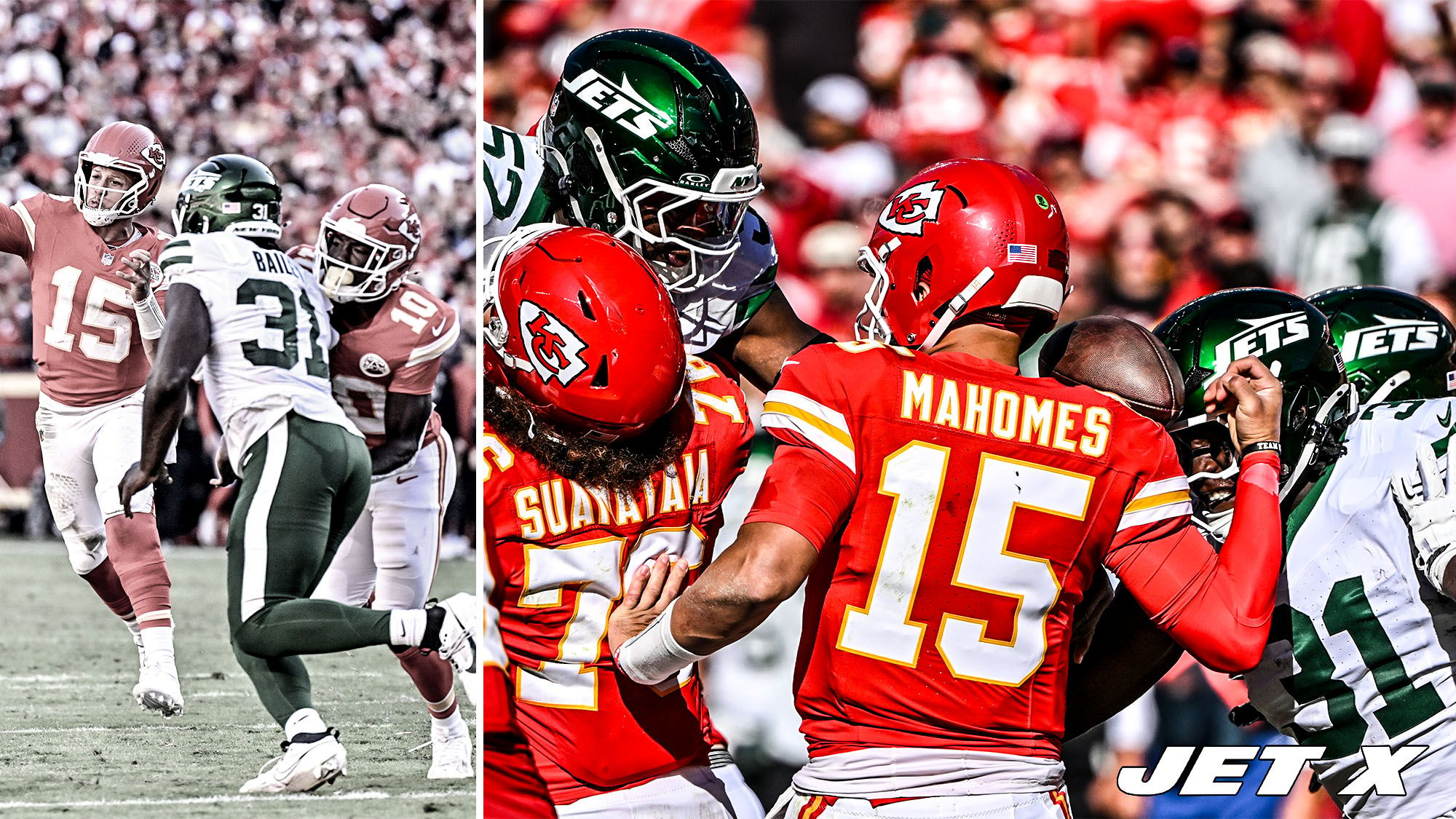
New York Jets rookie David Bailey just enjoyed his finest professional football performance. Not only is his second-best performance nowhere near his production against the Kansas City Chiefs, but it also has little to do with his work against Patrick Mahomes.
Granted, Bailey’s strip sack and end-of-first-half moments earn him splash play and widespread recognition, which never hurts, but the story does not begin or end there.
To be afforded the right to get after the quarterback in passing situations, a defense must first be willing to do the dirty stuff.
Guess what? David Bailey did the dirty stuff, and more, with plenty of impressive discipline, in the Jets’ 35-12 loss in Week 9.
The pass rusher’s plight
To point out when any player, no less a rookie, must improve in a certain on-field area is hardly a sin. In fact, it would be a football sin if the likes of Aaron Glenn and/or Karl Dunbar fail to harp on these things with their first-round rookie.
It could be argued that Bailey’s season norm leaves a lot to be desired on balanced downs. Despite some advanced metrics suggesting otherwise, nobody should ever be concerned with Bailey’s pass-rushing acumen.
Why? Well, his mentality is that of a pass rusher. His instincts are those of a pass rusher. His football life perfectly resembles that of a professional pass rusher. It’s always been that way, and it won’t change as his NFL journey continues.
On the surface, that’s a tremendous thing for the Jets. Yet many hard-to-see issues stem from such a mentality, which both defensive and offensive coaches — associated with the Jets or not — understand extremely well.
Quite frequently this season, Bailey’s ambition to get to the quarterback has hurt his defense. He often flies down the arc, while offensive tackles merely guide him down that way. This is a backbreaker for the integrity of the entire defense, particularly in today’s National Football League.
Jet X Final Drive
Ten Jets eras. A different finish every time. Call the plays, manage the clock and chase a score—or make the stop.

Another issue has been his production as one of 11 on balanced downs. Everybody knew his pros and cons coming into the season, so, again, this is hardly surprising, and should hardly be taken as a major slight.
Beyond that, coverage busts (see the New England and Miami games), along with individual responsibility busts, have appeared on tape to a considerable degree. Again, by no means is this a slight; it’s merely reality — and a reality that must be highlighted and faced in the name of progress and improvement.
Here’s the point: If and when he hones in on his keys and reads, he can play in a more disciplined fashion. And guess what? Whenever he does that, he’s rewarded via the pass-rushing stats.
The correct balanced-down mentality
From the very first play of the game, David Bailey’s mentality was both apparent and promising.
Andy Reid dialed up a GH Counter out of shotgun, which only went for three yards. The man who set the tone on the play was none other than Bailey:
As opposed to reacting or eluding blocks, Bailey honed in on the details and squeezed the tackle box. The amount of space this move takes away, thus helping the rest of his defense, is crucial.
Demario Davis fills hard, and the defense converges for an excellent team stop, setting up a decent defensive situation on second-and-7. One more similar balanced-down stop, then a third-and-long, which puts Bailey in his wheelhouse: Go get the quarterback.
Later in the game, Bailey featured a little snarl, continuing to fight Travis Kelce, and finishing the play:
While Bailey’s motor en route to the quarterback can never be questioned, his balanced-down violence absolutely can be. Again, this is not a crime against humanity; it’s instead about recognizing objective reality.
Yet, on a down-by-down basis against the Chiefs, the rookie brought a violent attitude on every play.
Late in the game, Bailey used the crown of his helmet to pop tight end Noah Gray as the force player:
It’s this type of dirty work that not only helps the defense as a whole but also puts him in more passing situations.
The correct pass-rushing mentality
Think back to the Cleveland Browns game, which was undoubtedly David Bailey’s best NFL game at the time. What did his three sacks look like? Were they chaotic in nature, in which crazy spin moves and flash-down-the-arc paths were taken?
No, sir. They instead featured the most efficient path. Not coincidentally, the Cleveland game also featured Bailey getting things accomplished on balanced downs, as he was asked to slant inside on spill-and-kill/replace designs.
The moment he starts venturing outside of his pass-rush lane is the moment he begins to hurt his defense, as seen too frequently this year. Against Kansas City, his efficient rushes were also physical, as seen at the end of the first half:
Why did Bailey suddenly burst onto your TV set at this moment in the game? What was it that made it occur? Think about it…
The Chiefs were locked into a two-minute situation. Andy Reid insanely reverted back to his old-school Philadelphia Eagles pass-happy days, giving Kenneth Walker just five carries in the first half.
Kansas City made the mistake of becoming too pass-happy on every play. Glenn knew it, which is why he began calling games upfront:
Bailey knew it as well, and this is precisely where this type of defender excels most:
The configuration
More than ever, courtesy of how the game is played these days, a smart offense can neutralize a pass-rusher. Those who love David Bailey should know this: He hasn’t even experienced the number of opportunities he otherwise should or will, based on the Jets’ current situation.
The Jets’ rookie is a pass-rushing weapon who will always pile up the pass-rushing stats. One way or another, the box score statistics will find him; that’s just who he is as a football player.
Unfortunately, unlike in the versions of the game from the 1980s, 1990s, or even 20 years ago, the window in which the pass rusher has to affect the quarterback is insanely small. Passing has become entirely too easy and efficient, which means offenses can hammer quicker, designed short-passing concepts to death, incrementally or fully replacing the rushing attack.
Think about the Chiefs’ game plan against the Jets’ defense for a moment; what was it that they attacked to death? It was painfully obvious that they attacked the right side of the field with quick designed short passes.
That’s just one of two major gaps the Jets’ defense has been dealing with this season, the other being run defense. Detroit’s second half in Week 3 exposed New York’s rush defense, whereas Josh McDaniels’s relentless right-side flat-area passing game put the second weakness on tape for the football world to witness.
Part of this has been on Bailey. Part of this has been on Will McDonald. Part of this has been on Demario Davis and Jamien Sherwood. Part of this has been on AZ Thomas.
A lot of it has been the fault of the Jets’ porous run defense, which forces safety Dane Belton to drive down into a box position, forcing Thomas — the boundary cornerback — to play softer (in a solo-high look). And a lot of it has been the fault of the Jets’ offseason decisions in how this front seven was configured.
In essence, the Jets’ 3-4 base is a 5-2 via personnel. Although most 3-4 fronts are 5-down in nature, the two edge players are technically linebackers, which makes in-space play critical.
Most of the Jets’ edge players are of the defensive-end ilk, rather than actual linebackers. Bailey, the man of the moment, can certainly get going in a hurry when asked to run straight ahead — as evidenced by the many backside tackles made downfield and chase-down tackles this season.
He also put another one on tape with his flat-area track-down of Walker in the flat, and, of course, when asked to slant inside (with an edge replacement), he usually excels:
Although everybody loves the tackle, the Chiefs continued the trend of hammering the right-side quick passing game and got the first down.
Should Bailey even be playing 3-4 outside linebacker?
The right to rush the quarterback
No matter the answer to that question, what’s clear is the following: No matter the truths of his rookie-season ups and downs, if David Bailey plays each game just as he did in Kansas City, the New York Jets should be more than pleased with his production and development.
For David Bailey, playing this way on a consistent basis — as opposed to seemingly having to be “reset” once every few weeks — will help both the team’s defense and his own production in a major way.
No pass-rusher has the right to rush the quarterback until his defense puts itself in a position to do so. Then, once in a position to do so, pass-rush-lane integrity becomes the default. Then, once pass-rush-integrity is the default, we get into game-plan specifics and down-and-distance particulars.
That’s just how it is in today’s National Football League. The more David Bailey embraces that reality, the more he and the New York Jets will progress.
