
With another playoff push thwarted before Thanksgiving, many New York Jets fans are focused on the future.
That future-focused mindset is largely built around mock drafts and offseason plans during the week, but it can apply on Sundays, too. Even if fans aren’t as invested in the final score as they would like to be, there are still plenty of long-term stakes between those white lines.
As the Jets take on the Buffalo Bills this afternoon (1 p.m. EST), here are three players for Jets fans to watch closely.
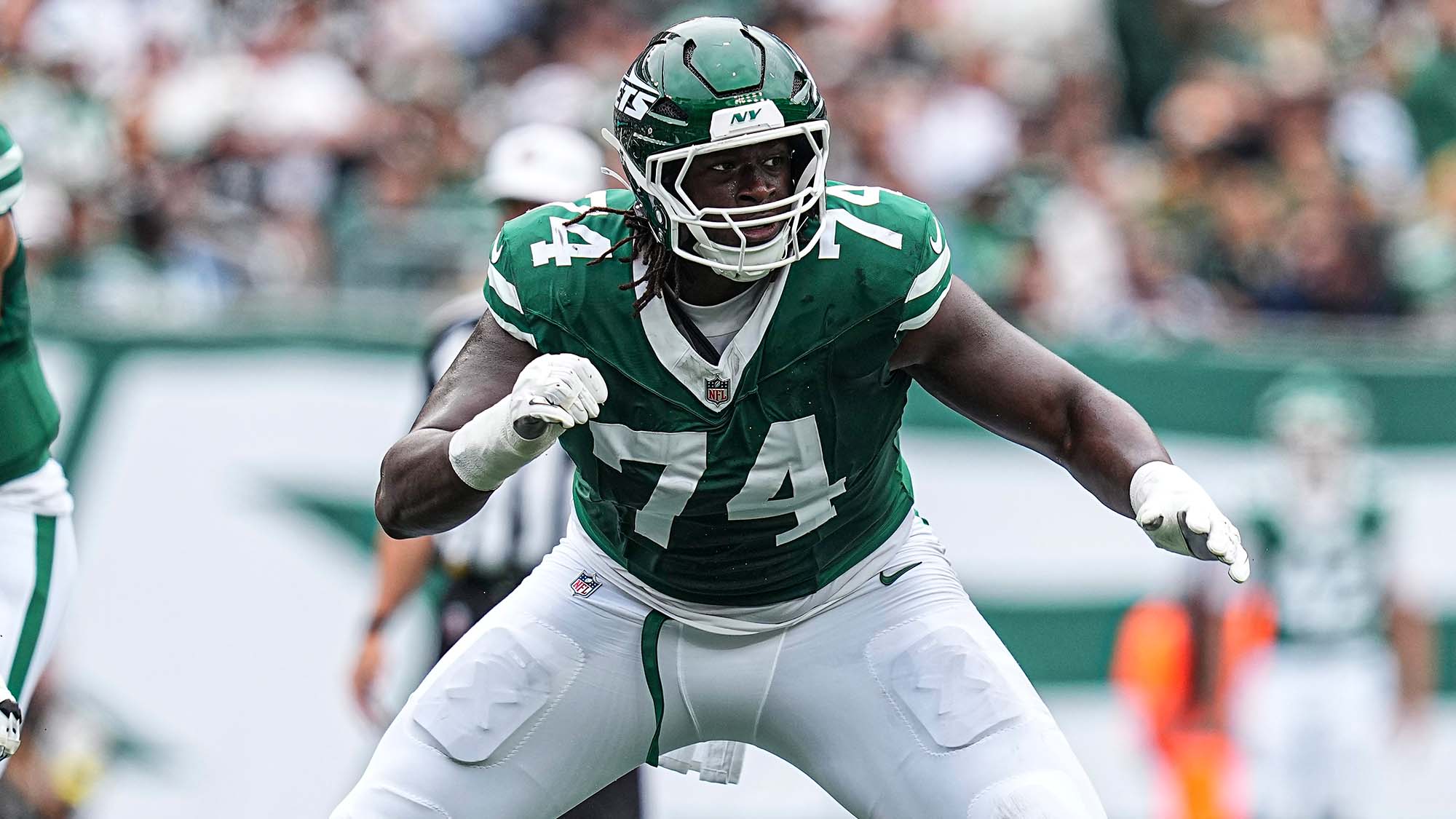
LT Olu Fashanu (No. 74)
The Jets came into 2026 hoping that Olu Fashanu, a 2024 first-round pick of the previous regime, would establish himself as the team’s left tackle of the future. Fashanu was on that trajectory, given his talent and his 17 starts of about league-average play in 2025, but there was more growing to be done.
Instead of taking a step forward, Fashanu has taken a giant step back. Through nine games, he has been charged with eight sacks and six penalties. He is on pace to become the first offensive lineman in Pro Football Focus’ database (2006-present) to finish a season with 15+ sacks allowed and 10+ penalties.
On top of his struggles with allowing sacks and penalties, Fashanu has struggled as a run blocker; the Jets have been inefficient when running in his direction, and for that reason, they tend to run away from him.
One of the Jets’ most important storylines over the next eight games will be figuring out how dire of a need left tackle will be in the offseason. It could range from a non-need to a clear-cut hole in the starting lineup that requires a premium asset, depending on how Fashanu closes the year.
If Fashanu can put everything together and play like a high-end left tackle in the second half, the Jets can cross the position off their shopping list. If he returns to his 2025 level of play, they will probably want to at least use a mid-level investment to add a worthy competitor who can push him for the 2027 starting job.
But if Fashanu keeps playing the way he has over the first nine games, the Jets won’t want to mess around at left tackle, not with a young quarterback likely entering the building. If the season ended today, the Jets would probably be planning to make a premium investment in a left tackle. The position is too important to roll the dice on Fashanu, given his mistake-proneness in 2026 and lack of development through three seasons.
Keep an eye on No. 74 today. His reps will play a major role in shaping the Jets’ offseason plan.
TE Kenyon Sadiq (No. 16)
The Jets took a big swing when they selected Kenyon Sadiq with the 16th overall pick of this year’s draft.
It’s rare enough to see a tight end drafted that high in general, let alone a tight end with Sadiq’s production resume. Across three seasons in college, he didn’t even reach 1,000 career yards, a mark that recent first-round tight ends like Colston Loveland (1,466), Tyler Warren (1,839), and Brock Bowers (2,538) comfortably eclipsed.
The Jets swung for the fences based on Sadiq’s athletic profile, which is arguably the best all-time for a tight end prospect. In a league where two-tight end sets are becoming increasingly commonplace, it made sense. The matchup game between linebackers and tight ends is where many elite offenses make their bread nowadays, and Sadiq has limitless potential in that department.
New York is hoping that Sadiq can gradually develop into a game-changing matchup weapon. To do that, though, they are counting on significant development as both a receiver and blocker.
Not only did Sadiq have limited college production as a receiver (relative to first-round prospects), but he also had a shaky resume as a blocker. His relatively slight frame for the position (241 pounds) made his blocking a particularly concerning aspect of his profile coming into the NFL.
Through his first nine games with the Jets, Sadiq has been a mixed bag.
Within what he can control, he has impressed in the receiving game. When the ball comes his way, Sadiq often shows off his all-world athleticism; his highlight reel is impressive for a guy targeted as infrequently as he is. He has secured four of his five contested targets and ranks sixth out of 35 qualified tight ends with 6.3 YAC per reception. Sadiq is also winning his routes at a strong clip, as he ranks eighth with a 54.8% separation rate (per FTN Fantasy).
The problem is that Sadiq has only been targeted 31 times in nine games. That’s not entirely his fault, given how many mouths the Jets have to feed on offense, especially since his separation rate indicates that the lack of targets is not due to a lack of separation.
From a value standpoint, it’s troubling that the Jets’ 16th overall pick is barely contributing any production; they have to figure that out long-term to justify the investment they made in Sadiq. But for Sadiq himself, within what he can control, he’s doing a nice job.
That’s part of why Jets fans should focus closely on him today against Buffalo. It’s easy to look at his box-score numbers can call him a budding bust, but if you just watch how he handles his business in the passing game, within what he can control, he’s generally done well, and it’s his execution in these areas that will give us the strongest signal of where he’s headed in the NFL. If he keeps executing at his job, the targets and production should eventually come.
The blocking game, though, is where Jets fans should focus the most closely on Sadiq.
Part of Sadiq’s lack of targets can be attributed to his blocking. Because the Jets don’t trust Sadiq much as a blocker yet, his snap count is limited, which limits his target count.
Sadiq has been on the field for just 43% of the Jets’ offensive snaps this season, including just 45% of their passing plays. That’s a lot of target opportunities for Sadiq to be missing out on, and it’s because in many situations, the Jets would rather have a better blocking tight end on the field.
While much of Sadiq’s target count is out of his control, blocking is the next factor that he must address to do his part in attracting targets. The more he gains the Jets’ trust as a blocker, the more snaps he’ll get, and thus, the more opportunities he will get to run routes.
Watch closely to see how No. 16 performs as a blocker today.
EDGE David Bailey (No. 31)
I’m not sure I have ever seen a Jets defender as polarizing as David Bailey, rookie or otherwise. He generates one of the widest spectrums of opinions that you will ever see from an NFL player.
Pass-rushing-wise, Bailey’s 7.5 sacks, five forced fumbles, and high pressure totals make it easy to tout him as a player who is already a premier pass rusher. However, his pass-rush win rate, average time to pressure, eye test, rush lane discipline and general consistency tell different stories about his impact as a pass rusher.
Against the run, we are now seeing leaderboards that paint Bailey as the league’s second-best run-stopping edge defender behind Will Anderson, while some moments on film make his run defense look like a colossal liability. Many numbers, though, suggest Bailey’s run defense is around average, rather than near either extreme.
So, who is David Bailey? Is he already the best defensive player that Mother Earth has ever been fortunate enough to have walk her surface? Or is he a sieve with the most misleading box-score stats of all time?
As usual, the answer is somewhere in the middle. He is not an elite player yet, nor is he anything close to a scrub.
Where it lies in that middle, though, is up to you. Ultimately, when it comes to player evaluation in a sport as complex as football, there will always be immense room for subjectivity, save for players whose dominance or struggles are glaringly obvious.
That’s why watching No. 31 closely on a snap-to-snap basis will be paramount for Jets fans as they look to develop informed opinions about the second overall pick, free from bias that could arise from cherry-picking stats that fit a certain narrative.
Focus on Bailey throughout each play. Is he winning his rush reps quickly, and in clean fashion against one-on-one matchups? Or do his pressures and sacks come from being unblocked or chasing quarterbacks more than 3-4 seconds after the snap? Simply put, how much impact does he make on the outcome of each dropback?
Perhaps most importantly, as it pertains to today’s game against Josh Allen, does Bailey maintain discipline in his rush lanes? Or does he rush with reckless abandon, yielding lanes for quarterbacks to step through and make plays?
Against the run, does Bailey hold his ground to set a firm edge? Does he stay disciplined to his gap assignments, rather than compromising gap integrity to chase tackles? Does he show good awareness when targeted on edge-threatening plays?
There are countless things to evaluate in an edge defender’s game that no single metric could ever capture. That’s why it’s important to trust what our eyes tell us about a player from watching him snap-to-snap.
Anybody could cite a handful of box-score stats to show why Bailey is the next Von Miller, and anybody could pull up some advanced metrics and a couple of bad reps on film to show why he actually should be playing in the XFL.
But what do your eyes say?
