
For a 14-year stretch, the New York Jets were one of the more respectable franchises in the NFL.
Yes, it really happened.
From 1997 to 2010, the Jets had the NFL’s 11th-best regular season win percentage (.536) while tying for the eighth-most playoff wins (7). The only AFC teams with more playoff wins were New England, Pittsburgh, Baltimore, Indianapolis, and Denver.
Today, the Jets find themselves mired in what will soon officially become a 16-season playoff drought. The franchise is known as the laughingstock of professional football, and it feels as if they have always held that distinction. That isn’t the case, though.
It wasn’t too long ago (well, over half of this writer’s life ago, but during his lifetime, nonetheless) that New York had been an above-average franchise for nearly a decade and a half. There were down years, but the rough times never lasted long; when the calendar flipped to 2011, the Jets had not endured back-to-back losing seasons since 1995-96.
That 2011 season in when New York’s downfall officially began. The Jets missed the playoffs with an 8-8 record after recording back-to-back AFC championship appearances in 2009 and 2010.
Fifteen years later, they still haven’t recovered.
That 2011 season really began to fall apart on this day 15 years ago, marking the first steps toward the Jets developing the reputation they are now burdened with.
“Tebow Time” kickstarts Jets’ franchise collapse
On Nov. 17, 2011, the Jets were still very much in the mix as a prime threat in the AFC.
New York’s 5-4 record was not quite what they had hoped for after starting 7-2 the previous season, and they were coming off a disappointing 37-16 home blowout loss at the hands of the New England Patriots. Entering the season, though, the Jets had the NFL’s fifth-best Super Bowl odds (+1200), including the third-best odds in the AFC, so they were expected to rebound. After all, given their four playoff wins over the previous two seasons, all they had to do to be considered a serious threat was get into the dance.
Despite the loss to New England, the Jets were in a good position to make a strong playoff push over the last seven games. They remained just one game out of the AFC’s final wild card spot, and their remaining schedule was filled with games they were expected to win. The Jets were allowed to have that kind of outlook back then; they had gone 9-1 in 2010 against teams that finished .500 or worse.
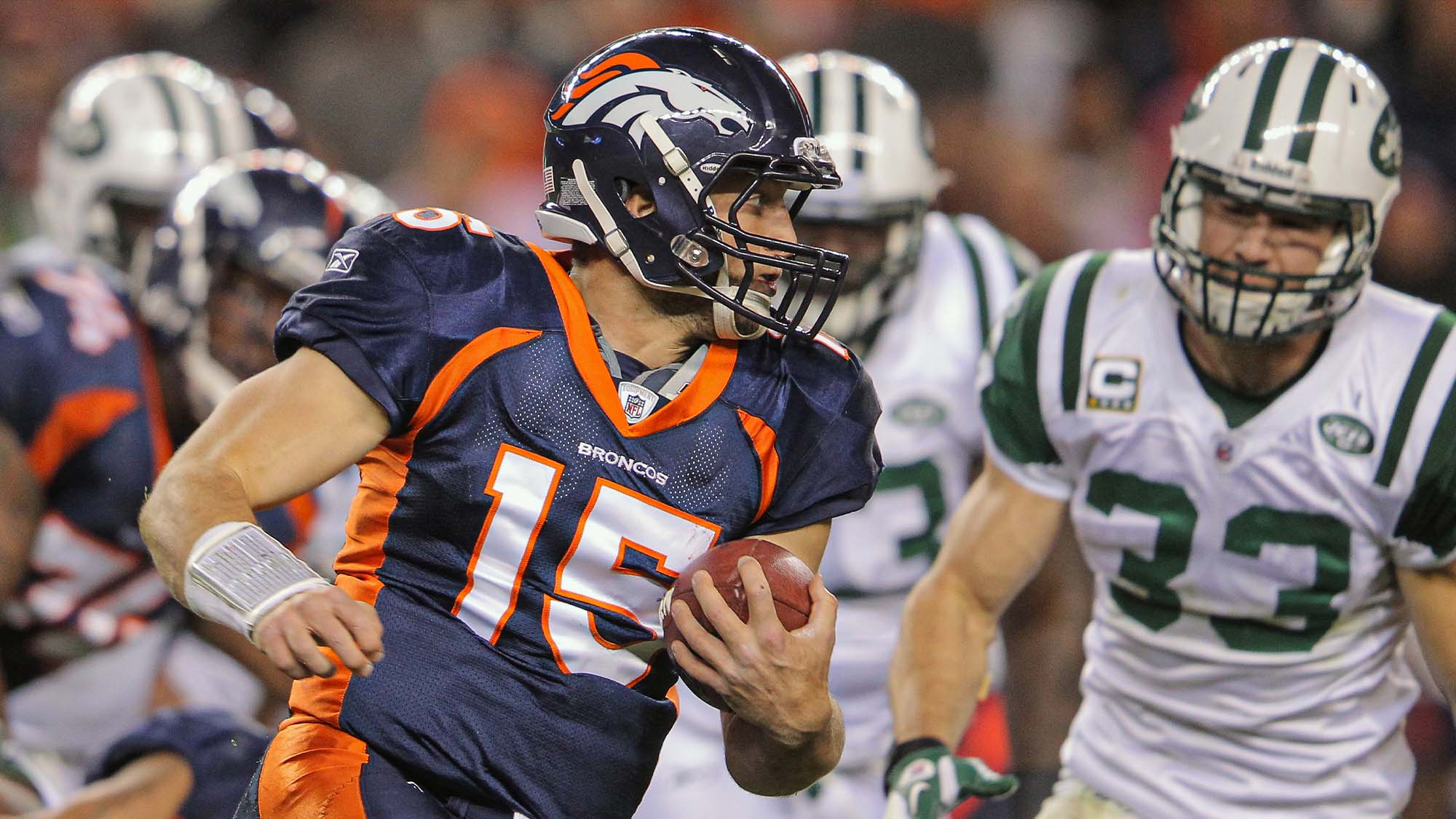
The first of those winnable games came against a 4-5 Denver Broncos team led by a quarterback who had completed 2 of 8 passes over a full four quarters in the team’s previous game, which they still managed to win, 17-10, over the then-bottom-feeding Kansas City Chiefs.
That quarterback was the Broncos’ 2010 first-round pick, a little-known 24-year-old by the name of Tim Tebow.
While the teams were separated by one game in the standings, this was expected to be a get-right opportunity for the Jets on Thursday Night Football. They were 6.5-point road favorites, which is tough to do in a building as difficult to play in as Denver’s.
For most of the game, the Jets made Tebow and the Broncos’ offense look silly. Over their first 11 drives, the Broncos scored three points, accumulating a measly 129 yards. After their first three possessions, Denver punted on eight consecutive drives, with seven being three-and-outs.
The Jets’ offense moved the ball at times, driving at least 30 yards on six different possessions, turning two into field goals and one into a touchdown by guard Matt Slauson on a fumble recovery. But crucial mistakes prevented the Jets from turning yards into points (sound familiar?), letting the Broncos hang around.
A Mark Sanchez pick-six gifted Denver seven points, while Nick Folk missed two field goals. Those three plays were the difference between a 19-3 Jets lead and a 13-10 Jets lead going into the final possession.
With 5:54 remaining on a cold November night in Denver, Tebow took the ball at his own 5-yard line. Keep in mind the context at this moment. The Jets were a 5-4 team, who entered the night as 6.5-point road favorites, and were coming off back-to-back AFC championship appearances. Tebow was a struggling second-year player who completed two passes in his previous game and had led his team to three points in the first 54-plus minutes that night.
The Jets of old would have wrapped up this ugly win and kept their wild-card pursuit moving.
The Jets of today would allow a quarterback who can’t hit the broad side of the barn to lead a game-winning drive on prime time.
That night, my friends, the Jets of today were born.
On the strength of six Tebow carries for 57 yards, the Broncos drove 95 yards down the field, capped off by Tebow’s 20-yard go-ahead touchdown run with 1:06 on the clock. The Jets could only settle for a Hail Mary attempt on the ensuing drive, and the Broncos picked up the win, officially kicking “Tebowmania” into full gear.
Afterward, the Jets actually went on to win their next three games, getting to 8-5 with three games left. From there, they finished the season on a three-game losing streak, dropping contests to the Eagles, Giants, and Dolphins. One could argue that the Jets’ downfall really began there, particularly with the ghastly Christmas Eve loss to Big Blue. Victor Cruz’s 99-yard touchdown that day is often pinpointed as the specific moment that everything fell apart.
But it was the Thursday night loss in Denver that first signaled a shift in New York’s respectability. It wasn’t just that they lost; it was the way they lost. It was a particularly embarrassing method of losing; they gave up a game-winning drive on prime-time to a quarterback who was more of a folk hero than an actual quarterback. Starting from that night, embarrassment has become the norm for the Jets.
Cruz’s touchdown came a little over a month later. The following season brought the fumble that must not be named, and the season after brought in the era of Geno Smith, which was best known for a locker-room altercation.
The Jets were no juggernaut before Nov. 17, 2011. They certainly had their share of brutal moments and brutal seasons over the previous 15 years. But even when things went bad, they weren’t always bad to such a meme-able (or, I suppose, in that era, “tabloid-able”) extent, and the team always followed its rare losing seasons (just three from 1997-2010) with a winning campaign.
The 2011 season is when the snowball was pushed down the hill, fittingly, in the shadow of the snow-capped Rocky Mountains. “Tebowmania” marked the beginning of the current Jets era, in which one embarrassing moment would always leak into the next.
This franchise used to be able to get the ship back afloat after short periods of maintenance. They’d hit rough patches in the sea, but things never got too far out of hand; they’d get on their merry way, cruising along on-schedule, like every other ship on the water.
But since that fateful night, the holes have become too large to manage. Occasionally, the Jets plug one, but every time they do, another springs loose, without fail.
The Jets are still frantically trying to plug all the holes in their ship, 15 years after they crashed into the Tebow-tanic on their way back to New York.
