
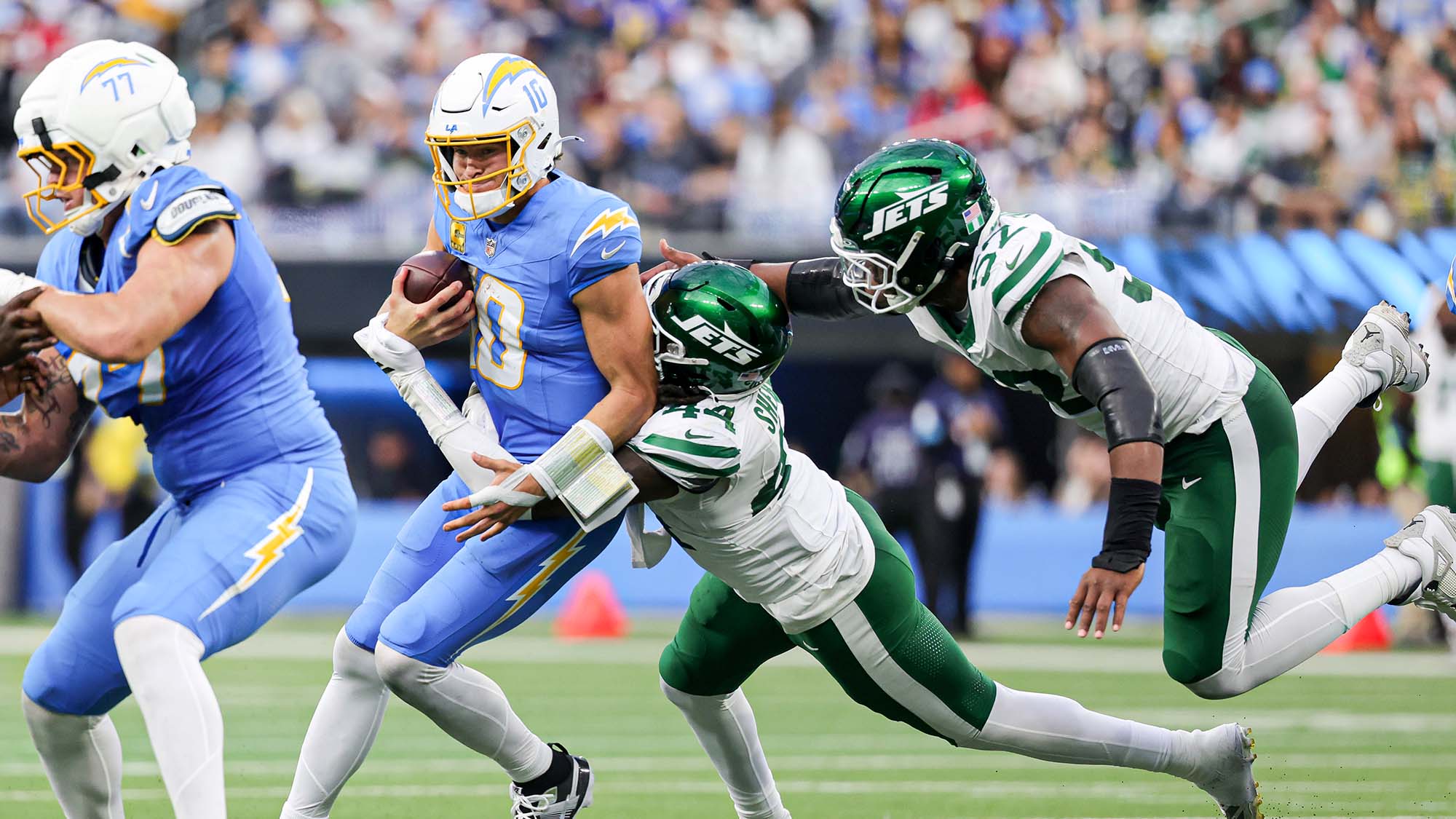
The New York Jets’ Week 11 win over the Los Angeles Chargers certainly wasn’t a pretty way to snap their five-game losing streak. Against a 1-8 team that entered with an average margin of defeat of 12.3 points, the Jets won by only three points (27-24).
New York’s offense certainly wasn’t at fault for that margin. In a low-possession game (just six drives per team), the offense scored on each of its first five possessions, including three touchdowns, before icing the game on the final drive.
Your team. Your decisions.
Jet X Game Simulator
Win a lifetime membership
Beat any of the five Legend challenges without simulating.
Play the weekly matchup or relive a classic. Choose a current matchup or classic game, and log in to save Coach Points.
Explore Game SimulatorChoose your mode on the Game Simulator page. Full games · Weekly prep · Classic challenges.
It was about as flawless of an offensive game as the Jets have ever played, although the low possession count puts an asterisk on that. Still, credit is due to Frank Reich, Geno Smith, the offensive line, and the team’s weapons.
Simple math, then, says the defense must have been at fault for the Jets only barely squeaking by the most horrendous team in the NFL.
That would be correct.
It’s obscured by the Chargers’ mild final point total of 24, but the Jets’ defense actually had a miserable outing. Remember, the Chargers only had the ball six times. Scoring 24 points on six drives is an average of 4.0 points per drive, which is almost double the league average (2.08). That’s like scoring 40 points on 10 drives.
At the end of the day, it can be said that the defense came out of the game with just one positive: David Bailey.
The rising star was solely responsible for the Jets’ only defensive stops of the day. His two sacks came on third down, forcing two Chargers punts, the only Los Angeles drives that did not end in points. Outside of the two Bailey-thwarted drives, the Chargers scored 24 points on four drives.
New York’s defense struggled in pretty much every area. On the ground, they allowed the Chargers to run for 158 yards on 30 attempts (5.3 yards per carry). Through the air, they yielded a 119.3 passer rating to Justin Herbert, a season-high by more than 30 points, which is outrageous.
The Jets did get six sacks on Herbert, including two from Jowon Briggs, who had a nice game, but only Bailey’s sacks meant anything. The other four sacks came on early downs and resulted in a combined loss of just 14 yards, and the Chargers still scored touchdowns on every drive after those sacks.
From an evaluation standpoint, the most notable defensive news of the day was that the Jets got their first extended look at slot corner D’Angelo Ponds, who played a season-high 58% of the snaps. It was a rough one for the rookie.
Ponds allowed both of the passes thrown his way to be completed for 25 yards and two first downs, and he was bullied in the run game, posting a team-worst 28.6 run defense grade at Pro Football Focus. The film backed it up; Ponds was pancaked at the second level to allow a 36-yard run, and on another play, he got stuck watching a motioning receiver and did not realize that a run play was darting straight past him, leading to a big hole and a 9-yard run.
In other disappointing news for the defense, Demario Davis continues to show his age, as he led the team with three missed tackles; he is now tied for the NFL lead with 17. Meanwhile, Will McDonald was completely shut out, posting no pressures on 21 pass-rush snaps. The same goes for Joseph Ossai, who had no pressures on 17 pass-rush snaps. Bailey was responsible for five of the Jets’ six pressures off the edge in this game.
This was by far the best performance of 2026 for a Chargers offense that has looked completely inept for most of the season. According to Pro Football Reference, the offense recorded 13.9 expected points, which was not just their best of the season, but by 12.4 points over their second-best game.
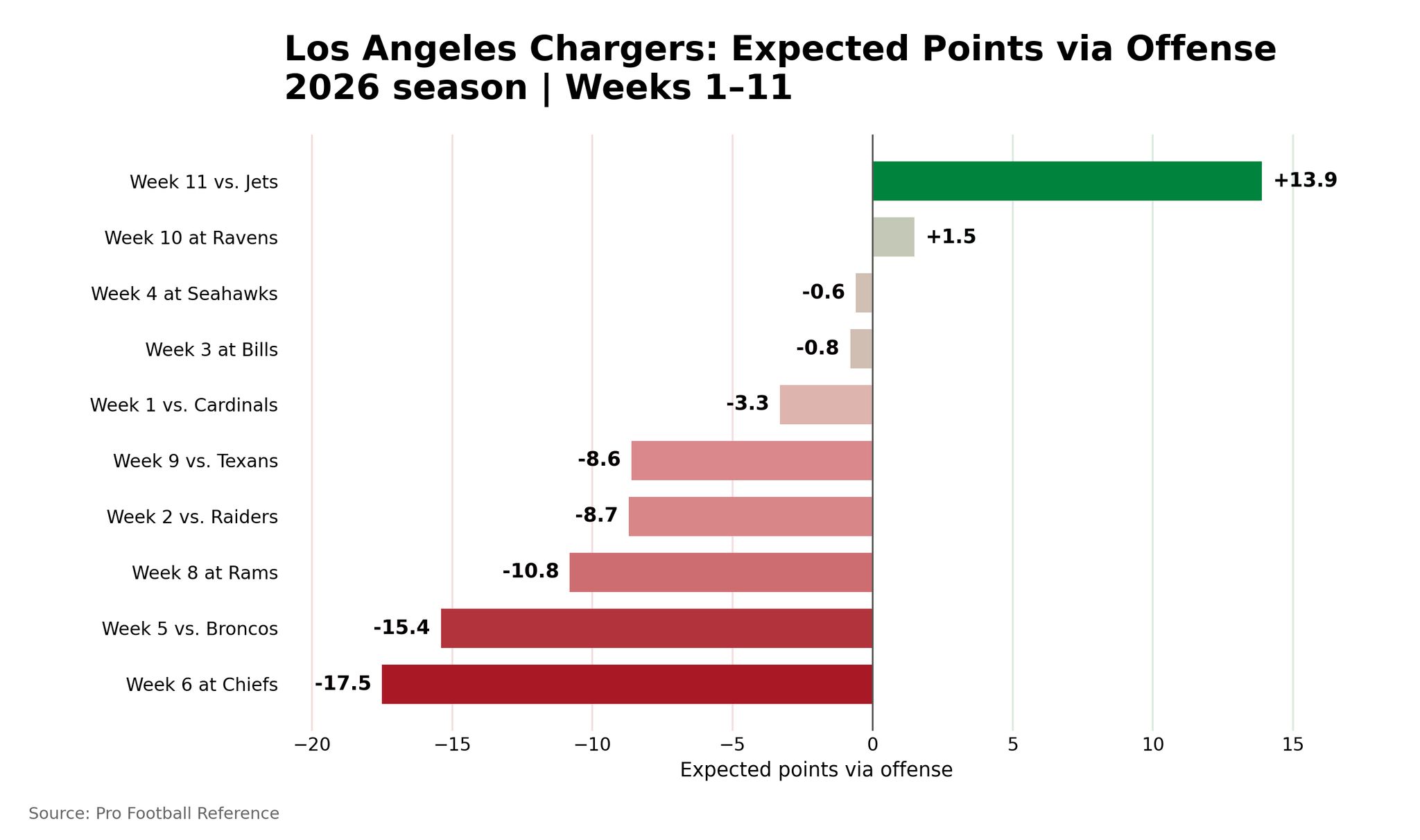
That paints a pretty embarrassing picture for the Jets’ defense. The Chargers’ offense was a massive negative in over half of their games, and it had only been a net-positive once (barely), yet the Jets made them look like a juggernaut.
Things are bleak for head coach Aaron Glenn and defensive coordinator Brian Duker. Outside of two early games in which they beat up on the hapless Titans and benefited from rainy conditions against the Packers, the Jets’ defense has been an utter disaster. Since Week 3, the Jets are 31st in defensive EPA per play (0.127), better than only the Raiders. Even if you include the first two games, they’re 29th in this category over the whole season (0.091).
Glenn revealed after the Jets’ Week 10 loss to Buffalo that he had handed defensive play-calling duties over to Duker (a move that was slammed by Wink Martindale). This was Duker’s second game calling plays, and neither outing was pretty.
Glenn isn’t off the hook just because he is no longer calling plays, though. In fact, as Martindale pointed out, Glenn arguably deserves more flak. He has given up on what was supposed to be his “superpower” and tossed the responsibility on an inexperienced coach who was only brought on to be an “organizer”, as Martindale labeled it.
Now, Glenn and the Jets are suffering the consequences of their dubious approach to the defensive coordinator search. Glenn blocked out an experienced coach in Martindale so he could call plays himself, only to fail at calling plays, forcing him to toss those duties onto the non-play-calling coordinator that he intentionally targeted so there would be no doubt as to who would call the plays.
Despite the win, it’s hard to say Glenn’s stock rose in any meaningful way. The Jets continue to be a mess in the area that he was supposed to have the most direct impact on.
