

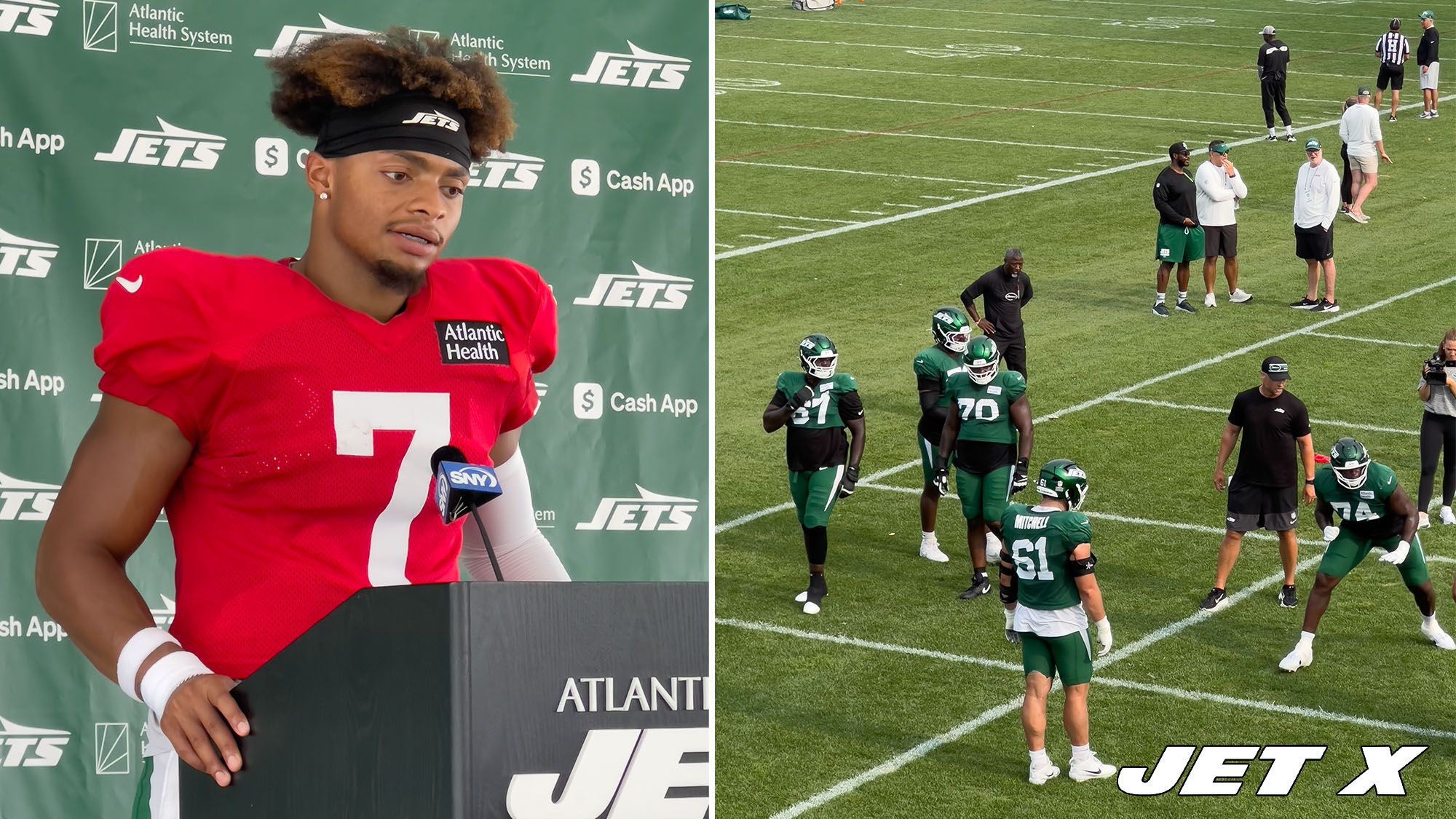
Before this summer began, who did New York Jets fans think Justin Fields was as a quarterback? Did this fanbase generally understand Fields’s game, or were they under the impression that he had a chance to become the next great pocket-passing quarterback?
At the very least, Jets fans understood that their team drastically declined in the “quarterback talent” department this past offseason, right? I mean, no serious person can argue that Justin Fields is a better quarterback than even the 41-year-old Aaron Rodgers.
Right?
Granted, there are legitimate reasons to claim dumping Rodgers for Fields is the right move—which is discussed further in this article—but it’s a no-contest from a strictly quarterbacking/passing conversation. Anybody who argues with that thought needs not apply or even show face, please.
We start with Aaron Glenn’s decision to dump Rodgers in favor of Fields, most likely to the chagrin of the many fans who pretend that Rodgers does not exist. Yet, those chagrins don’t wash away the importance of starting at the Jets’ pertinent quarterback decision this past offseason.
Discussing the move from Rodgers to Fields allows us to understand what this Jets team strives to be. That knowledge is the only thing that helps us understand this team’s identity goals and properly analyze Fields’s play on the practice field.
Yes, Fields’ struggles are real
If Saturday’s Green and White Scrimmage struggles were tough to watch, and Monday’s issues were overhyped, then Tuesday’s morning session can only be described in one way …
Horrendous.
While it’s challenging to analyze Justin Fields wholly on the practice field, there are base-level parts of the position he must execute. When those items are not executed, analyzing his practices isn’t tricky.
Time and again, Fields’s timing was late. It’s a crusher to Tanner Engstrand’s scheme that cannot stand. Whether it was scanning through his progressions or looking for the hot target against a pressure, Fields was stuck in his own head all morning.
Glenn decided to have his offense work on some backed-up team sessions early, which turned out to be a complete nightmare. The first play was a false start, which moved the ball from the 1 to the 1/2-yard-line.
Things did not improve from there. What followed were a couple of rushes, another false start, and an incompletion while targeting Garrett Wilson on a speed out (three-step drop).
Worst of all, running back Breece Hall left practice with a trainer during that situation.
Later, while working in standard team sessions, Isaiah Davis looked good on the ground. His one-cut ability within zone concepts stands out big-time.
Fields found Wilson for a modest gain on one of the standard drives, but the negatives far outweighed the positives. More specifically, Fields could not find open receivers to target—and that did not have to do with the Jets’ superb coverage (although Glenn’s coverage has been legit).
On a few occasions, Wilson ran free on shallow-cross-type patterns, only for Fields to bypass or miss him. He instead opted for the trail route (coming from the same side), while throwing into tight or even double coverage.
Fields’s indecisiveness was most apparent when the Jets brought heavy pressure or their responsible four-man conventional pass rush collapsed the pocket. And don’t get it twisted: “collapsed the pocket” does not mean the Jets’ offensive line was being overwhelmed.
Instead, the Jets quarterback’s indecisiveness was on full display.
When Fields did make the correct quarterback play, his weapon dropped the pass. At one point, he faced an overload from his right side (the defense’s left). Fields correctly looked for the hot on his left side, a shallow in-breaker, but Allen Lazard dropped the pass.
Nonetheless, the quarterback’s timing was still a tick late in that situation.
Not even seven-on-seven drills could snap Fields out of his funk:
The worst throw from Fields resulted in an Andre Cisco interception, which cannot happen.
It’s 7v7, which means the offense should have the advantage. Fields is facing a two-high look, yet he seeks a secondary read to his left side at the 20+ yard mark.
Worse yet, he decided to unload the ball as late as it gets, deep, on a secondary read. Cisco easily ranged over for the pick.
It’s all about structure
The lone glimmer of hope for the passing offense came when the quarterback decided to play within structure. He finally began trusting his primary read more, allowing Engstrand’s concepts to shine.
A couple of WR screens to Garrett Wilson worked, as did an excellent play-action boot that resulted in a nice 20+ yard connection with Stone Smartt.
This shouldn’t surprise anybody. Throughout his quarterback career, Justin Fields has struggled to roll through his progressions. He often locks onto the primary receiver while utilizing his legs as the secondary weapon.
The only shocking thought process comes from those who believe that it has a chance of drastically changing. Not only that, but when Aaron Glenn told the world that he wants to unlock Fields’s potential, to have him play quarterback in a more potential-filled way, I find it hard to believe that he was ever 100% committed to that claim …
That is if Glenn was thinking about potential by way of pocket-passing—which I don’t believe he was.
I firmly believe Glenn wants to keep Fields who he is, because that’s the element he believes will help his team win the most games. By no means is Glenn against wanting Fields to improve as a passer, but it cannot be jammed down the team’s throat.
In other words, once the regular season rolls around, this offense will look as Fields-friendly as it gets, with his legs taking center stage. Then, and only then, if success is found on the ground, can the next step even be considered—tinkering with Fields’s potential in the dropback game.
His threat as an anytime-runner is the only thing that’ll give him a chance to shine in the pocket-passing areas. It’s what allowed the likes of Lamar Jackson and even Josh Allen to get where they currently are.
How exactly does that work at practice, though? How feasible is it to ensure the defense treats Fields’s legs with the threat they deserve in an actual game?
If and when the Jets offense practices as though the quarterback is a processor, it won’t work. And that’s what’s been happening at practice lately, partly due to the nature of practice, where running many RPOs and zone reads won’t provide the right bang for the buck.
Unfortunately, as soon as Fields began finding some success while playing within the structure of the offense, he threw an interception. Interestingly, his timing was nice, but there may have been too much steam on the pass.
It deflected off Jeremy Ruckert’s hands, turning into an easy Brandon Stephens pick. No matter the quarterback’s criticism, it’s a ball Ruckert still has to grab.
Forget the numbers (pass completions and attempts): What Justin Fields put forth on Tuesday morning was by far his worst effort of the summer. It boils down to structure, which means he must be “on time” and trust each play-call’s integrity.
The New York Jets quarterback must trust his primary reads much more.
This offense’s potential boils down to the rushing attack and Justin Fields’s off-schedule playmaking. Everything in the passing game must remain structured and simple.
With that knowledge, it becomes much easier to understand what’s happening. It also becomes evident that Aaron Glenn relies heavily on his offensive coaches to out-scheme the defense—which is a truism even in the face of the drastic talent decline in the traditional quarterback bucket (from Rodgers to Fields).
Camp news and notes
Tuesday’s only two offensive positives were some flashes from the rushing attack and Brady Cook’s steady ascent. Davis and Braleon Allen both looked solid, as did Olu Fashanu.
Cook, the Jets’ UDFA quarterback, continues to fly under the radar. I believe he’s easily moved from “afterthought” to “workable” status. His improvement since OTAs is drastic, and the kid’s confidence continues to grow.
On one play, Cook delivered a beauty on a deep corner route to fellow UDFA Jamaal Pritchett:
In addition to Breece Hall leaving practice early, rookie safety Malachi Moore was also seen leaving with a trainer. The Alabama product returned to practice Tuesday, but his injured oblique appeared to be acting up again.
Mason Taylor, Tyrod Taylor, Quinnen Williams, John Simpson, Xavier Gipson, and Kris Boyd missed practice again.
Tuesday was also a legends day of sorts. Glenn invited many former Jets players, many of whom he played with in the 1990s.
Among the crowd were Kevin Mawae, Jason Fabini, Adrian Murrell, Chad Cascadden, Glenn Foley, Victor Green, James Hasty, Gerald Sowell, Ray Mickens, and Jets X-Factor’s own Wayne Chrebet.
The Jets will not practice on Wednesday (off-day) but will return for a camp session on Thursday morning.
