

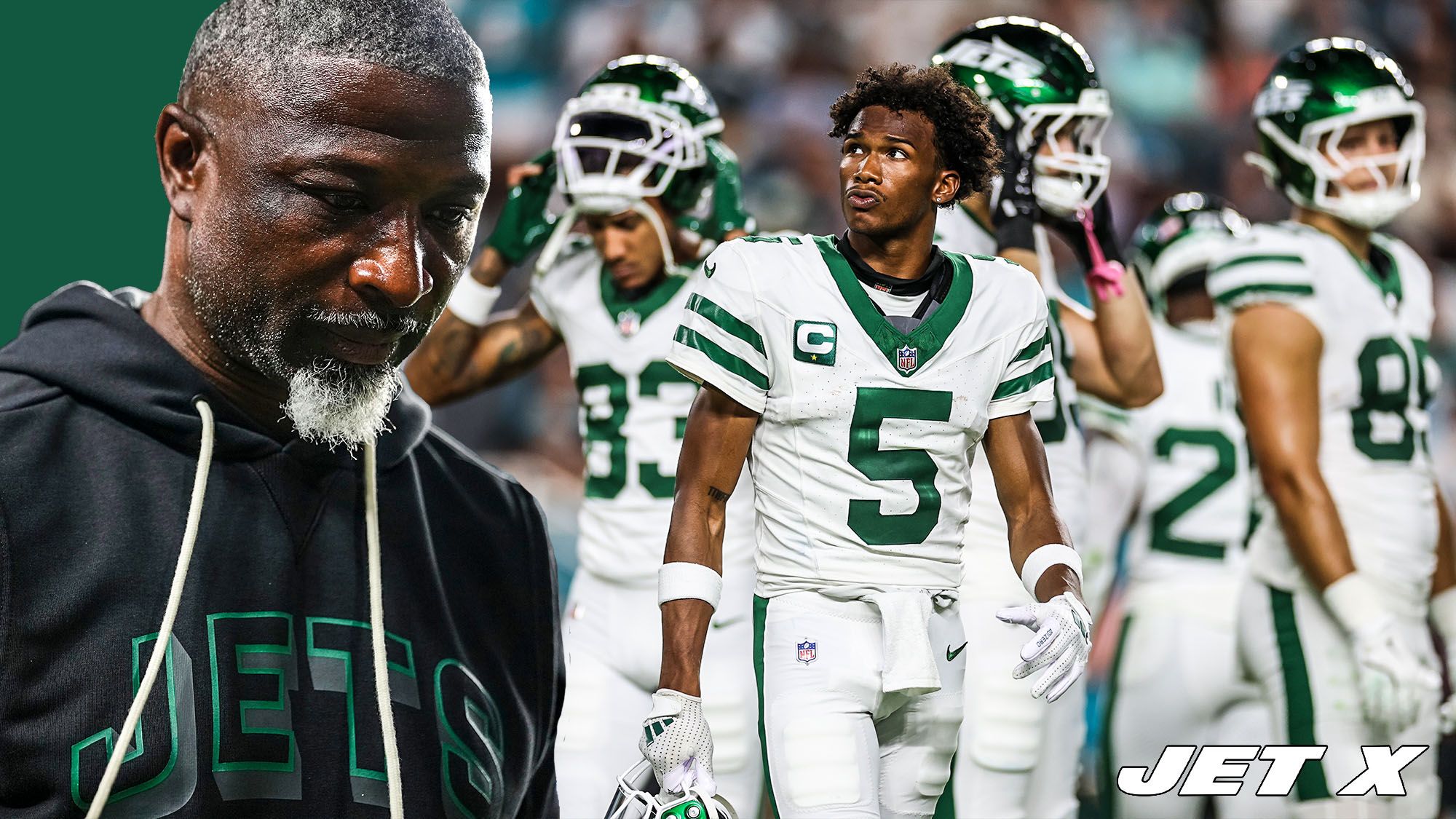
Aaron Glenn’s New York Jets offense opened Monday Night Football with a bang. After the defense bent but did not break—relenting just a field goal on the game’s opening possession—Tanner Engstrand’s unit engineered a brand of smash-mouth football that any fanbase would proudly wear on its sleeve.
Faced with a second-and-goal at the Miami Dolphins’ 6-yard line, the Jets offense executed a beautiful inside zone concept with heavy personnel (six offensive linemen) and numbers. Braelon Allen took his time, hopped, and allowed the blocking to wash everything to the right, as he found daylight up the gut.
Then, the ghosts of Earnest Byner appeared in Miami. Allen fumbled at the goal line, leading to despair.
Yet again, one demoralizing play seemingly halted any semblance of progress.
A fumble here, a missed opportunity there. An interception here, a silly procedural penalty there. A missed tackle here, a fair catch inside the 5-yard line there.
Mistake after mistake piled onto the Jets fans’ bitter Monday night, and yet, mistakes are the last thing the Jets’ rookie head coach should concern himself with this week. Please let me rephrase that: The idea of a mistake must be the last thing mentioned this week at 1 Jets Drive.
For the 2025 New York Jets, ball security isn’t the top priority. It’s one of the issues, granted, but it’s not the primary concern. Disciplined football that reduces penalties shouldn’t be No. 1 on the “things to fix” list either.
This holds true despite the ugliest of numbers: 13 penalties for 101 yards and a -3 in the turnover battle (not to mention having zero takeaways through four games).
All of those boneheaded mistakes that contributed to Week 4’s 27-21 loss in Miami are painfully and transparently on display, but as Glenn referenced in his Tuesday press conference, the how is what’s most critical.
It’s the how that leads Glenn to the thing that most desperately needs to change before everything else.
“There are a number of reasons why we didn’t win that game, and to me, I want to focus on the how more than the why,” Glenn told reporters on Tuesday morning. “There are some things that we know that we have to do to clean those things up, and one and most important is the turnovers. We cannot turn over the ball and expect to win those games and those are things that we have to fix, and there’s a number of ways we can fix those things.”
That all sounds well and good, but to me, it’s simple: The Jets must play football with freedom.
I don’t care which player is referenced—highlight any Jets player while watching the broadcast. When evaluating a player’s performance and observing their movement, while also analyzing their facial expressions, the only conclusion that makes sense centers on the tightness of the senses.
Instead of playing this game to win and make plays, each guy is waiting for the next mistake to occur. Each of Glenn’s players is pressing in a troubling fashion.
It’s painfully obvious.
Take the aforementioned Allen fumble as Exhibit A. Sure, any youngster who chokes up the ball at the 1-yard line like that will be disappointed. He’d surely feel a certain angst about what just occurred.
The problem lies in how dramatized the reaction actually was.
Allen needed to be consoled by his head coach following the turnover. So much so that it’s impossible not to think about the insane level of care and attention each guy is putting into this thing.
On the surface, of course it’s a good thing. These guys are independent contractors, professional football players who play in a league for pay. Caring isn’t just a positive; it’s demanded.
When caring gets in the way of actual performance, however, is when anxiety rears its ugly head. The moment we’ll know when caring isn’t in the way of performance is when we see a kid like Allen shake it off while briskly moving on to the next moment.
It’s a mistake; it’s not a matter of life or death.
Nobody can play scared. The football player who plays to not get hurt, or plays to avoid a mistake, is the football player who will find himself injured while making more mistakes than the rest, more often than not.
Time and again, Jets players all say the same thing after games: “We preach it; Aaron Glenn preaches it.”
“It’s disappointing,” wide receiver Garrett Wilson said after Monday night’s loss. “It’s stuff we preach all throughout the week. AG preaches it. As players, we’ve got to be better at going out and executing. That’s ridiculous.”
It’s about time Aaron Glenn stops preaching it.
That’s not to say the goal bypasses eliminating mistakes. Cutting down on the penalties and boneheaded turnovers are of the highest priority, but is “preaching it” the best way to achieve that vision?
It’s simply a matter of fact that some humans respond poorly to an over-aggressive and repetitive message. For others, who can handle it, it has an unintended consequence of caring “too much” to solve his team’s woes.
Think about it: By no means are the Jets facing an effort issue. Each player, to a man, is busting his ass out there. If anything, over-pursuit and extending too far down the line are occurring on defense, while dancing for the home run chunk (instead of picking up a solid four years) is happening on offense.
Not only do the Jets play with effort and care, but many of them also try to play like superheroes. Insanely, simply executing one’s job accomplishes much more for the team than a cape could ever accomplish.
Following Monday night’s horrific loss, several reporters heard loud screaming coming from the Jets’ locker room. The assumptions are strong that the Jets’ rookie sideline boss laid into his team pretty solidly.
He can be as angry as anybody, but it won’t do anything to help his team, not if/when his players are playing to make the next mistake, as opposed to playing for positives. It won’t mean a damn thing if his players walk out onto that football field tighter than skinny jeans painted on Chris Farley’s legs.
For the 2025 New York Jets, it’s simple: Fixing their self-destructive ways is the priority. For the Jets’ leader, Aaron Glenn, it’s much messier.
To address those harmful ways, the leader must determine the “how.” First, however, he must understand that the “how” does not involve screaming, yelling, or preaching—especially with the modern athlete in today’s NFL, where strategy and deception prevail. That only forces his team to press harder and tighten up even more.
Aaron Glenn must play the psychology game in a way that allows his players to play with freedom. Hopefully Bill Parcells is on speed-dial.
Only then will the New York Jets begin to eliminate their masochistic ways.
The best motivation for the modern athlete playing in this modern NFL has nothing to do with yelling and screaming, and everything to do with placing players in the best possible position to succeed. Not only does that deal with strategy, but it also delves into the psychology of leadership.
