

Most.
Valuable.
Player.
That’s what “MVP” is supposed to mean.
Looking at the history of the award, though, it’s never felt as if voters respect the simple definition laid out by the acronym’s three letters.
I propose that we rename the award to portray a more honest description of its actual criteria. In my opinion, an accurate title would sound something like this: “Offensive Player With The Flashiest Box-Score Stats (As Long As Their Team Is Really Good) Award”, or OPWTFBSSALATTIRGA for short.
Admittedly, it doesn’t roll off the tongue, but I think people would eventually get used to it. After all, they’ve already accepted the fact that the “MVP” award doesn’t always go to the most valuable player in football, so I believe that football fans will embrace any sort of absurdity, even a 17-letter acronym (aptly chosen in honor of the latest MVP wearing No. 17).
Usually, the MVP award goes to the quarterback with the most impressive box-score stat line, but only as long as he meets the criteria of playing for one of the best teams in the league; quarterbacks on sub-elite teams are not allowed to win. Occasionally, running backs have swooped in and stolen the award for racking up gaudy box-score numbers on one of the league’s best teams.
That just about wraps up the list of players eligible for MVP discussions.
MVP voting has become an arbitrary concept based on decades of established standards that describe what the NFL MVP “should” look like.
Well, it’s 2025, and we’re too smart to allow this to continue. Enough is enough, and I’m putting my foot down. (I’m sure the league office is shaking in its boots at some random guy on the internet complaining about the legitimacy of the MVP award.) Let’s stand up together and make a difference in the world.
The MVP award should go to the most valuable football player. Period.
Sometimes, the most valuable football player might simultaneously be the OPWTFBSSALATTIRGA. Oftentimes, though, he’s not.
Including this year.
I’m about to reveal my honest, organic, Grade A, no pesticides MVP favorite through Week 13 of the 2025 NFL season, designed to stay true to the term “Most Valuable Player.”
Before we dive into it, though, we need to understand what that second word means: “Valuable.”
In my mind, it’s a simple formula: How many wins does this player add to his team?
We track hundreds of stats nowadays, but at the end of the day, all of those stats are in service of one end goal: Winning games. When it’s all said and done, the object of the game is to win, which means a player’s “value” is determined by his ability to generate wins.
This is where your run-of-the-mill ESPN personality starts to misconstrue things. While they also prioritize winning in their MVP rankings, they’re focused on team success rather than each individual player’s impact on team success, which is what we should really be focused on when discussing an individual award. Players cannot control how successful their team is as a whole; they can only control their own impact on that success.
When evaluating a player’s MVP candidacy (by my FDA-approved formula), I use a basic process: I imagine what the team’s record and overall quality of performance would look like if you substituted a replacement-level player (an average backup) for all of that player’s snaps during the entire season. And, voila: The resulting margin reveals how valuable the player is.
It’s a completely hypothetical exercise, of course. Still, to me, it is a more accurate method for determining a player’s “value” than merely stating how many touchdowns he threw and how many games he won.
A quarterback can throw a lot of touchdowns because of his scheme, receivers, or linemen, and he can win a lot of games because of his defense and special teams on top of the offensive supporting cast. If we want to figure out how “valuable” a player is, we should be considering what he’s working with.
That means giving players credit for playing with subpar supporting casts that ding their teams’ win totals (and perhaps their individual stats), rather than dinging them. On the opposite side of the coin, players’ MVP candidacies should be knocked down the ladder if they enjoy impeccable support.
Now that we’ve gained an understanding of what “value” truly means in the NFL, here is my MVP favorite entering Week 14 of the 2025 season.
The real 2025 MVP favorite
It’s Dak Prescott.
Plain and simple.
Prescott leads the NFL in QBR thus far (75.3). He’s first in pass completions (303), first in passing first downs (161), first in passing yards per game (271.8), and second in passing touchdowns (25).
Under Prescott’s leadership, the Cowboys have fielded the second-best scoring offense in the league (29.3 points per game) despite a flimsy supporting cast around him. This is what puts Prescott over the top as the MVP favorite: He’s facilitated elite team success in spite of his surroundings, not because of them. That’s what value looks like.
Dallas has one of the league’s worst offensive lines in pass protection, ranking 27th in Pro Football Focus’ pass-blocking grade. Prescott is solely responsible for mitigating this weakness. Despite the putrid protection, Prescott has taken a sack rate of just 3.7%, second-best behind only Bo Nix, who has enjoyed the league’s first-ranked offensive line in PFF’s pass-blocking grade.
Additionally, the Cowboys are a middle-of-the-pack team at running the football, ranking 13th in rushing yards per game. Their passing attack ranks first in yards per game. Dallas averages 149 more passing yards per game than rushing yards, the highest margin in the NFL.
Meanwhile, at the wide receiver position, Prescott has facilitated a massive breakout year from George Pickens, who was previously viewed as a one-dimensional player in Pittsburgh. Since joining forces with Prescott, Pickens is averaging a career-high 95 yards per game, up from 59 in Pittsburgh.
To summarize, the Cowboys have the second-best scoring offense in football, and just about all of that success can be credited to Prescott. He is mitigating their bottom-six pass protection, outperforming the team’s run game to a greater extent than any other quarterback, and has turned a previously “decent” receiver into a megastar. With a replacement-level quarterback in Prescott’s shoes, Dallas’ offense would not be remotely close to second-best in scoring.
This, my friends, is value.
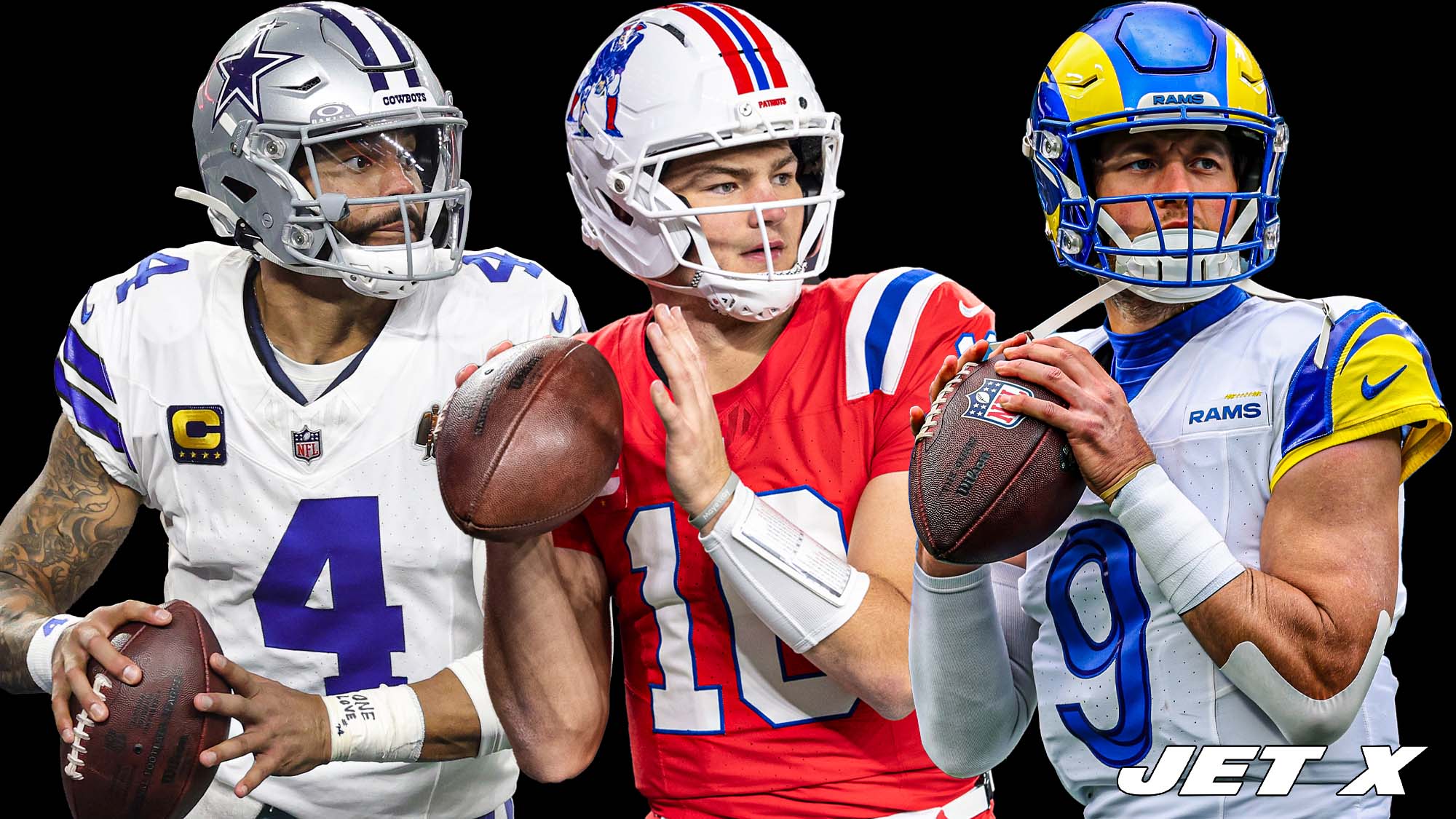
Yet, according to FanDuel Sportsbook, Prescott currently has 16-to-1 odds to win MVP. He ranks third, but he’s miles behind Drake Maye (-125) and Matthew Stafford (+125).
Why? Well, check out the standings.
- Patriots: 11-2
- Rams: 9-3
- Cowboys: 6-5-1
That pretty much explains the odds to a T.
And why is Prescott’s team 6-5-1 despite their outstanding success on offense? Simple: They rank 31st in points per game allowed.
The Cowboys’ pitiful defense has wasted some of Prescott’s best performances this year. Prescott had two performances of three-plus touchdowns and zero turnovers in which the Cowboys did not pull off the victory.
Why should Prescott’s MVP candidacy suffer because of factors beyond his control?
It makes no sense whatsoever, and it highlights just how goofy of an award MVP has become. Voters don’t bother to consider context; they just look at the top three or four teams in the standings and vote for the most statistically impressive quarterback from that group.
It’s lazy, and voters should be ashamed.
Unless Prescott pulls off the upset, it will be the second straight year in which the true MVP was robbed. Joe Burrow absolutely should have been the league MVP in 2024.
Burrow led the NFL in completions (460), passing yards (4,918), and passing touchdowns (43). While handling an absurd volume of 652 pass attempts (most in the league), he maintained elite efficiency, ranking third in QBR (72.1), third in passing success rate (53.6%), and fourth in adjusted EPA per play.
Like Prescott, Burrow did it while overcoming pitiful support. Burrow played with the league’s 29th-ranked pass-blocking unit according to PFF, along with a run game that ranked 30th in yards per game. The Bengals averaged 180.4 more passing yards per game than rushing yards, an even higher margin than the 2025 Cowboys so far.
With no protection or run game, Burrow led the Bengals to sixth-best in points per game. Yet, because of a poor defense that ranked 25th in points allowed, the Bengals only won nine games, missing the playoffs. Thus, Burrow was excluded from legitimate MVP candidacy.
Josh Allen was a deserving winner, and Lamar Jackson had an almost equally strong case, but when it comes down to value, Burrow was arguably more valuable to his team than each of those stars. The Bills and Ravens both ranked top-10 in PFF’s pass-blocking rankings, and both had above-average defenses. Their run games were also highly ranked (although in fairness to Allen and Jackson, they played large roles in those rankings). Most likely, the Bengals would have suffered a greater hit by losing Burrow than the Bills or Ravens would if they lost Allen or Jackson.
Perhaps my outlook on the MVP award is unorthodox, but I will always stand by it. As long as the award is named the “Most Valuable Player,” I would like to see it go to the player who adds the most value to his team, plain and simple.
