
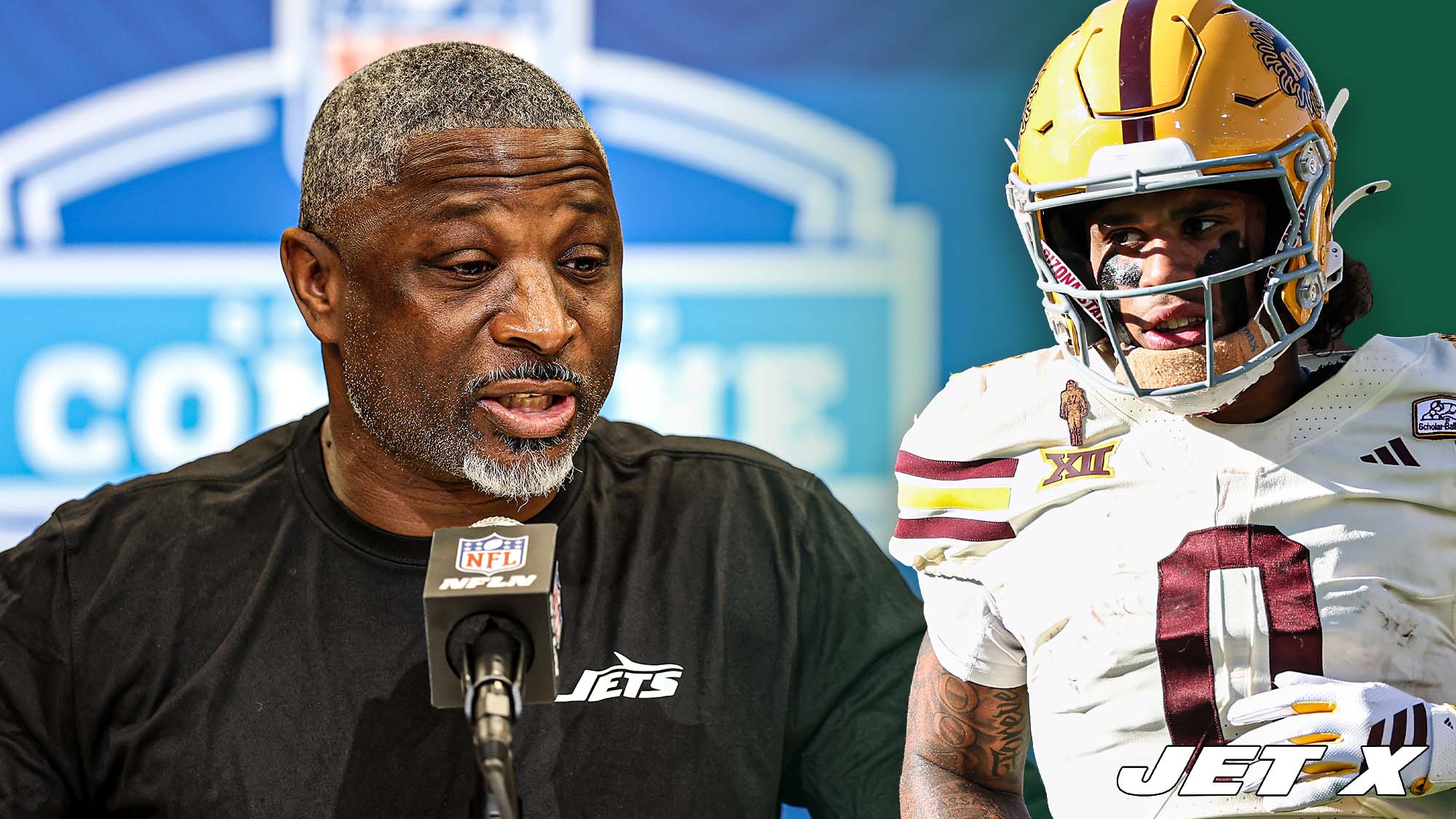
This Thursday, drills will begin at the 2026 NFL Scouting Combine in Indianapolis.
Here are five things the New York Jets will be monitoring closely.
1. Rueben Bain’s arm length
Each year, there are at least a couple of major storylines surrounding the measurements of top prospects.
From watching prospects’ film, concerns can arise about their measurements in certain areas, whether it’s arm length, hand size, or height. However, we do not receive official confirmation of these measurements until prospects appear at the combine.
This year, Miami edge rusher Rueben Bain Jr. will be the subject of one of the most anticipated measurements. Since he is among the top options for the New York Jets with the second overall pick, you can be sure that New York will be paying close attention to his measurables.
Bain’s apparently short arms have frequently been flagged by analysts as a top concern in his game. It didn’t stop him from shredding NCAA defenses as a true junior in 2025, though, as Bain racked up 9.5 sacks, 15.5 tackles for loss, and 83 total pressures in 16 games for the national championship-bound Hurricanes.
Still, arm length is a critical trait for edge rushers at the NFL level. While it is far from impossible for short-armed edge rushers to be dominant in the pros, it is certainly an advantage to have longer arms.
According to Mockdraftable, the 50th-percentile arm length for an edge rusher is about 33½ inches. Analysts speculate that Bain could measure around 31 inches. The combine will give us an official number.
Such a measurement would not automatically preclude Bain from becoming an NFL star, but it would be absurdly short for an NFL defensive end. Even Aidan Hutchinson, the second overall pick of the 2022 draft, had 32⅛-inch arms (8th percentile among EDGE)—and his arm length was a hot topic in that year’s draft process. It’s arguably why the Jacksonville Jaguars took Travon Walker over him, as Walker had mammoth 35½-inch arms.
Yet, Hutchinson’s arm length was still more than an inch above Bain’s projection.
Ideally, from Bain’s perspective, he beats expectations and measures around 32 inches. This would put him right in Hutchinson’s ballpark, allowing teams to feel a lot more comfortable about his odds of succeeding despite short arms.
If he comes in around 31 inches, though, Bain would have to be a significant outlier to become an NFL star. That doesn’t mean he is incapable of doing it, but teams would be much more apprehensive about how likely it is, especially the Jets, who need to use the second pick on a prospect with a high chance of panning out.
2. Can anyone separate themselves from the pack among the top prospects?
The Jets are expected to select the first non-quarterback of the 2026 draft. This leaves them with a plethora of options, as there is no clear-cut “best non-quarterback available.”
Edge rushers Arvell Reese, Rueben Bain Jr., and David Bailey all have cases to be the best at their position. Wide receiver Carnell Tate is special enough to justify the second overall pick, and some say the same about safety Caleb Downs, despite the diminished value of his position.
With no clear-cut answer as of today, the combine could provide some clarity.
Will any of these prospects use the combine to separate themselves from the pack as the most outstanding talent of the group?
The combine can seem meaningless to some. However, the Jets themselves have witnessed multiple recent examples of a prospect’s standout combine performance foreshadowing a successful New York draft pick.
Back in 2022, Sauce Gardner’s outstanding combine performance ultimately raised his stock enough for the Jets to feel comfortable selecting him fourth overall, ahead of multiple edge rushers and offensive tackles who were considered strong candidates for the spot.
Gardner’s historic combination of length and speed already had him looking like an unprecedented prospect coming out of the 2022 combine. That eventually translated to his All-Pro performance on the field.
Just last year, Missouri tackle Armand Membou boosted his stock with an incredible combine (9.89 Relative Athletic Score), prompting the Jets to take him seventh overall. One year in, that pick looks like a home run.
A prospect’s film and production should ultimately comprise the crux of his resume. No, a couple of sprints in tank-tops shouldn’t mean too much.
But we have seen plenty of instances where jaw-dropping combine performances did, in fact, hint that a prospect is uniquely talented at football relative to his peers. For that reason, the Jets can use this week’s drills to help them decide which blue-chip prospect is the surest bet with the second overall pick.
3. Jordyn Tyson’s health and overall physical profile
Arizona State wide receiver Jordyn Tyson is one of the most polarizing first-round prospects in this draft. There are mock drafts that have him going as high as fifth to the Giants, and some down in the 20s.
The vast spectrum of projections is understandable. Tyson’s college career was marked by extremely high peaks, low valleys, and a ton of injuries.
Coming out of the 2024 season, Tyson was on track to establish himself as a clear-cut top-10 pick in the 2025 draft if he could build on his performance. However, further injuries, adding to an already-established injury history, caused Tyson to have a poor year of production (relative to first-round wide receiver prospects).
This will be a crucial week for Tyson. It’s his opportunity to not only show scouts that he’s healthy after battling a hamstring injury late in 2025, but also to reestablish himself as a premier wide receiver prospect after a middling campaign.
If Tyson can light up the combine, teams will buy back into his ceiling, overlooking the injuries and the down year in 2025. If he struggles, though, teams may be inclined to lean toward his red flags rather than his ceiling.
Tyson is a popular mock-draft selection for the Jets at No. 16. It’s a reasonable place to slot him; the Jets have a dire need at wide receiver, and the mid-first-round placement is a middle ground between Tyson’s ceiling and floor.
With Tyson being squarely on the Jets’ radar, New York will be among the teams watching him the closest this week.
If Tyson excels, he may not even reach the Jets’ No. 16 pick. Could a stellar performance entice the Jets to trade up for him, though? New York has the ammo to pull off a move if they are smitten by a prospect.
If Tyson struggles, his odds of reaching the Jets’ 16th pick will increase dramatically, at which point New York will have to weigh the risk versus the reward.
4. Who is the workout warrior to avoid?
The combine can drastically improve or weaken a prospect’s stock. Sometimes, the movement is justified, and other times, it’s an overreaction to how well a guy executes specific actions he will rarely be asked to perform in a real game.
We often see prospects overdrafted as a result of their combine performance. These players are dubbed “workout warriors”.
In 2017, Washington wide receiver John Ross was considered an early second-round prospect before the combine. According to NFL Mock Draft Database’s consensus big board, Ross was ranked as the No. 34 overall prospect as late as Feb. 18.
Then, Ross broke the 40-yard dash record with a 4.22-second run. After that, his stock ballooned, and the Cincinnati Bengals eventually took him ninth overall.
Ross failed to reach 1,000 total receiving yards in his NFL career.
If you plan to draft a prospect 25 spots earlier than he was expected to be drafted before he ran 40 yards untouched in a straight line, something players almost never do in a real game, it might be worth reevaluating your process. It’s one thing to use the combine to distinguish the highest-ceiling prospect among a select group of prospects who are rated similarly (treating it as a tiebreaker of sorts), but it’s an entirely different thing to upgrade a player’s stock by an entire round just because of his 40-yard dash.
Another notable workout warrior in recent memory was Georgia edge rusher Travon Walker. He posted a near-perfect 9.99 Relative Athletic Score in 2022, prompting the Jacksonville Jaguars to select him first overall above Aidan Hutchinson, despite a massive difference in their collegiate production. As we broke down extensively at Jet X, this is an extremely faulty process, since college production tends to be highly correlated with NFL success among first-round prospects.
Not to mention, Hutchinson was no athletic slouch in his own right, posting a 9.88 RAS. Yet, the Jaguars leaned toward the lengthier and marginally more athletic prospect despite his substantially worse production. Four years later, Walker is just a decent starter, while Hutchinson is a superstar.
As much as the Jets can use this week to identify standouts, they should also use it to identify prospects whose stock gets too far out of hand. If there are any players who are suddenly projected to be drafted significantly higher because of the combine, the Jets should make sure they are not the team that falls for the trap.
5. Who is the faller that will be a steal?
On the other side of the coin, the combine provides an opportunity to identify steals.
The same way that players can rise too dramatically because of the combine, they can also fall too dramatically. Oftentimes, teams find immense value by scooping up these post-combine fallers.
Terrell Suggs set the NCAA single-season sack record with 24 in 2002, pulling it off in just his third year at Arizona State. The 20-year-old proceeded to stink up the combine, posting a 4.76 RAS, while his 32-inch arms didn’t help matters.
Suggs fell to the 10th overall pick despite his otherworldly college dominance at a young age. The Baltimore Ravens instantly benefited from snatching a talented football player who dropped because of the Underwear Olympics, as Suggs recorded 12 sacks in his rookie year and won Defensive Rookie of the Year. He played 16 seasons for the Ravens, racking up 132.5 sacks.
Just last year, the Jets made a pick of this ilk. Of course, it remains to be seen whether Suggs-esque success awaits, but the early returns were promising.
After a dominant junior season that saw him allow zero touchdowns and a 50.2 passer rating on 357 coverage snaps, Florida State cornerback Azareye’h Thomas was widely viewed as an early second-round or late first-round prospect. The 20-year-old ranked No. 40 overall on the consensus big board as of Feb. 15.
Then, Thomas put up a concerning combine performance, running a 4.58 in the 40-yard dash, which is poor for a cornerback.
Thomas’ overall ranking plummeted to No. 52 by draft day, and he ended up getting drafted even later, as the Jets picked him 73rd overall in the third round.
There is a lot of football ahead of Thomas, but the Jets have to be excited by what they’ve seen so far. As a 21-year-old rookie, he allowed just 48% of passes in his direction to be completed, per Pro Football Focus.
Before his season ended due to injury, Thomas closed the year with an active six-game streak in which he recorded at least one pass defended, which is currently tied for the sixth-longest streak in Jets history (since the stat was first recorded in 1999) behind Darrelle Revis (8), Aaron Glenn (8), D.J. Reed (7), Sauce Gardner (7), and Revis again (7).
That company isn’t too shabby—and if the Jets bought into the idea that Thomas should be written off because of his 40 time, he would be having this success elsewhere.
While the Jets should absolutely take note of combine standouts this week, they should be equally eager to identify prospects who could become steals because of post-combine falls. In some cases, a prospect who has a bad combine could be a good thing for a smart team. It opens the opportunity to land a good football player at a later pick than expected.
The key is to identify players whose on-field skills quell any concerns that arise from their combine drills, yet will drop down the draft board because of said drills, simply due to long-standing beliefs that prospects should automatically fall if they do not reach certain benchmarks at the combine.
Stockpiling Thomas-esque picks is an excellent path to accumulating draft value over a span of years. Let’s see if picks of this variety become a trend for Jets general manager Darren Mougey.
