
No.
We could end the discussion with that single word, but this is an article, not a tweet, so you’re here for the details.
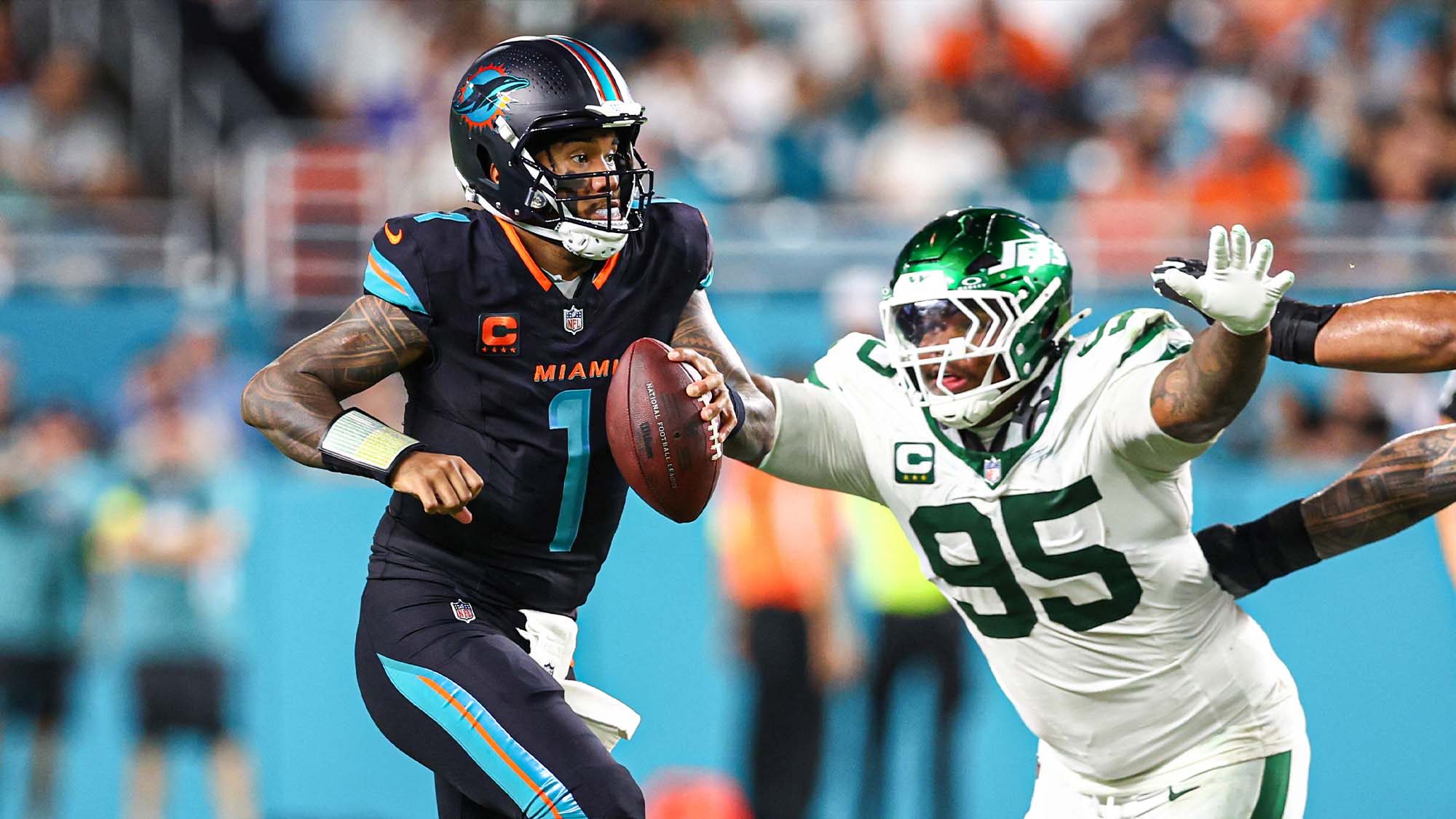
The Miami Dolphins are expected to release quarterback Tua Tagovailoa, making him a free agent. NFL Network has already reported that the New York Jets are “doing work” on the one-time Pro Bowler, which even includes making “some calls to get the fullest sense of who Tua is as a person.”
Thus, the Tua-to-New York buzz has officially begun taking over the internet. Jets fans are bracing for the news they don’t want to hear. NFL content creators are filling their drafts with lazy jokes that will generate thousands of likes upon the announcement of the signing.
Let’s be clear: The Jets should not be criticized for doing due diligence on a player. That is standard practice for an NFL organization. They should be expected to analyze every player in the league.
However, if the Jets take the next step and actually pursue Tagovailoa, they should absolutely be criticized, whether he signs with them or not.
For reasons that are anything but complex, Tagovailoa makes no sense for the Jets, unless their goal is to tank—which may be the goal for some fans, but is probably not for the organization (at least, it shouldn’t be). Therefore, a Tagovailoa pursuit would be an alarming sign of incompetence.
There isn’t a realistic universe where this works out
In a vacuum, it is understandable why a quarterback-needy team like the Jets might find Tagovailoa appealing.
A former top-five pick, Tagovailoa has a high-level pedigree dating back to college. While his NFL career has been rocky, he has displayed an elite production ceiling at the pro level, winning the 2022 passer rating title and the 2023 passing yards title. This is a guy who has proven he can produce top-tier numbers at the game’s most important position, and he is still only 28.
It’s extremely rare to see a quarterback with this type of talent and production hit the open market at any age, let alone before turning 30. For those reasons, it makes sense why Tagovailoa should at least demand examination from New York and other quarterback-needy teams.
However, once you take a single step further, the idea of Tagovailoa being remotely appealing falls apart. When pragmatically analyzing his future outlook, it is difficult to envision a scenario in which Tagovailoa ever delivers another season of competent quarterback play.
Having missed at least three games in five of his six professional seasons, Tagovailoa is so injury-prone that he has an entire Wikipedia article dedicated solely to his health. He has suffered four documented concussions in his NFL career, and we can only speculate as to how undersold that number may be. On top of that, he has missed games due to hip, rib, thumb, and middle finger injuries.
Tagovailoa may be one concussion away from the end of his NFL career. That alone is enough to write him off as a player that any team should want as their starting quarterback, but what completely buries him is the harsh reality that, even if he manages to stay on the field, he will probably never be the peak version of himself again.
Due to his injury history—specifically, the concussions—Tagovailoa essentially played football in bubble wrap this past season. He managed to start 14 of the Dolphins’ 17 games, but he may as well have not been out there at all, because Miami had to coddle him so much that their passing offense became a total non-threat.
Across the board, Tagovailoa’s 2025 tendencies paint the picture of a predictable quarterback who was incredibly easy to defend. Among 36 qualified quarterbacks, he had the league’s quickest time-to-throw (2.55 seconds), threw screens at the highest rate (17.0% of pass attempts), averaged the fifth-lowest ADOT (7.2 yards), and scrambled the seventh-fewest times (12).
Essentially, the Dolphins restricted Tagovailoa to spitting out screens and quick-hitters in an effort to minimize the chances of him taking the hit that ends his football career. As a result of his overly conservative play style, he was one of the least effective quarterbacks in the NFL.
Tagovailoa’s 37.5 QBR was not only a career low (more than seven points behind his rookie year), but it placed fourth-worst among quarterbacks with at least 240 pass attempts, beating only J.J. McCarthy, Geno Smith, and Cam Ward. The former passing champion also ranked 29th in passing yards per game (190.0), right between Joe Flacco (who didn’t even start three of his games) and Bryce Young.
The Dolphins’ failed Tua experiment in 2025 leaves the Alabama product in a no-win situation moving forward. There are two likely scenarios.
One, his next team continues running an exceedingly safe offense to preserve his health, yielding terrible results on the field.
Two, teams allow him to actually play quarterback, which might lead to better results, but puts him at grave risk of suffering a season or career-ending injury.
Where is the realistic scenario that features Tagovailoa returning to the early-career peaks that make him even worth talking about? Or even a scenario that features him providing league-average quarterback play, for that matter?
Football is weird, so anything can happen. Maybe Tagovailoa starts all 68 games over the next four seasons and establishes himself as the league’s best quarterback. Sam Darnold just won a Super Bowl, for crying out loud, so we can’t rule it out.
Realistically, though, Tagovailoa does not offer any appealing routes to success as a starting quarterback. He struggles mightily to stay on the field, and even when he does, it’s hard to envision him playing as well as he once did, because his concussion history demands that he plays a constrained style of football.
If the Jets want to sign Tagovailoa for a minimal salary to be their backup, so be it, but any plan that involves him being in the mix for the starting quarterback job sends the message that winning games in 2026 is not the priority.
Starting Tagovailoa is the type of faux quarterback move that looks just good enough on paper to successfully get the public to believe they are legitimately trying to win games in the short term, whilst hiding their true intention: using it to facilitate a tank pursuit.
A world where Tagovailoa starts for the Jets in 2026 and does something other than playing bottom-of-the-barrel football or spending most of the season on the sidelines is a 1-in-100 reality. If the Jets go this route, fans will not buy their phony claims that the team really believes the 1-in-100 reality will come to fruition. The move will have been made in search of an entirely different “1,” which sits right atop the 2027 NFL draft board.
Either that, or the Jets would simply be downright incompetent to truly believe Tagovailoa can be their answer in any capacity. The tanking scenario is arguably preferable, even if less ethical.
Tagovailoa is a shiny object on the quarterback market because of his age, draft pedigree, and statistical peaks. Given the Jets’ long-standing need for a quarterback, it’s understandable why they are kicking his tires.
However, they cannot let their desperation cloud their judgment. If the Jets want to push the organization forward by winning games in 2026, breaking the losing stigma that shrouds their building, they are better off going in almost any other direction.
