
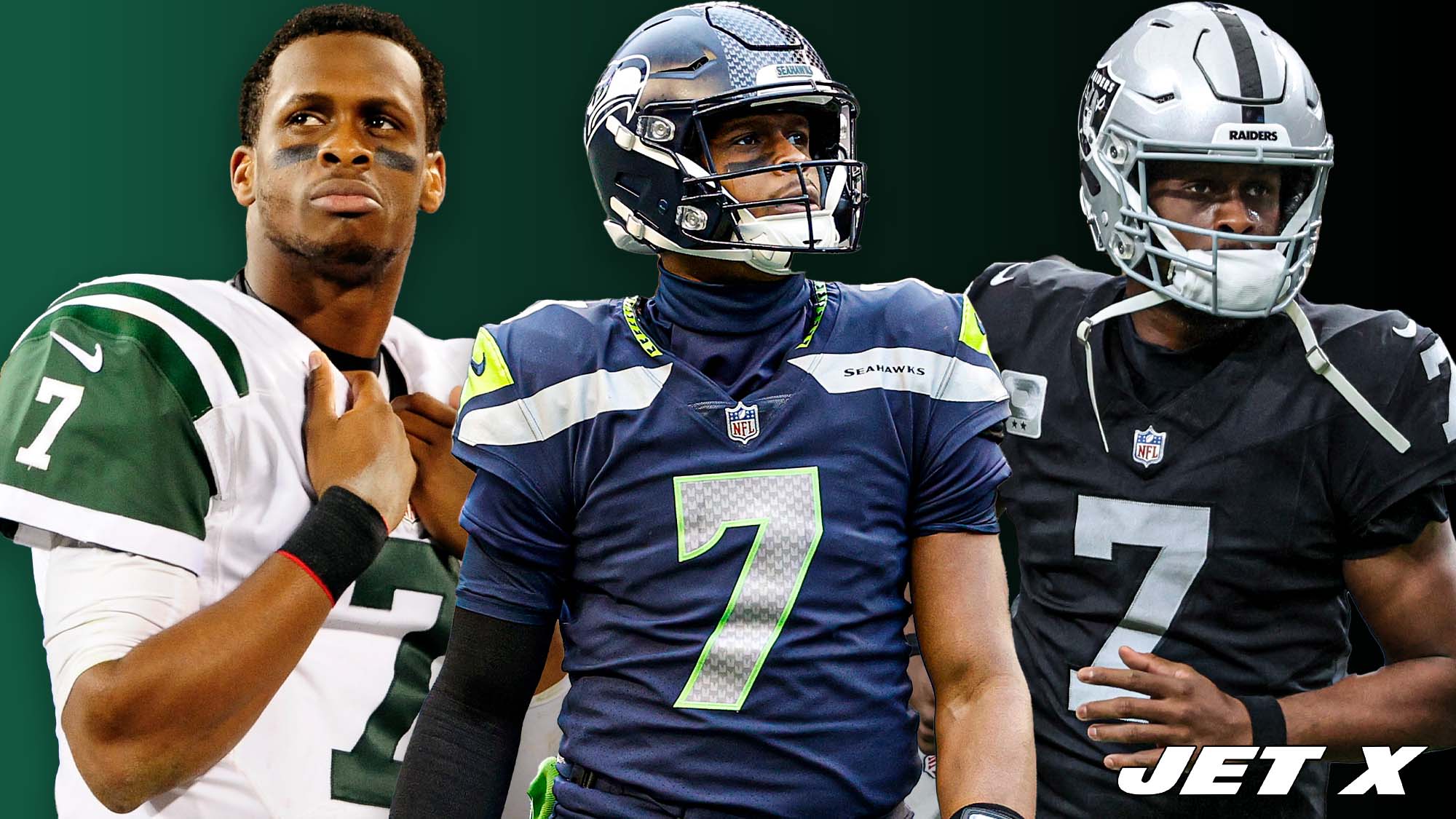
Geno Smith is on his way back to the New York Jets after 10 years away from Florham Park.
While the Jets may still add at least one competitor for Smith, be it through free agency, trade, or the draft, the 35-year-old is currently the Jets’ penciled-in QB1. There is a good chance he will be New York’s opening-week starter in 2026… the same role he played 13 years ago.
Before having any sort of conversation about Smith’s game, it must be understood that the Jets’ acquisition of Smith has a lot more to do with the available quarterback options and the franchise’s rebuild stage than it does with Smith’s on-field ability. Acquired for a late-round pick swap and a cap hit near the league minimum, New York clearly isn’t expecting much of Smith.
The Jets are simply a team in transition that did not have any realistic “franchise quarterback” options available to them this offseason. So, they elected to save as much money as possible at the position by settling for a cheap veteran stopgap who can bridge them to 2027 without hampering the future.
That is the reality of the situation, even if the Jets themselves will not speak those words in public. It means Smith’s on-field outlook ultimately isn’t worth thinking about too deeply, at least in the grand scheme of things.
However, there are a dozen quarterbacks the Jets could have targeted for the same purpose. They honed in on Smith.
While the Jets’ low expectations for Smith are reflected in their valuation of him, they clearly still believe he was their best available option to help them win games in 2026. Aaron Glenn is coaching for his job, and this franchise is desperate for some victories after 10 straight losing seasons. The organization must have some degree of confidence that Smith is capable of leading a competitive season.
They aren’t totally off-base to believe that. Just a year ago, Smith was coming off three consecutive seasons of over-.500 football for the Seattle Seahawks, earning Pro Bowl nods in two of those campaigns.
That’s the perspective you will see through Gotham Green-shaded goggles. If you take them off, though, what you see is a version of Geno Smith that looks eerily reminiscent of the one who wore a Jets uniform over a decade ago.
In 2025, Smith led the NFL with 17 interceptions for the lowly Las Vegas Raiders, helping them secure the first overall pick. Las Vegas went 2-13 across Smith’s 15 starts, as he finished with 19 touchdowns, 17 picks, and a ghastly 34.1 QBR, fifth-worst among 42 qualified quarterbacks. Each of the four quarterbacks who ranked below him was a rookie.
Given the price New York paid to acquire him, Smith’s ceiling is relatively high. In three of his past four seasons, he was an average-or-better starting quarterback. That would not only be a strong return on investment, but it would make him easily the Jets’ best quarterback since at least the 2015 version of Ryan Fitzpatrick, possibly much longer depending on how you feel about Fitz’s 2015 campaign.
However, the extremely low floor displayed by Smith in his most recent season is what brought his stock down to the point where the Jets could land him for the measly price they did.
So, which version of Smith will the Jets get? Could Geno and the Jets shock the world as he returns to his Seattle peaks? Or will the Jets get exactly what they paid for?
Let’s examine Smith’s outlook as a player heading into the 2026 season.
Why Smith could return to his Seattle form
From 2022-24, Smith was comfortably situated as an average to above-average starting quarterback. Here are some of his numbers over that span, and where they ranked among 42 qualified quarterbacks (min. 500 attempts):
- 7.4 yards per pass attempt (12th)
- 6.28 adjusted net yards per pass attempt (19th)
- 95.5 passer rating (14th)
- 0.096 adjusted EPA per play (20th)
- 4.3% touchdown pass rate (22nd)
- 2.1% interception rate (22nd)
Smith’s third season as Seattle’s starter wasn’t quite as strong as his first two; he saw his QBR drop by about 10 points to 50.4, ranking 21st of 32 qualifiers. In his first two seasons, he posted QBRs of 62.8 (7th) and 60.3 (14th).
But even in that down year, he led the Seahawks to a 10-7 record and completed 70.4% of his passes for 7.5 yards per attempt. The QBR drop could be pinned on a spike to 15 interceptions (compared to 11 and 9 in his first two seasons), but his overall passing efficiency was quite similar across the board.
So, even if the Jets were to get the worst version of Smith that we saw in Seattle, he would still be a sizable upgrade over New York’s 2016-25 quarterbacking.
The question is, why should the Jets (and their fans) believe that it is possible for Smith to return to his Seattle form in 2026?
There is only one realistic answer to that question: Pray that Smith’s 2025 fall-off was mostly the Raiders’ fault.
As bad as Smith was in 2025, it has to be noted that he was playing within an utterly abysmal situation in Las Vegas. From the coaching staff to the roster, the Raiders were a mess.
It starts within the coaching staff. Pete Carroll was a laughable head coaching hire from the beginning. Perhaps even more laughable was the hire of Chip Kelly as offensive coordinator, a guy who had not coached in the NFL since 2016, when he won two games as the 49ers’ head coach. Kelly did not make it past 11 games with the Raiders.
As little help as Smith had on the sidelines, he had even less on the football field.
Smith played behind a Raiders offensive line that generated the fifth-worst pass-blocking grade in the NFL (56.9), according to PFF. That same offensive line also struggled mightily to open holes in the run game, leading to league-worst finishes in rushing yards per game (77.5) and yards per rush attempt (3.6).
To recap, Smith had an ancient head coach, a completely out-of-touch OC, bottom-five pass protection, and the league’s worst run game.
Any quarterback would struggle in those circumstances.
The Jets are hoping that their environment is enough of an upgrade over Las Vegas’ to help Smith return to his peak form.
There are a few areas where the Jets will undoubtedly provide an upgrade. Their offensive line is much better, which will provide sturdier pass protection and a stronger run game.
New York should also offer better weapons. Smith had an all-world tight end in Brock Bowers, but that’s about all there was to write home about, save for seven games of Jakobi Meyers. The Jets have Garrett Wilson, Breece Hall, Mason Taylor, and likely an incoming top-45 draft pick at wide receiver.
Perhaps there is a world where nothing has changed about Geno Smith’s game since 2024, and his rough year in 2025 was merely a byproduct of his awful surroundings. If that is the world we live in, Smith could get back to being a quality starting quarterback in 2026 if the Jets’ supporting cast is as good as they hope.
There is also a world in which Smith simply hit a wall at 35 years old and will never again be the player he was in Seattle.
Why Smith might not improve on his 2025 season
While it is fair to point out that Smith battled numerous obstacles in Las Vegas, it cannot be brushed aside that he played some flat-out brutal football at times, regardless of his supporting cast.
There were many instances when Smith’s field-reading and decision-making would have you squinting to make sure it wasn’t 2013. Many of his interceptions were the same type of gifts that he wrapped for AFC East defenders in his younger days with the Jets.
Perhaps, though, you could pin some of those on the lack of chemistry within a Raiders offense that had poor coaching and a weak wide receiver unit. After all, Smith was not nearly as interception-prone with the Seahawks—he had a 2.1% INT rate in Seattle compared to 3.8% in Las Vegas—and it’s not as if his football IQ is among the things that we would expect to regress at age 35.
That would be a fair argument. Maybe his interceptions will regress to the mean in 2026.
The most daunting aspect of Smith’s 2025 season was not the interceptions, though. It was how he looked athletically.
There are bright red flags suggesting that Father Time caught up to Smith in 2025. While Smith has never been a world-class athlete, mobility has always been a key part of his game. But in Las Vegas, Smith looked like a statue.
Smith allowed himself to be sacked on a whopping 25.9% of his pressured dropbacks, the highest rate among 38 qualified quarterbacks. He also set career-lows (across seven seasons where he started multiple games) in rushing yards per game (7.3), yards per rush attempt (2.7), and rushing touchdowns (0).
Yes, Smith was pressured quite often behind a bad Raiders offensive line, but that doesn’t have much bearing on his pressure-to-sack rate. The point of this metric is to understand how effective the quarterback is at negating pressure once it arrives, whether by getting the ball out quickly or by evading defenders.
Smith has been gradually trending down in this category. Here are his pressure-to-sack rates over the last three seasons:
- 2023: 13.9% (5th of 39)
- 2024: 19.9% (20th of 40)
- 2025: 25.9% (38th of 38)
Smith’s rushing production has also been trending down for years. Back in 2022, he ran for 21.5 yards per game on 5.4 yards per attempt. After dropping to 10.3 and 4.2 in 2023, he crept back up to 16.0 and 5.1 in 2024, only to nosedive to 7.3 and 2.7 in 2025, mere fractions of where he was just three years earlier.
These numbers suggest that Smith, who will turn 36 this year, may have simply hit the athletic wall that all quarterbacks eventually hit.
This could be the root of his ballooned interception rate, thereby reducing confidence that it will tick back down in 2026. If Smith’s athleticism has declined as much as the numbers suggest, it is likely that his diminished mobility prompted him to attempt dangerous throws in situations where he would have been able to extend the play in the past.
If you can’t move as a quarterback in today’s NFL, there isn’t much that any scheme or supporting cast can do to prop you up.
Speaking of the scheme, we don’t even know if Smith will get an upgrade in that department.
Jets offensive coordinator Frank Reich hasn’t been in the NFL since 2023 and was fired mid-season in each of his last two campaigns. Sure, he has a better NFL track record than the likes of Chip Kelly, but Reich is far from a surefire bet to run a competent system in New York. Meanwhile, at head coach, Aaron Glenn has hardly proven that he should be considered better than even an aging Pete Carroll.
Given Smith’s obvious signs of physical decline and a similarly questionable coaching staff to the one he had in Las Vegas, there is a realistic chance that Smith does not play significantly better than he did in 2025.
But if that were to transpire, it’s not as if the Jets would be surprised. They acquired him for a 20-spot drop on the third day of the draft and a nearly league-minimum salary. The franchise’s expectations for him are low, as they should be.
