
Has the New York Jets’ roster improved over the past year?
If we’re being honest, the Jets probably don’t care too deeply about that particular question.
In November 2025, the Jets’ front office made it clear that their sights are set on the 2027 season. Everything the franchise has done since its trade-deadline firesale has been intended to lay the foundation for long-term success in 2027 and beyond. The goal is not to pursue a championship in 2026.
Still, after a productive free agency period, it’s fascinating to think about whether the Jets may have actually improved over the past year. After all, the team went 3-14 in 2025, and even when they shipped off their two star players, they were 1-7.
Let’s compare the Jets’ roster on March 18, 2026, to their roster at this point one year ago (archived from April 1, 2025). At each position, we’ll rate the comparison as a wash, a slight advantage, a significant advantage, or a major advantage.
Quarterback
- 2026: Geno Smith, Brady Cook, Bailey Zappe
- 2025: Justin Fields, Tyrod Taylor, Jordan Travis, Adrian Martinez
It’s easy to forget at this point, but Justin Fields was coming off a solid season in Pittsburgh when he joined the Jets. Fields led Pittsburgh to a 4-2 record across six starts, while ranking 17th out of 45 qualified quarterbacks in adjusted EPA (Expected Points Added) per play.
That’s a heck of a lot better than the season Geno Smith is coming off of, ranking 40th out of 45 qualifiers in adjusted EPA per play while leading the Raiders to a 2-13 record. Toss in the fact that Fields was 26 while Smith is 35, and Fields arguably offered a better ceiling and floor at this point one year ago.
The argument in favor of Smith is that, unlike Fields, Smith actually has a track record of proven above-average passing production in the NFL. From 2022-24, Smith had the fourth-most passing yards of any quarterback, while ranking 12th among 42 qualifiers in yards per attempt, 14th in passer rating, and 20th in adjusted EPA per play.
Since Smith remained in his NFL prime as recently as two years ago, there is a realistic chance he could get back to being an average-to-above average starting QB in 2026—a much higher chance than a fifth-year breakout from Fields, who showed glaring deficiencies as a passer throughout his first four NFL seasons, even in his successful mini-stint with Pittsburgh.
All things considered, I believe Smith and Fields wash each other out. That means, for now, the advantage goes to 2025. The Jets had Tyrod Taylor in place as a quality veteran backup, while the Jets have yet to fill that role. They could still fill it in the near future, making this room an overall wash, but until then, I’ll give 2025 a slight edge.
- Advantage: 2025 (Slight)
Running back
- 2026: Breece Hall, Braelon Allen, Isaiah Davis, Kene Nwangwu
- 2025: Breece Hall, Braelon Allen, Isaiah Davis, Kene Nwangwu, Zach Evans
Nothing to discuss here, as the room is identical.
- Wash
Tight end
- 2026: Mason Taylor, Jeremy Ruckert, Jelani Woods, Andrew Beck (FB/TE)
- 2025: Jeremy Ruckert, Stone Smartt, Zack Kuntz, Neal Johnson, Andrew Beck (FB/TE)
The only major change over the past year was the second-round selection of Mason Taylor, who proved himself to be a solid building block in his rookie year. So, the advantage goes to 2026.
- Advantage: 2026 (Significant)
Offensive tackle
- 2026: Olu Fashanu, Armand Membou, Chukwuma Okorafor, Max Mitchell
- 2025: Olu Fashanu, Carter Warren, Chukwuma Okorafor, Max Mitchell, Zack Bailey, Obinna Eze
Similar to tight end, this unit was eventually upgraded with the addition of a high draft pick who had an excellent rookie year: right tackle Armand Membou.
Given that, the current unit has a significant advantage over the one with Carter Warren as a penciled-in starter. The depth remains equally concerning, though, holding the unit back from being viewed as a major upgrade.
- Advantage: 2026 (Significant)
Interior offensive line
- 2026: Dylan Parham (LG), Josh Myers (C), Joe Tippmann (RG), Xavier Newman, Liam Fornadel, Marquis Hayes, Gus Hartwig, Kohl Levao
- 2025: John Simpson (LG), Joe Tippmann (C), Alijah Vera-Tucker (RG), Josh Myers, Xavier Newman, Kohl Levao
Based on their 2025 production and career trajectories, Dylan Parham is an upgrade over John Simpson at left guard.
However, the Jets were in a better spot at the other two positions one year ago.
Joe Tippmann would be an upgrade at center over Josh Myers, and Alijah Vera-Tucker would be an upgrade at right guard over Tippmann. A healthy AVT also meant Myers would be a backup, where he would be a significant upgrade over the likes of Xavier Newman and Liam Fornadel.
The difference ultimately comes down to the fact that New York has yet to replace Vera-Tucker with another quality starter. The Jets could still do that in free agency or the draft, at which point this unit could be viewed as a wash compared to last year. For now, the starting trio has essentially swapped an elite starter for a low-end one.
In April 2025, when the Jets were expected to start a trio of John Simpson (coming off an excellent 2024 season), Joe Tippmann, and a healthy Alijah Vera-Tucker, this looked like one of the best interior units in the NFL. That isn’t quite the case at the moment, although the group still looks solid.
- Advantage: 2025 (Significant)
Wide receiver
- 2026: Garrett Wilson, Adonai Mitchell, Isaiah Williams, Arian Smith, Irvin Charles, Jamaal Pritchett, Quentin Skinner, Mac Dalena
- 2025: Garrett Wilson, Josh Reynolds, Allen Lazard, Malachi Corley, Tyler Johnson, Xavier Gipson, Irvin Charles, Brandon Smith, Easop Winston, Ontaria Wilson, Marcus Riley
Both groups are Garrett Wilson and a bunch of dudes.
Perhaps you can give the 2026 unit a slight edge for the potential of Adonai Mitchell, but the Jets also believed that Malachi Corley had potential at this point one year ago.
Wide receiver was by far the Jets’ top non-quarterback need one year ago, and it still is.
- Wash
Defensive tackle
- 2026: T’Vondre Sweat, Jowon Briggs, David Onyemata, Harrison Phillips, Payton Page, Mazi Smith, Jack Heflin
- 2025: Quinnen Williams, Derrick Nnadi, Byron Cowart, Leonard Taylor III, Jay Tufele, Phidarian Mathis
One year ago, this unit was the Jets’ defensive equivalent of wide receiver. They had one star in Quinnen Williams and nothing else to write home about.
Depth-wise, this unit has improved considerably since then. Some of that improvement occurred before the 2025 regular season began, as the Jets traded for Jowon Briggs and Harrison Phillips in August. Recently, they supplemented those additions by trading for T’Vondre Sweat and signing David Onyemata.
It cannot be overlooked, though, just how dominant Williams is. There is a reason the Dallas Cowboys traded a first-round pick and a second-round pick to get him. He is a game-wrecker who demands considerable attention, making every other player on the unit more effective.
The Jets don’t have a player anywhere close to Williams’ level at the moment, which makes this position a wash despite the significantly improved depth.
Still, this unit is a good spot, and should be considered one of the team’s greatest strengths entering the 2026 season.
- Wash
Edge defender
- 2026: Joseph Ossai, Will McDonald, Kingsley Enagbare, Braiden McGregor, Tyler Baron, Eric Watts, Kingsley Jonathan, Ochaun Mathis, Paschal Ekeji
- 2025: Jermaine Johnson, Will McDonald, Micheal Clemons, Braiden McGregor, Eric Watts, Rashad Weaver
The peak version of Jermaine Johnson certainly surpasses that of Joseph Ossai.
However, Johnson entered the 2025 season coming off an Achilles injury, so it was uncertain how productive he’d be. Given that Ossai is essentially an average starter, it seems fair to say that he washes out a post-Achilles version of Johnson.
From there, the unit is mostly unchanged, besides one major upgrade: Instead of having Micheal Clemons, the Jets have Kingsley Enagbare.
Clemons is a total liability. He makes more negative plays than positive, which is borderline impossible for a defensive end, so the Jets instantly became a better team the moment he left. They would be better off if they put a tackling dummy in Clemons’ spot, because at least it wouldn’t commit any penalties.
But by filling the hole with Enagbare, who has proven himself to be an extremely consistent and reliable backup, the Jets finally have a normal-looking depth chart at this position.
For now, the Clemons-to-Enagbare upgrade is enough to give the 2026 unit a slight advantage, but that advantage will likely increase after the draft.
- Advantage: 2026 (Slight)
Linebacker
- 2026: Jamien Sherwood, Demario Davis, Kiko Mauigoa, Mykal Walker, Marcelino McCrary-Ball, Kobe King
- 2025: Jamien Sherwood, Quincy Williams, Marcelino McCrary-Ball, Zaire Barnes, Jamin Davis, Jackson Sirmon, Jimmy Ciarlo
This position was viewed as one of the Jets’ top strengths going into 2025. Jamien Sherwood and Quincy Williams were one of the league’s best duos in 2024.
Sherwood was coming off a breakout 2024 season that earned him a $45 million contract extension. While Quincy Williams had taken a step back from his All-Pro heights in 2023, he was still a strong starter in 2024.
Today, the main difference in the unit on paper is that Demario Davis has replaced Williams in the starting duo. However, more significant is the fact that Sherwood fell off the map in 2025, descending to a below-average starter.
Davis is still considered one of the best linebackers in the league. His performance in 2025 was better than that of either Sherwood or Williams in 2024, so he offers a slight upgrade. The issue is that Sherwood’s stock is much lower than it was one year ago.
For those reasons, we’ll consider this unit a wash for now. Davis significantly raises the floor, and the ceiling is still high with Sherwood in there. If he can bounce back, this unit could be even better than it was in 2024.
To be clear: As we sit here today, Davis’ arrival certainly inspires confidence that this unit will be an improvement over what the Jets actually got in 2025, as both Sherwood and Williams struggled mightily.
However, the purpose of this exercise is to compare the current Jets roster to its counterpart from one year ago, which means we have to consider how each position was viewed at that time, regardless of what ended up happening.
- Wash
Cornerback
- 2026: Brandon Stephens, Azareye’h Thomas, Jarvis Brownlee Jr. (SCB), Nahshon Wright, Qwan’tez Stiggers, Samuel Womack III
- 2025: Sauce Gardner, Brandon Stephens, Michael Carter II (SCB), Qwan’tez Stiggers, Jarrick Bernard-Converse, Kris Boyd, Tre Swilling
The Jets’ depth has improved here. They are poised for some fascinating competitions in the summer.
Ultimately, though, one of these units has Sauce Gardner as its CB1, and the other has Brandon Stephens. One of these players allowed eight touchdowns in 2025, and the other has allowed five touchdowns in four NFL seasons. Take a guess who is who.
Perhaps a breakout from Azareye’h Thomas and a solidified depth chart could make the Jets’ cornerback unit an upgrade over the 2025 edition, even the first-half group that included Gardner. But as we sit here today, it would be foolish to claim the group is better without Gardner than it would be with him.
Not to mention, Michael Carter II was still viewed as a high-end slot corner. He was coming off a down 2024 season that was riddled by injuries, and those concerns ultimately proved legitimate as he endured another shaky season, resulting in him being traded to Philadelphia.
But in the spring of 2025, Gardner and Carter II offered more value on their own than the Jets’ entire cornerback unit today.
- Advantage: 2025 (Significant)
Safety
- 2026: Minkah Fitzpatrick, Dane Belton, Malachi Moore, Andre Cisco, Dean Clark, Jarius Monroe, Keidron Smith, Chris Smith II
- 2025: Andre Cisco, Tony Adams, Isaiah Oliver, Jaylin Simpson, Jarius Monroe
This is by far the most improved position on the Jets’ roster. After all, the unit’s projected best player in 2025, Andre Cisco, is now projected for the fourth slot on the depth chart.
While this article compares 2026 position groups with their 2025 counterparts, Minkah Fitzpatrick can be viewed as an addition that makes up for Sauce Gardner’s absence.
The Jets lost a two-time All-Pro in the secondary and replaced him with a three-time All-Pro. Gardner is four years younger and plays the more premium position, which makes him a much more valuable overall asset, but in terms of helping a team win a football game today, Fitzpatrick is on par with Gardner. Fitzpatrick was still an elite safety in 2025.
- Advantage: 2026 (Major)
Special teams
2026
- Returners: Kene Nwangwu, Isaiah Williams
- Kicker: Cade York, Lenny Krieg
- Punter: Austin McNamara
- Long snapper: Thomas Hennessy
2025
- Returners: Kene Nwangwu, Xavier Gipson, Isaiah Davis
- Kicker: Greg Zuerlein, Anders Carlson
- Punter: Thomas Morstead, Austin McNamara
- Long snapper: Thomas Hennessy
Nobody could foresee the Jets’ special teams unit becoming an all-time-great juggernaut in 2025.
At this point one year ago, the Jets’ kicker competition still looked like a mess. Greg Zuerlein remained on the roster after a poor season, and his projected competitor was Anders Carlson, who has struggled in the NFL. It wasn’t until the summer that the competition shifted to Nick Folk and Harrison Mevis.
Jets fans are hoping for the same type of turnaround in 2026, as the current competition of Cade York and Lenny Krieg is uninspiring, to say the least.
At punter, the Jets are currently locked and loaded with Austin McNamara after he delivered a fantastic 2025 season. That’s an upgrade over last year, when McNamara was unproven, and veteran Thomas Morstead was coming off a down year.
The Jets were a mixed bag at returner. The signing of Kene Nwangwu was tantalizing, as Nwangwu offered a proven track record of success in Minnesota. However, Xavier Gipson was still a fumble-prone, one-return-wonder.
Today, the Jets still have Nwangwu after another impressive season, while Isaiah Williams has emerged as another top-tier weapon at the position.
Overall, the Jets have a significant advantage today thanks to their proven options at punter and returner. But the kicking competition is just as dubious.
- Advantage: 2026 (Significant)
Scorecard
- QB: ’25 (★)
- RB: Wash
- TE: ’26 (★★)
- OT: ’26 (★★)
- IOL: ’25 (★★)
- WR: Wash
- DT: ’25 (★)
- EDGE: ’26 (★)
- LB: Wash
- CB: ’25 (★★)
- S: ’26 (★★★)
- ST: ’26 (★★)
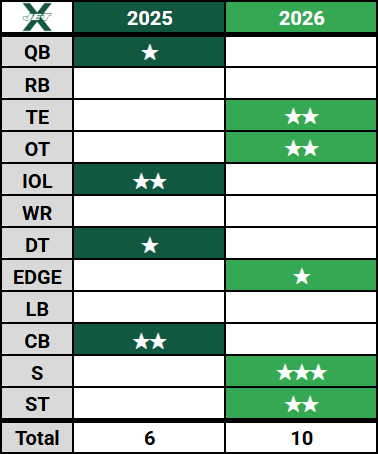
In total, the 2026 depth chart racked up a four-star advantage over the 2025 depth chart.
Of course, plenty of things will change between now and opening week. The draft will shake up many position groups.
That doesn’t mean the 2026 team’s advantage could only grow, however. If we do a post-draft edition of this comparison, some things will even out in the 2025 roster’s favor—remember, the March 2025 Jets did not have Armand Membou or Mason Taylor yet.
Some picks, though, will aid the 2026 unit—the EDGE and WR units, in particular, should look much more appealing once May comes around.
And with four top-45 picks to last year’s two, the hope is that, as much as the Jets’ roster has already improved compared to one year ago, it will take an even bigger post-draft leap than it did last year.
All of this, and we haven’t even gotten to 2027 yet, when the Jets will be loaded with an unfathomable hoard of assets.
Suffice to say, the Jets’ roster is trending in the right direction. What comes next is the qualifier that has deemed the Jets’ offseason championships meaningless for the last decade: having a coaching staff that can translate the talent into victories.
Is Aaron Glenn the guy to pull that off?
We’ll surely find out, because the way things are trending, there won’t be any excuses if Glenn cannot facilitate significant progress in the win column this year.
