
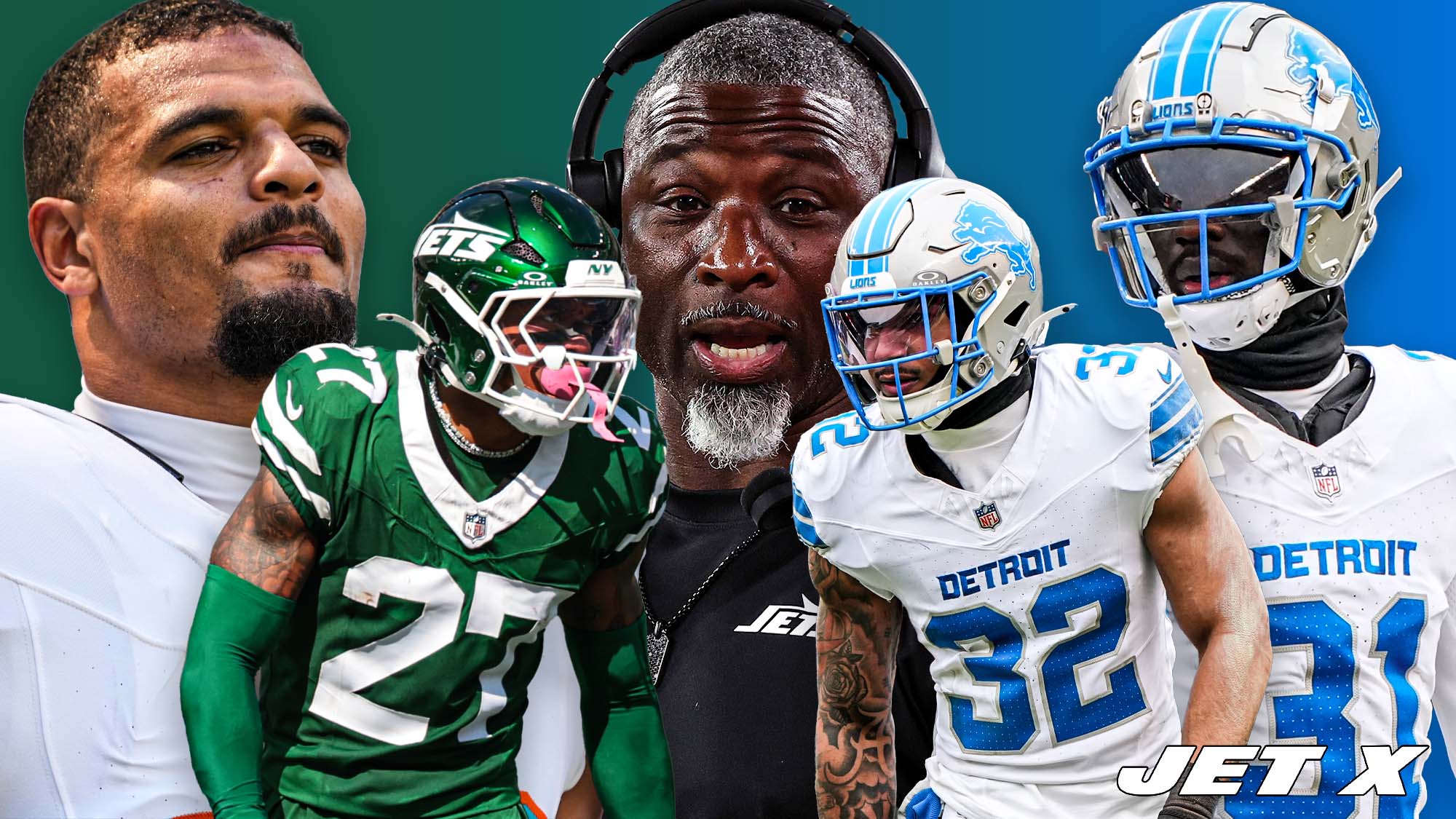
There might not be a position on the football field that handles more different roles than safety.
Whether it’s single-high coverage, two-deep coverage, man-to-man coverage, replacing a linebacker in the box, or blitzing off the edge, the safeties are a defense’s Swiss Army Knives, tasked with filling in the final holes of any given concept.
Because of their versatility, safeties must be carefully managed by their teams to deliver the best results. Any safety can range from outstanding to a liability on any given Sunday, depending on how effectively their team uses him.
Unlike defensive linemen, for example, you can’t just toss a safety out there and expect him to make plays simply by being better than the man across from him on each down. Since there are so many different roles a safety can be asked to play, it is up to the coaching staff to utilize a safety as best as possible, maximizing his strengths and hiding his weaknesses.
Aaron Glenn and the New York Jets are facing a fascinating challenge in this arena.
The New York Jets’ safety challenge
After fielding one of the league’s worst safety units in each of the past few seasons, the franchise has overhauled its safety unit in 2026. Three-time All-Pro Minkah Fitzpatrick has arrived to spearhead the group, while former Giants starter Dane Belton was brought in to compete with 2025 fourth-round rookie standout Malachi Moore.
Meanwhile, the Jets’ projected top safety entering the 2025 season, Andre Cisco, has been re-signed to a modest deal to provide depth and competition, signaling just how much the unit has been turned around in one year.
On paper, the Jets’ safety unit has not looked this good since Jamal Adams and Marcus Maye patrolled the back end in 2019.
However, on-paper talent arguably matters less at safety than at any other position. If safeties are not utilized properly, they can vastly underperform compared to their talent level, and vice versa.
Of course, this applies to any position, to some extent, but perhaps none more than safety. Two NFL players listed as “safeties” could be handling completely different jobs that do not overlap whatsoever, a distinction that does not quite exist at any other position.
For instance, even if two edge defenders or wide receivers play much different roles (3-4 OLB vs. 4-3 DE, or slot WR vs. X), their end goals are still ultimately the same. At safety, though, you could have one player who spends the entire game as a center-fielder (think Ed Reed), and another player who could easily be confused with a linebacker (think Jamal Adams). Those two players don’t even align within 20 yards of each other.
That’s why it is imperative for Glenn to identify the specific roles that get the most out of each safety on the Jets’ roster.
Fitzpatrick has played almost every role in the book during his NFL career. Cisco is known as a center-fielder, but also has some box experience. Belton and Moore are younger players who are still trying to find their niches in the NFL.
So, what’s the optimal plan for the Jets to utilize their safeties?
Before we can answer that question, we have to understand what Glenn’s scheme typically demands of its safeties.
What does Aaron Glenn want in his safeties?
This is Aaron Glenn’s defense now. Gone are the days of a blend between Glenn and Steve Wilks’ contrasting styles.
Since we know that Glenn will be calling the Jets’ defense, it would make sense to use Glenn’s four-year run as the Detroit Lions’ defensive coordinator as a guide for what he asks of his safeties.
Over Glenn’s first two seasons, the Lions’ defense struggled mightily, as it was in the midst of restocking talent from the ground up. It was from 2023-24 when the Lions’ defense took off, which directly coincided with the formation of a new safety duo in 2023: Kerby Joseph (2022 third-round draft pick) and Brian Branch (2023 second-round draft pick).
Branch and Joseph offered distinct skill sets. Joseph was best known for his deep coverage, while Branch was known as a menace around the line of scrimmage.
In the 2024 season (when Detroit broke out as an elite defense), Joseph lined up as a deep safety on 54% of his defensive snaps. He was primarily asked to drop back and play deep zone coverages. This is evidenced by the fact that, across 17 games, Joseph was targeted just 27 times on 746 coverage snaps, an average of once every 27.6 snaps. Only two NFL safeties were targeted at a lower rate.
A low target rate at the safety position typically indicates that the player was primarily responsible for playing deep zones rather than handling man-to-man or shallow zone assignments, as the latter two are much more likely to draw targets than deep zone assignments. Most of the man-to-man snaps and shallow zone snaps went to Branch in Detroit’s defense.
This resulted in Branch handling a higher volume of targets in his direction, with many of those being shorter passes, since Branch was often working in the slot or as a quasi-linebacker.
While Joseph was targeted once every 27.6 coverage snaps, Branch was targeted once every 8.1 snaps, which is over three times as frequent. Branch saw 73 targets on 593 coverage snaps, giving him the second-most total targets of any safety.
The Lions also counted heavily on Branch to make plays in the run game, as he finished fourth among safeties with 24 run stops. Blitzing was another significant part of Branch’s role, as he placed ninth at the position with 10 total pressures. Compare those numbers to Joseph, who had just 11 run stops and 2 total pressures.
- Kerby Joseph: 27 targets, 11 run stops, 2 total pressures
- Brian Branch: 73 targets, 24 run stops, 10 total pressures
The gaps between Branch and Joseph in these categories help to quantify how differently they were utilized.
Despite Branch posting gaudier statistical totals as a byproduct of playing closer to the ball, both players thrived in their roles. Joseph was Pro Football Focus’ top-ranked safety (91.3 overall grade), helping him earn first-team All-Pro honors. Branch was 10th in the same metric (77.6 overall PFF grade).
The key to the duo’s dominance was Glenn allowing each of them to focus on what they excel at. There was less interchangeability than your typical safety duo, which meant neither player wasted too many snaps in roles where they had to do something outside of their wheelhouse.
This was made possible by Glenn’s heavy usage of Cover 1, a classic single-high safety look. According to FFToday, Glenn led the NFL with a 37.2% usage rate of Cover 1 in the 2024 season. This was substantially above the league average of 22.3%.
Put another way, the average NFL team was using Cover 1 once every 4.5 plays, while Glenn was using it once every 2.7 plays.
Detroit’s league-leading Cover 1 usage meant they frequently lined up with one safety deep and one closer to the line, rather than both deep. This allowed Joseph and Branch to spend unusually high percentages of their snap counts in a role that emphasized their strengths.
Whenever Glenn called Cover 1, which was very often, Detroit had the perfect man to play single-high (Joseph) and the perfect man to drop into the box (Branch). Glenn played into this. Rather than diminish his usage of the perfect call for the sake of interchangeability, he just spammed the call that allowed each of his safeties to excel in their roles. It consistently gave Detroit the best version of their 11 that they could possibly devise.
In 2025, with Wilks calling plays, the Jets operated differently. According to Sharp Football Stats, the Jets ranked just 21st in middle-closed rate (48.3%), which is the percentage of plays with one high safety. It means that the Jets had two safeties deep more often than the average NFL team.
With Glenn back in the play-calling role, the Jets should be expected to skyrocket in Cover 1 usage and middle-closed usage in general (with Cover 3 being another example of middle-closed coverage).
That means the Jets need to figure out who should be their Kerby Joseph and who should be their Brian Branch.
And there’s a clear answer.
Who is the Jets’ Joseph-Branch duo?
The great news for Glenn is that Minkah Fitzpatrick has proven throughout his career that he can do quite literally anything at the safety position. You name it, he’s excelled at it.
So, ultimately, the Jets can count on Fitzpatrick to do whatever the Jets’ other safeties are worst at.
In a perfect world, though, Fitzpatrick should be the Jets’ Kerby Joseph.
It’s as a roaming centerfielder where Fitzpatrick has been the most dominant in the NFL. This is the role he played when he was making more game-changing plays than any other safety.
From 2019 to 2022, Fitzpatrick racked up 17 interceptions (second among safeties), 4 defensive touchdowns (first), and 38 passes defended (second), helping him earn three first-team All-Pro appearances in a four-year span. He racked up all of this production while hanging deep at one of the highest rates in football.
Across those four seasons, Fitzpatrick lined up as a deep safety on a whopping 76% of his defensive snaps, per PFF.
Since 2023, Fitzpatrick’s on-ball production has dipped: two interceptions, no touchdowns, and 13 passes defended across 41 games. This decline directly coincides with a shift in Fitzpatrick’s role.
Fitzpatrick has spent the last three seasons playing closer to the line of scrimmage. From 2023-25, he played just 49.8% of his snaps as a deep safety, an enormous decline.
This didn’t necessarily make Fitzpatrick a far worse player. As we broke down previously, Fitzpatrick had an excellent 2025 season for the Miami Dolphins in a role that had him playing a massive dosage of slot reps.
But if the Jets want Fitzpatrick to get back to picking off passes and scoring touchdowns, he should be playing center field.
So, we have identified Fitzpatrick as Glenn’s ideal Kerby Joseph. That leaves us with two competitors for the Brian Branch role: Malachi Moore and Dane Belton.
Playing Fitzpatrick as the centerfielder is doubly appealing for the Jets because the other safeties on this roster are better suited to play near the line of scrimmage than in deep coverage. Moore and Belton give the Jets two dart throws at finding one quality box safety.
With Fitzpatrick deep, Moore and Belton can both focus on what they do best: tackling.
Moore was an active tackler in his rookie season, finishing with 101 total tackles. Most impressively, he developed into a more consistent tackler as the season went on. After whiffing on some tackles early, Moore settled in, posting a missed tackle rate of just 9.5% from Weeks 6-18, ranking 19th-lowest among 63 qualified safeties.
Moore was particularly valuable in the run game over that span, ranking 13th among safeties with 10 run stops from Weeks 6-18.
However, coverage was a struggle for Moore, who allowed a 116.1 passer rating on throws into his coverage, while earning a 54.0 coverage grade from PFF. He also had two penalties in coverage (illegal contact and holding).
There isn’t much hope for Moore to develop into a better deep safety, as his limited athletic profile (6.10 Relative Athletic Score, 4.57 forty time) puts a firm ceiling on his ability to cover grass in single-high coverage. However, the 196-pounder plays with undeniable intensity and strength, which makes him an intriguing box player.
Belton profiles similarly. He is a much better athlete (9.42 RAS, 4.43 forty), but his on-field skill set across four NFL seasons has looked similar to Moore’s.
Few safeties are as reliable as Belton when it comes to finishing tackles. In 2025, his 4.1% missed tackle rate was the best among qualified safeties. He only missed four tackles all year, per PFF.
Like Moore, though, Belton can be exploited in coverage. This past season, he had a 59.8 coverage grade at PFF, while allowing three touchdowns and a 102.5 passer rating on throws in his direction. Belton also had two pass interference penalties.
The good news for the Jets is that with Fitzpatrick in tow, they don’t need to count on Moore or Belton as their last line of defense in Glenn’s middle-closed-heavy scheme. Fitzpatrick can be trusted to handle that, while Moore and Belton can compete to see who is better at flying around and laying hit-sticks near the line of scrimmage.
Of course, this role wouldn’t completely absolve Moore or Belton from coverage responsibility; the Jets would still have to worry about whether they can handle shallow zones and some man-to-man assignments, particularly against tight ends. But the physicality and tackling skills required for those assignments would better suit their profiles than deep coverage, which demands instincts, range, and speed they haven’t yet shown in the NFL.
As for Andre Cisco, he profiles as a backup to Fitzpatrick. Cisco is best known as a ball-hawking centerfielder, although he has never been nearly as good in the role as Fitzpatrick, and he hasn’t even been league-average in that role since his early-career peak from 2022-23.
Considering that Cisco’s tackling is a major weakness (he had a career-high 18.4% missed tackle rate for the Jets in 2025), you don’t want him in the box, so he can stick to backing up Fitzpatrick as the centerfielder. If the Jets ever need Fitzpatrick to shift into the box, Cisco would be the next man up in center field.
Projected Jets safety depth chart
Glenn’s plans at safety could be completely different than what we laid out today. He may not view these players the same way as we do. In fact, he may carry an entirely new schematic vision into 2026.
All of this analysis is speculative until we see Glenn’s new scheme on the field for the first time (in the regular season).
For now, though, this would be the Jets’ optimal safety depth chart based on what worked for Glenn with the Lions:
- FS: Minkah Fitzpatrick, Andre Cisco
- SS: Malachi Moore vs. Dane Belton (camp competition)
Fitzpatrick’s return to the deep safety role would give him a chance to recapture the big-time playmaking production that made him a household name. Meanwhile, Moore and Belton are intriguing young players who each have the potential to thrive in a role that allows them to focus on their tackling and physicality around the line of scrimmage.
It all looks good on paper, but will Glenn concoct the proper plan for it to translate to the field?
