
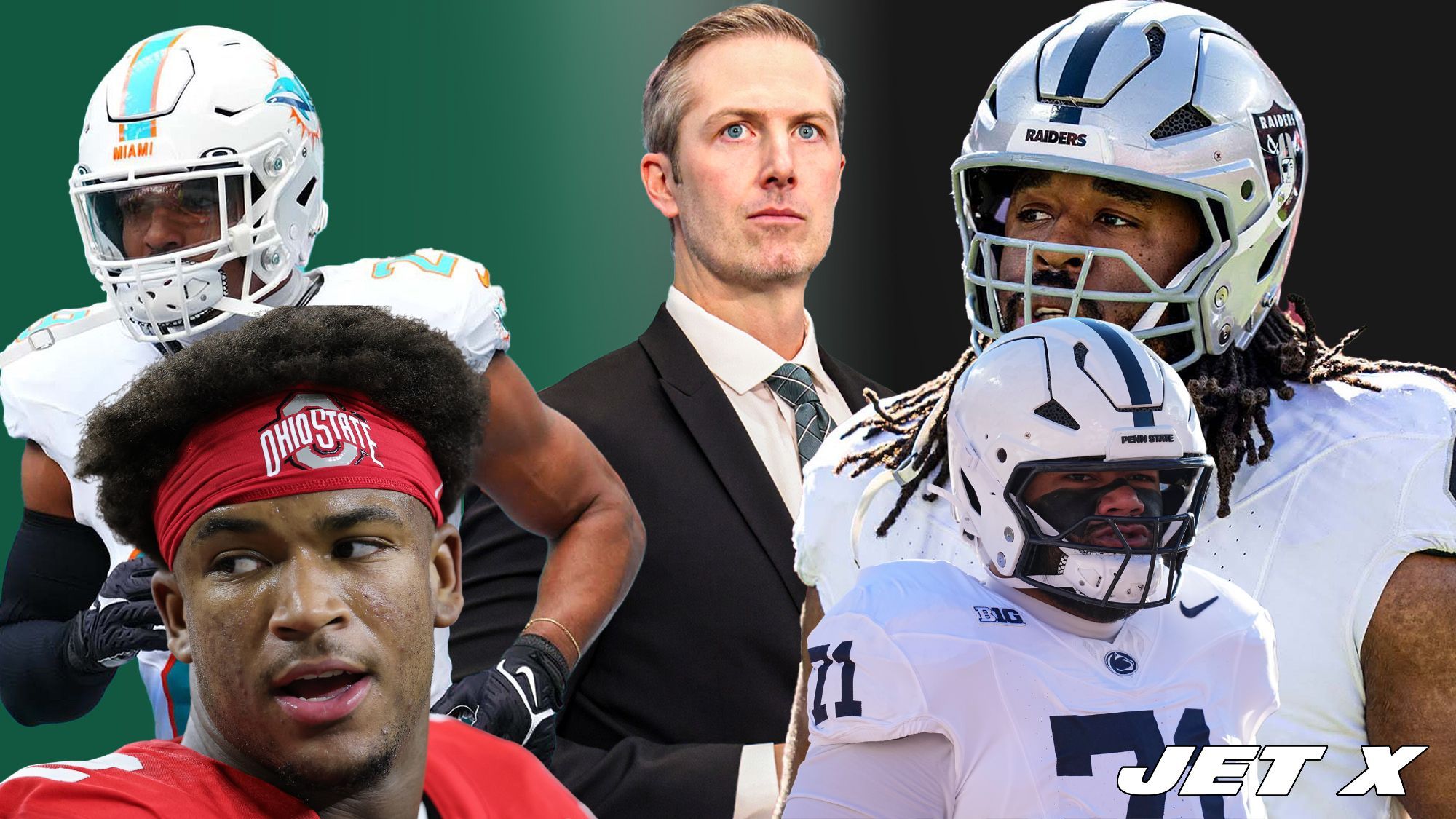
The meat and potatoes of NFL free agency are behind us, and the league’s next big event is less than 35 days away: the draft.
While the NFL draft is always a substantial event for teams around the league, it means a little more for the Jets this year.
Gang Green owns nine total selections, including four picks in the top 45 and two in the top 20. That amount of premium capital can significantly change an organization’s trajectory… if used correctly.
The Jets entered this offseason with needs riddled all over their depth chart, and they took an excellent approach to free agency, finding a surplus of starters, particularly on the defensive side of the ball.
Their haul certainly impacts how they will approach April’s draft.
Here are three areas where the Jets must adjust their draft strategy after the bulk of free agency.
1. Take the best pass-catcher at No. 16
The only aspect of free agency where Jets fans have a legitimate gripe with general manager Darren Mougey is his failure to add a wide receiver, let alone a top-tier option, as of this writing.
Currently, the team’s wide receiver room remains comprised of Garrett Wilson and a bunch of unproven options.
While the Jets could still look to add some available wide receiver on the open market, the team must look to secure the best available pass catcher with their second first-round pick at No. 16 overall.
Ohio State’s Carnell Tate is not expected to be available when the Jets are back on the clock, but top options in that spot could include Arizona State’s Jordyn Tyson, USC’s Makai Lemon, and Indiana’s Omar Cooper Jr. Along with those names, Oregon tight end Kenyon Sadiq should not be ruled out.
Bottom line: one of the Jets’ primary focuses on opening night of the draft should be landing a stud pass-catcher to complement Garrett Wilson.
2. Guard doesn’t make sense in Round 1
Entering free agency, guard was one of the most intriguing positions on New York’s depth chart.
Two of their top guards, John Simpson and Alijah Vera-Tucker, were slated to hit the open market, and their futures were unknown. Ultimately, both players landed elsewhere within the first week of free agency.
However, it is important to keep in mind that losing Vera-Tucker was not as significant for the team’s draft plans, given his long injury history. He didn’t appear in a game last season due to a torn triceps, meaning his departure wasn’t impactful for the Jets’ starting offensive line.
To replace Simpson at left guard, Mougey and the Jets found an upgrade in Dylan Parham, who has the upside to be the steal of the offseason.
At 26, Parham is not only younger than Simpson by two years, but he’s also coming off a stronger season. According to Pro Football Focus, Parham finished 14th among qualified left guards (minimum 500 snaps) in 2025, while Simpson checked in at 20th.
The Jets also landed him at a more team-friendly number. Simpson agreed to a three-year, $30 million deal with Baltimore, while Parham signed a two-year, $16 million contract in New York.
There’s added value, too. Parham has logged snaps at center, right guard, and left guard during his career, even if left guard remains his natural spot.
Prior to the addition, there was speculation that the Jets could take a guard at No. 16, with Penn State’s Olaivavega Ioane commonly being listed as the top option at the position.
Those conversations can be put to rest.
Guard is far from one of the Jets’ top needs after securing Parham, and while they could certainly look to take one on Day 2 or 3 of the draft, taking a guard at No. 16, given where the team stands, would be nonsensical.
3. Safety is no longer a glaring need
Among a flurry of weaknesses during the 2025 season, safety was one of the Jets’ most atrocious position groups.
Andre Cisco underperformed while on the field. Tony Adams’ 15.5% missed tackle rate was a career high, while Malachi Moore was pushed into a starting role as a fourth-round rookie, although he outplayed expectations.
By the evening of free agency’s first day, Gang Green’s outlook at the position changed drastically.
The team swung a trade, acquiring one of the league’s best safeties, Minkah Fitzpatrick, in exchange for a seventh-round pick. Later that day, the team made a very sneaky move, signing former New York Giant Dane Belton to a one-year deal worth up to $6 million.
Before free agency, there were conversations about the Jets potentially taking a safety as high as No. 2 overall, with Ohio State’s Caleb Downs drawing consideration for the slot.
Similar to guard, though, the Jets should no longer consider safety in the first two rounds. They could still look to add a safety later in the draft, but the conversations of Gang Green addressing the position with one of their top 45 speculations should be silenced after coming away with Fitzpatrick and Belton.
