
As we continue pondering over who the New York Jets will ultimately select in the 2026 NFL draft, it is worthwhile to consider the past drafting tendencies of their top coaches.
Here are three prospects who project as potential targets for the Jets based on the historical draft picks made under offensive coordinator Frank Reich.
Denzel Boston, WR, Washington
During Reich’s six-year run as the Indianapolis Colts’ head coach, Indy selected seven wide receivers.
All of them were over 200 pounds, and six of them were at least 6-foot-2:
- 2018 (Round 5): Daurice Fountain (6-foot-2, 210lb)
- 2018 (Round 6): Deon Cain (6-foot-2, 202lb)
- 2019 (Round 2): Parris Campbell (6-foot-0, 208lb)
- 2020 (Round 2): Michael Pittman Jr. (6-foot-4, 223lb)
- 2020 (Round 6): Dezmon Patmon (6-foot-4, 220lb)
- 2021 (Round 7): Mike Strachan (6-foot-5, 225lb)
- 2022 (Round 2): Alec Pierce (6-foot-3, 211lb)
In Reich’s lone draft as the Carolina Panthers’ head coach, the team selected one wide receiver, second-round pick Jonathan Mingo, who measured in at 6-foot-2 and 220 pounds.
There are enough consecutive examples of Reich’s teams drafting bigger wideouts to believe that it is not coincidental. It seems clear that Reich prefers receivers with wide catch radiuses and sturdy frames.
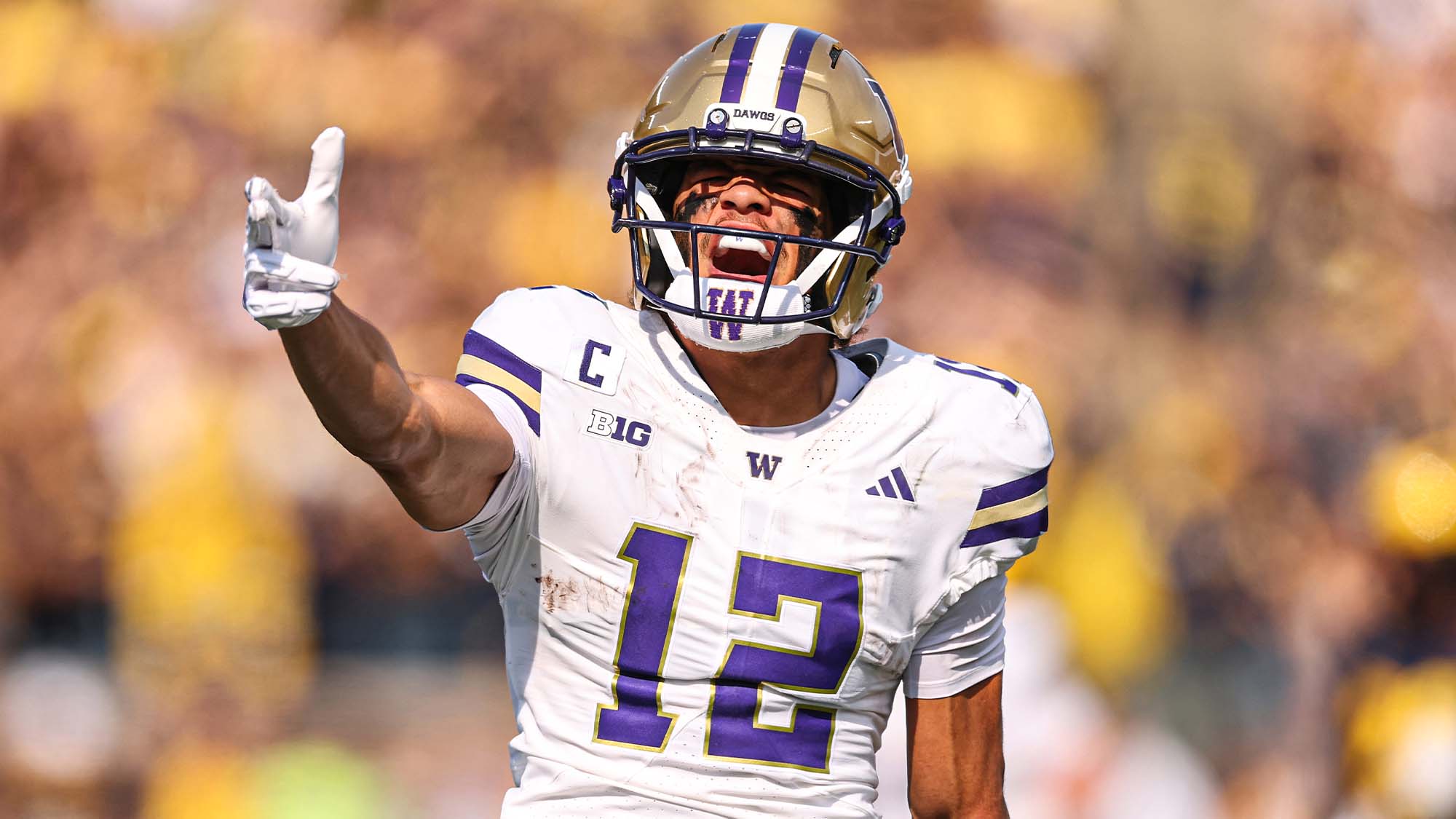
That should put Washington’s Denzel Boston firmly on the Jets’ radar.
At 6-foot-3⅝ and 212 pounds, Boston is easily the biggest wideout among the highest-ranked prospects in this year’s class.
Not to mention, Boston also offers arguably the best short-to-intermediate production of this year’s class, another reason that he would fit snugly in Reich’s offense. Historically, Reich has leaned toward throws in the short and intermediate ranges, while devaluing throws behind the line of scrimmage and deep throws.
These two traits—size and short-to-intermediate production—seem to go hand in hand.
Reich’s favorite throws in the short and intermediate ranges are drag routes and dig routes, which are in-breakers over the middle of the field. Big receivers are ideal for those routes, as they have the size to hang onto the ball through the hard hits they are likely to take while running horizontally over the middle.
So, given what we know about Reich’s route tendencies, it makes perfect sense that he prioritizes bigger wideouts. They are ideally built to execute the route concepts that he prefers calling.
Thus, Denzel Boston is tailor-made for Reich’s offense.
Elijah Sarratt, WR, Indiana
Staying on the topic of bigger wide receivers, Indiana’s Elijah Sarratt is an appealing target if the Jets want to target the position after the second round.
Ranked 80th on the consensus big board at NFL Mock Draft Database, Sarratt could be a target for the Jets if they make their way back into the third round.
Sarratt measured in at 6-foot-2½ and 210 pounds at the combine. This past season for the undefeated Hoosiers, he was a trusty red-zone target, racking up a plethora of touchdowns on short-to-intermediate throws.
Sarratt led all FBS wideouts with seven touchdowns on short targets (0-9 air yards), three more than any other player. He also tied for 10th with four touchdowns on intermediate targets (10-19 air yards).
The Jets had the NFL’s second-worst red zone offense in 2025, punching the ball into the end zone on just 44.7% of their trips past the 20-yard line. Playing in a Reich offense that will cook up plenty of in-breakers in that part of the field, Sarratt’s size and red-zone production make him an ideal player to help the Jets start turning field goals into touchdowns.
Jonah Coleman, RB, Washington
Reich likes to get his running backs involved in the pass game.
Across his six seasons as a head coach, Reich’s teams averaged a 21.0% target share to running backs, comfortably above the 2025 league average (18.2%). His teams exceeded that 18.2% mark in all five of his seasons as the Colts’ head coach.
Washington’s Jonah Coleman is one of the most talented pass-catching backs in the draft. In 2025, the senior caught 31 passes for 354 yards and two touchdowns, all without dropping a pass. He finished 13th among FBS running backs in receiving yards, and his 31 receptions without a drop were the ninth-most.
Coleman was particularly effective on screen passes. He caught all 13 of his screen targets for 167 yards (fifth-most among FBS RBs). Over half of those targets (7-of-13) resulted in first downs. Coleman did a lot of the work on his own, too, as he forced five missed tackles.
The screen production is appealing for Reich, as the veteran coach called a high rate of screens at his most recent stops. From 2021-23, Reich’s teams threw a screen on 9.8% of all pass attempts, 1.0% above the 2025 NFL average of 8.8%, his third-highest differential compared to league average of any route type.
Coleman is also known as a quality pass blocker.
Reich likes running backs who can do their part in the pass game, and Coleman fits the bill perfectly. He’s only the 96th-ranked overall player on the consensus big board, probably due to his iffy profile as a rusher (he ran for only 758 yards on 4.8 yards per carry in 2025), but that could allow him to fall into the Jets’ laps in the fourth round.
In 2018, Reich’s first season as the Colts’ head coach, Indianapolis selected NC State running back Nyheim Hines in the fourth round. Hines was an accomplished collegiate pass catcher, recording 89 receptions for 933 yards in three seasons.
At the NFL level, Reich immediately deployed Hines as a focal point in the pass game. Hines finished his rookie year with 63 receptions for 425 yards and two touchdowns.
The Jets already have an appealing receiver out of the backfield in Breece Hall, but they lack a proven secondary option. Backups Braelon Allen and Isaiah Davis have combined to average under one reception per game in the NFL.
You can never have enough weapons on offense, nor enough depth and youth in the backfield. If Reich is seeking to maximize the Jets’ pass-game skills at the running back position, Coleman could be a prime target on late-Day 2 or early-Day 3.
