
No NFL draft prospect is perfect.
As the New York Jets set their board ahead of the 2026 draft, they must carefully weigh the red flags that surround each player. Some prospects have more concerning red flags than others, which could cause the Jets to deem them too risky to gamble on in the first round.
Here is the biggest red flag for a few of the draft prospects who are widely expected to be in consideration from New York in the first round.
EDGE Arvell Reese: Pass-rush snaps and pass-rush win rate
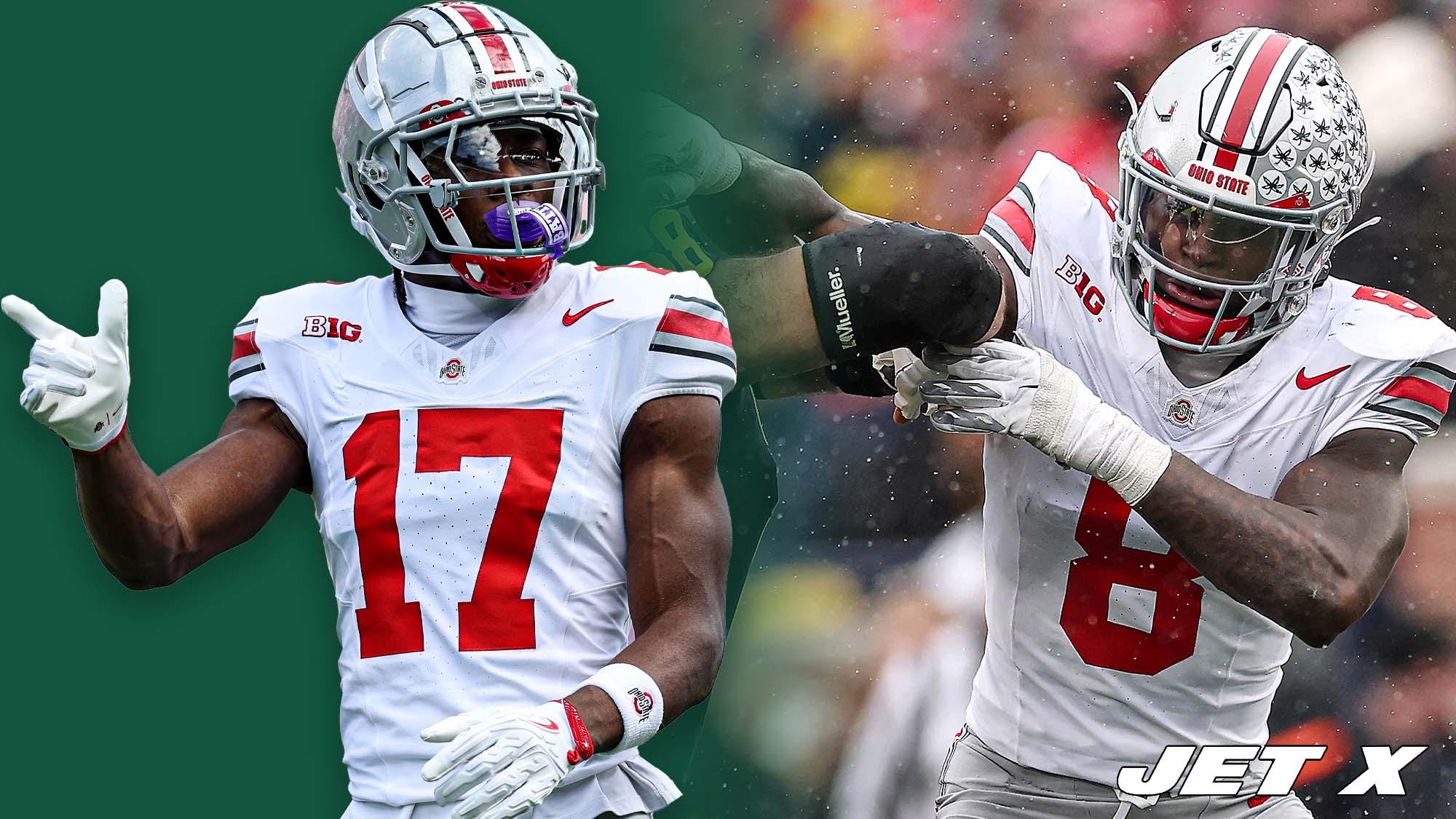
When Arvell Reese got a chance to rush the passer at Ohio State, he made it count. In 2025, Reese collected 6.5 sacks and 27 total pressures on just 119 pass-rush snaps.
The issue is the last number: 119.
Coupled with his measly 19 pass-rush snaps in 2024, Reese only rushed the passer 138 times in his college career. As efficient as he was, that is a tiny sample size to rely on as the basis of his NFL potential as an edge rusher, especially when his ceiling in that role is being used to justify his status as a potential No. 2 overall pick. Compare that to David Bailey’s 904 career pass-rush snaps.
This isn’t to say that Reese cannot or will not hit that ceiling; after all, he revealed that his Buckeyes coaches didn’t even coach him on pass rushing. Nonetheless, Reese’s minuscule sample of pass-rush snaps is a real red flag that teams like the Jets must contend with.
EDGE David Bailey: Discipline
Statistically, it is difficult to poke many holes in Bailey’s profile. He was utterly dominant at Texas Tech, building a profile that yields a high probability of NFL success.
Bailey’s red flags can only be seen on film, where his lack of discipline jumps off the screen. It didn’t stop him from racking up big numbers against Big 12 opponents, but against NFL offenses, the same gambles that led to TFLs will yield massive plays.
EDGE Rueben Bain: Arm length
Sometimes, too much is made of a prospect’s arm length, but in Rueben Bain’s case, it is fair to be concerned. His 30⅞-inch arms rank at the 1st percentile all-time among edge prospects.
There just isn’t much of a precedent for players with this type of build having success at the pro level.
WR Carnell Tate: Lack of dominant production ceiling
On a per-opportunity basis, Carnell Tate was a superstar for the Buckeyes this past season. He snatched 85.7% of his contested targets (12 of 14) and dropped zero passes. When Ohio State threw him the ball, he delivered.
The only issue with Tate, especially as it pertains to his candidacy for the No. 2 overall pick, is his lack of a dominant production ceiling in college. Across three seasons, his career-highs were just 52 receptions, 875 receiving yards, and 9 touchdowns.
The obvious explanation is that Tate had to compete for targets against Jeremiah Smith, who may be one of the best wide receiver prospects of all time. It isn’t necessarily fair to ding Tate because an all-time-great college athlete stole targets from him.
Nonetheless, as the Jets consider making Tate the No. 2 pick over a defender like Reese or Bailey, it does raise concerns about whether Tate is truly special enough to justify being the first non-quarterback selected in the draft.
G Olaivavega Ioane: Arm length
Olaivavega Ioane’s arm length is not nearly as much of a concern as Rueben Bain’s, but at 32¾ inches, he ranks in just the 26th percentile all-time among guard prospects, so if he goes on to struggle in the NFL, this will likely be part of the reason.
WR Makai Lemon: Size
Makai Lemon was a nearly flawless player at USC—his 90.8 overall Pro Football Focus grade led the nation, beating even Jeremiah Smith—but his small frame could scare some teams off from selecting him too early in the first round.
At 5-foot-11⅛ and 192 pounds with 30½-inch arms (16th percentile all-time among WR) and 8¾-inch hands (9th percentile), Lemon is much smaller than your typical first-round wideout.
It’s easy to claim that Lemon is talented enough to overcome his small frame and continue thriving at the pro level; after all, plenty of sub-six-foot wideouts are shining in today’s league, including Wan’Dale Robinson and Zay Flowers.
Still, the size issue cannot be written off. No matter how dominant a small receiver looked in college, things could change immensely when their opponents suddenly get a lot bigger, stronger, and longer in the NFL.
If there wasn’t a historical precedent for smaller receivers having tougher transitions to the next level, then teams wouldn’t still be dinging small receivers on their boards in 2026.
WR Omar Cooper: Production vs. top teams
On the surface, Omar Cooper’s 2025 numbers are impressive: 69 receptions, 937 yards, and 13 touchdowns in 16 games. However, he accumulated a huge chunk of that production in a few games against weak opponents.
Cooper collected 44% of his receiving yards (408 of 937) and 46% of his touchdowns (6 of 13) in three of his 16 games (19%), those coming against FCS Indiana State, 4-8 Michigan State, and 4-8 Maryland.
Across his 13 other games, Cooper averaged just 40.7 receiving yards per game. He disappeared in some big contests, including a shutout performance in the Big Ten championship against Ohio State and a 17-yard game in the playoffs against Oregon.
WR Denzel Boston: Reliance on contested catches
At 6-foot-4 and 209 pounds with a 10-of-13 performance on contested catches this past season, Denzel Boston has an extremely intriguing profile as a jump-ball winner and red-zone threat.
However, it is always fair to be concerned about receiver prospects whose games are primarily built around contested catching.
At the NFL level, the prospect is unlikely to win those jump balls at nearly as high a rate, given the uptick in competition, so they must have other tools to help them succeed. They can’t physically overwhelm pro corners the same way they did college corners.
In 2025, Boston forced only seven missed tackles on 62 receptions, so his YAC game isn’t a proven strength yet. He also averaged just 2.44 yards per route run, which is low for a potential first-rounder, indicating that he didn’t separate at too consistent a rate.
CB Mansoor Delane: Size
In terms of pure coverage production, Mansoor Delane comes into the NFL with a pristine resume against top-tier competition at LSU. In 2025, Delane allowed 14-of-35 targets (40%) in his direction to be completed for 165 yards, no touchdowns, and two interceptions, while committing zero penalties.
The questions have to do with Delane’s size. His height is ideal at six feet, but at 187 pounds with 30-inch arms (8th percentile all-time among CBs), he is lanky and lacks length. There are plenty of schemes where this type of build may make Delane a less-than-ideal fit, including the Jets’ scheme under Aaron Glenn.
CB Jermod McCoy: Sample size/injury
The fact that Jermod McCoy is still projected to be a first-round pick despite missing the entire 2025 season with a torn ACL shows you how talented he is. McCoy is fully covered from the injury, as he took part in drills at the combine.
McCoy’s ceiling is undeniable. As a 19-year-old true sophomore in 2024, he allowed 31-of-62 passes in his direction to be completed (50%) for 386 yards, two touchdowns, and four interceptions, while yielding a 53.6 passer rating. His 89.6 coverage grade from PFF ranked fifth-best among Power Four corners.
The issue is that McCoy is going to be drafted in the first round based on one season that occurred two years ago, prior to a serious injury. McCoy eased some concerns about the effects of his injury with a 4.37/4.38 forty time at Tennessee’s pro day, but until we see him on the field in a real game, it is very unclear where he stands in his development.
Cornerback tends to be one of the most volatile positions in football when it comes to production, so if there’s any position where it’s risky to draft a player based on his statistics from two years ago, it’s this one. McCoy could have easily had a down year in 2025 that dropped him out of the first round.
Instead, his injury may have been a blessing in disguise from a draft-stock standpoint, as teams can only base their evaluations on the high point where he left off.
QB Ty Simpson: One-year starter
After sitting for his first three years at Alabama, Ty Simpson finished his college career with just 15 starts.
The success rate for first-round quarterbacks with under 20 college starts has been poor in recent years. Since 2015, the other quarterbacks drafted in the first round with under 20 college starts are Kyler Murray (17), Trey Lance (17), Mac Jones (17), Dwayne Haskins (14), Anthony Richardson (13), and Mitchell Trubisky (13).
Oftentimes, one season isn’t enough tape on a player to truly grasp his skill level. When a quarterback starts for a second season, his opponents have a full season of tape to game plan around his strengths and weaknesses, potentially revealing flaws that weren’t visible in the quarterback’s first season.
Remember, many quarterbacks that will be drafted after the first round this year were projected to be first-round picks before the 2025 season began. An extra season of football revealed red flags in prospects like Garrett Nussmeier, Cade Klubnik, and Drew Allar that weren’t there before.
If Simpson got another season to start, he may have seen his stock drop, too. But it is also possible that he could have raised it, given how he struggled to close the 2025 season (partially due to injuries). Nobody knows, and therein lies the issue with drafting a quarterback in the first round off a small sample of film and data. There just isn’t enough information to make an informed decision, and that will lead to mistakes.
WR Jordyn Tyson: Injuries
Jordyn Tyson was on an excellent trajectory after a breakout 2024 redshirt sophomore season, when he recorded 75 catches for 1,101 yards and 10 touchdowns at 20 years old.
However, that remains the peak of Tyson’s career to this point. His production declined in an injury-riddled 2025 season, and he failed to make an impression during the pre-draft process, as a hamstring injury prevented him from working out. With all of this coming after he missed nearly the entire 2023 season with a torn ACL, MCL, and PCL.
Tyson is this year’s bona fide high-risk, high-reward prospect. If you pick him, and he bombs because of injuries, you only have yourself to blame—everyone could have seen it coming, right? But at the same time, if you pass on a player with his talent due to injury concerns, only to see him thrive with a rival, you’ll be kicking yourself for years.
Such is life in the NFL draft.
