
On Sunday, we discussed the New York Jets’ development plan for each rookie from their 2026 draft class, focusing on the weaknesses each player must iron out.
Today, we’re flipping the script. Here is one area where each rookie can be trusted to immediately help the Jets win games.
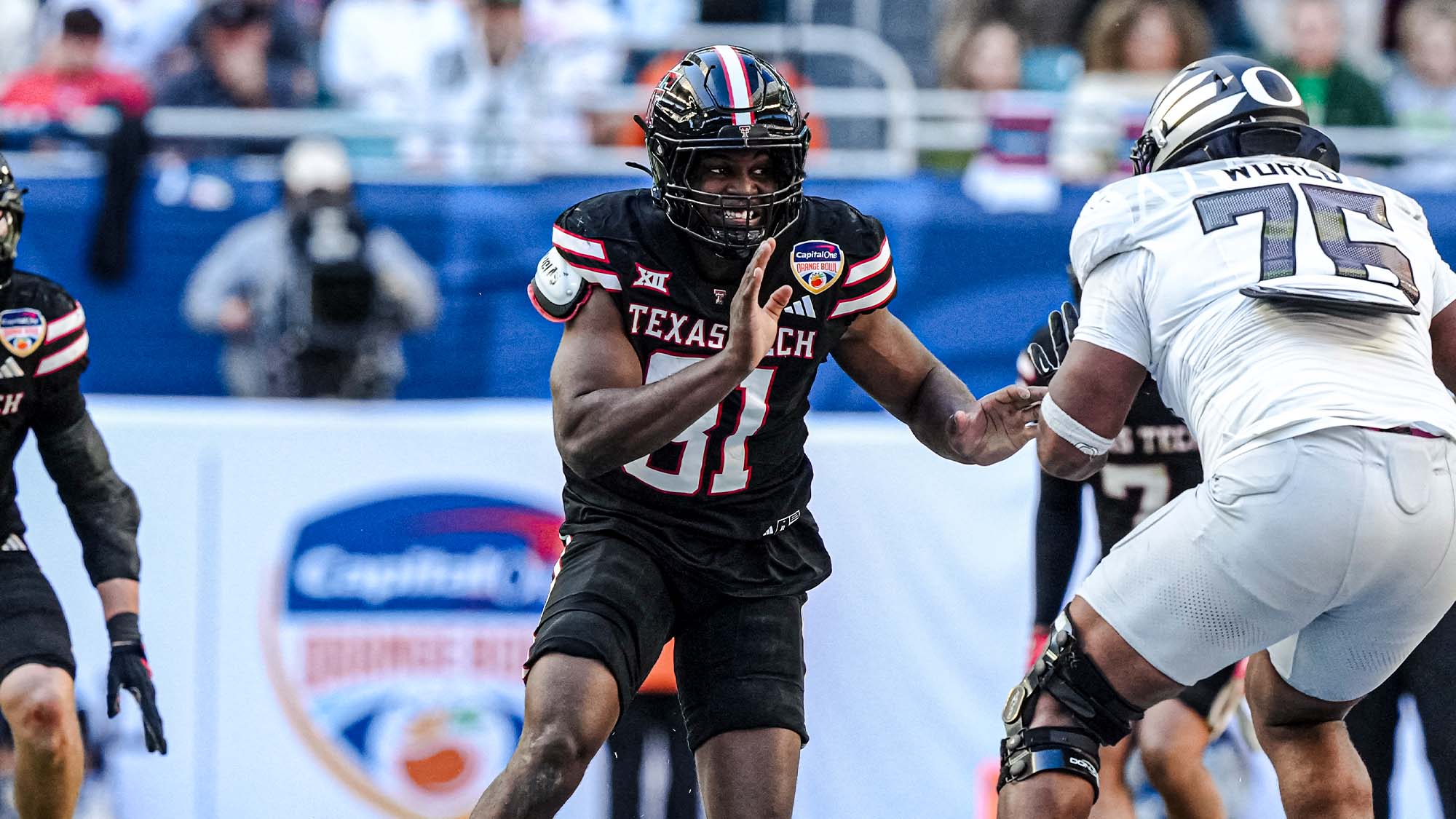
EDGE David Bailey
Bailey’s run defense will be a work in progress at the NFL level. It also may take time for him to maximize his pass rushing ability.
Some of the pass rush moves that worked against college tackles will not work against NFL tackles, and Bailey will need experience to hone his pass rushing repertoire. Pick any superstar pass rusher in NFL history, and it’s a near-guarantee that their rookie season featured their worst pass rushing consistency until their twilight years.
As a result, Bailey’s pass rushing consistency—wins, pressures, hits—may not be elite off the bat. He should be very good in those areas, but he is more likely to achieve superstar status in metrics like pressure rate and pass-rush win rate in his second or third season.
However, what Bailey could absolutely do at an elite level in his rookie year is finish sacks when he does get home, even if he isn’t getting home as often as he will in future seasons.
While there will be a step up in competition when it comes to the tackles he will face, the athletic ability of the average quarterback across from Bailey should not change by much. In fact, quarterbacks may only become easier to bring down. In the NFL, Bailey will face some aging, immobile veterans, who do not exist in college football.
Due to a combination of veteran quarterbacks and the difference in pro-style offenses versus college offenses, sacks are actually more common in the NFL than in college. In 2025, the median sack rate for FBS teams was 6.0%, compared to 6.8% for NFL teams.
Bailey proved himself as an elite sack finisher in college, racking up an FBS-high 14.5 sacks in 2025. He has the length, speed, and bend to project as a strong sack finisher in the NFL, too. Given that sacks are more common at the pro level, Bailey should be able to convert a high percentage of his pressures to sacks in 2026.
How many sacks that results in will come down to how often he wins, but the Jets should rest assured that Bailey will make his pressures count as soon as he touches an NFL field. At least, that should be the expectation for a second overall pick.
Since 2010, there have been eight first-round picks to record at least 10 sacks in their rookie season. Bailey could be next.
TE Kenyon Sadiq
In many ways, Kenyon Sadiq is a major projection pick for a first-round tight end. He needs to cut down on drops, refine his route running, and strengthen his in-line blocking.
What we know with certainty is that Sadiq will be more athletic and more skilled in the open field than nearly every defender who tries to tackle him in the NFL.
Sadiq boasts a 4.39 forty time and a 43.5-inch vertical, and both traits consistently translated to the field in college. Over the last two years at Oregon, Sadiq averaged 6.6 YAC per reception, while forcing 18 missed tackles on 76 receptions (0.237 missed tackles forced per reception).
The hope is that New York will eventually have enough confidence in Sadiq’s hands, route-running, and blocking to fully unleash him as an all-around weapon. In the meantime, he can be trusted to do serious damage on screens, shovel passes, drag routes, shallow crossers, or whatever else the Jets can cook up to give Sadiq chances to make plays in the open field.
WR Omar Cooper Jr.
Similar to Sadiq, Omar Cooper Jr. has some finer points of his game that require development, including his hands in the middle of the field. At the same time, though, he is prepared to immediately step on an NFL field and make people miss.
In 2025, Cooper ranked fourth among FBS wide receivers with 27 missed tackles forced. He was also 16th in the nation with 494 yards after the catch, which made up over half of his 937 total receiving yards.
The Jets didn’t trade up to draft Cooper in the first round in hopes that he could be a gadget guy; the plan is for him to eventually become a dependable all-around wideout. But while Cooper works on his game, the Jets can count on him to consistently add bonus yards after the catch that most other receivers would not create in the same situation.
CB D’Angelo Ponds
D’Angelo Ponds was an all-around superstar in college. It’s hard to poke many holes in how he performed at Indiana. We’re just waiting to see how his undersized frame will hold up in the NFL.
As great as Ponds was in college, though, it’s reasonable to expect that his lack of size will cause a few weaknesses to pop up in the NFL, especially in his rookie year. There will be a growth curve for him, particularly if the Jets start him out in the slot, a role that he essentially never played in college.
Of Ponds’ many strengths in college, the one that seems to have the highest chance of translating from Day 1 is his tackling.
Highly aggressive with fundamentally sound form, Ponds was a phenomenal tackler throughout all three seasons of his college career. Across 2,199 career defensive snaps, Ponds missed just 11 tackles. His missed tackle rate was a paltry 6.1%.
In 2025, Ponds was better than ever, missing just two tackles in 15 games. His 3.0% missed tackle rate was the lowest among Power Four cornerbacks who played at least 500 defensive snaps.
Time will tell how Ponds’ coverage holds up in the NFL, but the Jets can count on him to handle his business as a tackler.
DT Darrell Jackson Jr.
To see how high his ceiling could go, the Jets will try to help Darrell Jackson Jr. tap back into the pass-rush potential he displayed in 2024 before experiencing a significant production drop-off in 2025.
Even if that does not pan out, Jackson offers a high floor (for a fourth-round pick) thanks to his size and run defense.
Not only is he 6-foot-5 and 315 pounds, but he offers 34¾-inch arms (92nd percentile among DT) and 11-inch hands (97th percentile). That length will help him make first contact with opposing linemen, allowing him to get his hands into the chest, extend his arms, anchor down, and stand his man up.
Jackson’s frame makes him a trusty player to stick at nose tackle and stand up the center to clog up the A-gaps.
QB Cade Klubnik
The Jets are probably hoping that Cade Klubnik never sees the field in 2026, barring a tremendous training camp in which he wins the backup job, which, of course, they would sign up for. They aren’t expecting it, though.
But if Klubnik does somehow snag the backup role, it will likely be thanks to his mobility. At his best, Klubnik excels at escaping pressure, extending plays outside of the pocket, and making throws on the run. This type of creation ability is one of the traits that could give him a surprisingly high ceiling for a fourth-round pick.
G Anez Cooper
Anez Cooper has a long way to go in the run game, but the Jets are hoping that his pass protection can quickly translate if he is forced to play in 2026.
Cooper earned a 78.9 pass-blocking grade at Pro Football Focus in 2025, which ranked 22nd among 119 Power Four guards with at least 300 pass-blocking snaps.
S VJ Payne
VJ Payne is a major work in progress on defense, but the Jets likely believe his athleticism makes him a candidate to crack the roster via special teams impact.
Payne earned a 9.74 Relative Athletic Score, mainly thanks to his 4.40 forty time at 6-foot-3 and 206 pounds. These traits could make him an interesting player to try out as a rusher or jammer for the punt return team, or a blocker for the kick return team.
His athleticism also gives him a high ceiling as a gunner, but he has significant tackling concerns, so if we’re talking about instant impact, it is more likely that Payne helps the Jets in the areas of special teams where he does not have to make tackles. Ideally, though, he refines his tackling and proves worthy of contributing to as many special teams phases as possible.
