

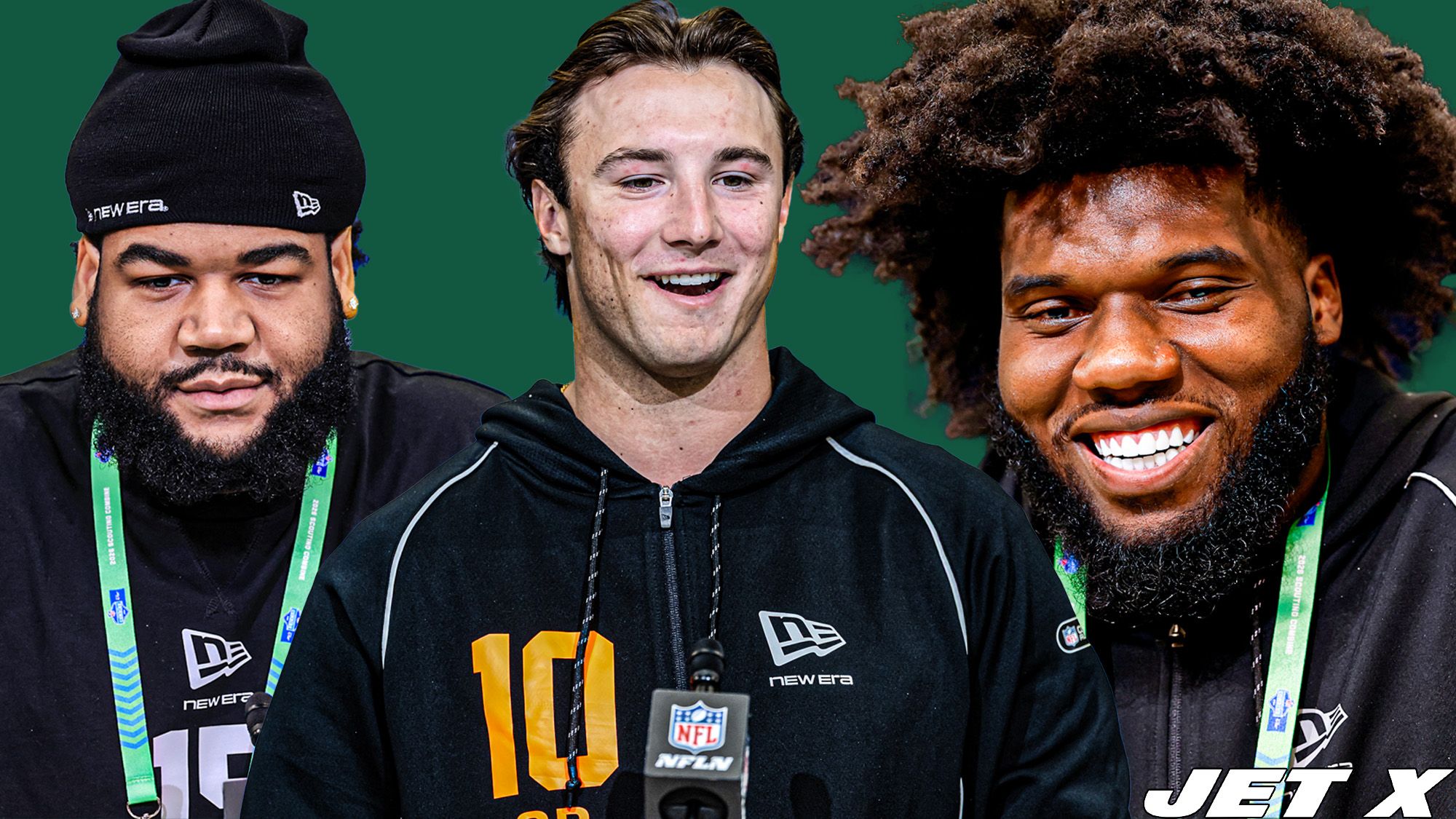
The NFL draft was nearly a month ago, meaning we have had plenty of time to dissect each and every one of the New York Jets’ eight selections.
Today, we rank each pick in order of their expected contributions as rookies.
1. David Bailey, DE, Texas Tech
This one is obvious. When you take a player at No. 2 overall, you expect him to contribute right away.
However, it’s important to keep in mind that Bailey’s production and snap count in Year 1 could be limited if he doesn’t develop quickly as a run defender. Contrary to much of the media, though, the Jets aren’t concerned about that aspect of his game.
Regardless, he can rush the passer, as evidenced by his 14.5 sacks and 81 total pressures last season. His 14.5 sacks led the nation, and his 81 total pressures were only two behind Rueben Bain for the national lead, even with Bain playing two more games.
The Jets need that kind of pass-rushing juice after finishing 31st among NFL teams in sacks last season (26). After selecting Bailey at No. 2, he should be expected to be a prime candidate to win Defensive Rookie of the Year while logging somewhere from 7 to 10 sacks.
As for Bailey’s run defense, he doesn’t need to become the best run-defending edge in the league, but at the very least, he needs to become competent enough to earn the Jets’ trust to play three downs.
A glass-half-full approach to that conundrum is that New York’s defensive line coach, Karl Dunbar, is among the best in the league and has a knack for developing young edge rushers and getting the most out of his players.
2. Omar Cooper Jr., WR, Indiana
After trading back into the first round to select Cooper Jr., he is expected to be the Jets’ WR2 behind Garrett Wilson.
Entering the draft, Gang Green lacked a clear-cut No. 2 behind Wilson after not making any additions at the position in free agency. Now, they are relying heavily on an end-of-the-first-round rookie to fill that crucial void.
Cooper Jr. certainly has the potential to thrive right away. Most importantly, he offers the versatility to play both X and Z receiver positions and has shown solid production in each role.
Serving mainly as a deep threat in 2024, he collected 594 yards and seven touchdowns across just 28 receptions, averaging 21.2 yards per catch.
After moving inside to the slot during the 2025 season, he broke out, compiling 937 yards and 13 touchdowns on 69 receptions. He was highly reliable, posting a 143.2 passer rating when targeted, and incredibly elusive, logging 27 missed tackles forced, the fourth-most in the FBS.
As things stand, Cooper is almost certainly going to have the second-highest target volume among WRs behind Wilson. With his ability to contribute in multiple roles, he should be versatile enough to carry a WR2 load as a rookie.
Geno Smith needs pass catchers who can consistently get open and create after the catch. Cooper Jr. brings both of those essential aspects to the table.
3. Kenyon Sadiq
As recently discussed, Sadiq should put up similar numbers in 2026 that Colston Loveland and Tyler Warren tallied during their rookie seasons last year.
If he is able to fine-tune his route running and tidy up his hands in the pros, he has the upside to be an elite all-around weapon for the Jets.
As he develops those parts of his game, though, he should still play a primary role in the Jets’ passing attack. Similar to Cooper Jr., his versatility is crucial, especially when it comes to fitting alongside 2025 second-round pick Mason Taylor.
During the 2025 season, Sadiq spent significant time both in-line (314 snaps) and in the slot (331 snaps).
Right away, the No. 16 pick should emerge as one of Smith’s primary targets, especially in the red zone, as his eight touchdowns last season led FBS tight ends.
4. D’Angelo Ponds, CB, Indiana
Ponds, often dubbed “Aaron Glenn Jr.,” was the Jets’ lone second-round pick in this year’s draft.
He should be a key contributor right away, and he has the upside to develop into the Jets’ long-term CB1.
While Ponds spent the vast majority of his time in college at boundary corner, according to Glenn, the Jets will “cross-train” him at boundary corner and in the slot.
For multiple reasons, though, he appears to fit best in the slot. First off, the height. Standing at 5-foot-8 and 182 pounds, he is undersized compared to the average outside corner, which could particularly cause him trouble against big-bodied receivers in contested catch situations.
That isn’t to say he can’t have success at that position. He did it in college, and there have been several small corners who have succeeded in New York, including Glenn (5-foot-9 and 183 pounds) and D.J. Reed (5-foot-9 and 190 pounds).
Also, the Jets need more help in the slot than they do on the outside. While neither Brandon Stephens, free agent pickup Nahshon Wright, nor Azareye’h Thomas has yet to establish themselves in that spot, they have each shown the capability of starting.
With another strong year, Thomas can turn into the Jets’ CB1 in that spot, while Wright is an elite ball-hawker, leading CBs with five interceptions last year. Stephens has proven to be serviceable.
The same can’t be said about the slot. Jarvis Brownlee Jr., a seventh-round pick from the 2024 NFL draft, showed flashes as a run defender at times but overall struggled during his time with the Jets after being acquired in-season. He is also a penalty machine, having led the Jets with nine penalties, tied for the 10th-most among cornerbacks.
Ponds should certainly be able to fill that void this season.
5. Darrell Jackson Jr., DL, Florida State
Jackson Jr. is a perfect example of a wise Day 3 pick.
In Jackson, the Jets landed a fourth-round pick who aligns perfectly with the team’s defensive scheme and, at the very least, will be a rotational player in his rookie season.
According to Glenn, the Jets plan to use him as a “big edge.” At 6-foot-5 and 315 pounds, he also appears capable of playing nose tackle, which the Jets need multiple of, as they are expected to use a 3-4 base defense from time to time this season.
He has the alignment versatility and ability to see the field right away. Those key attributes are what make wise Day 3 selections.
6. VJ Payne, S, Kansas State
Payne projects as a special teams contributor for Gang Green, with the potential to develop into a rotational safety.
Many evaluators had a fourth-round grade on him, meaning the Jets could have landed a steal. He earned a 73.3 defensive grade from Pro Football Focus last season, while allowing a 57.4 passer rating when targeted. He can also play in the box as a strong safety/rover.
7. Anez Cooper, OL, Miami
Cooper will be a backup interior offensive lineman who hopefully doesn’t need to see the field. Ideally, the Jets can keep the same starting offensive line for all 17 games this season, just like they did last year.
The pick itself makes sense. It was a smart move by the Jets to select an offensive lineman on Day 3 known for his pass-rushing chops, as the team is expected to insert a franchise QB into the lineup for the 2027 season.
8. Cade Klubnik, QB, Clemson
Klubnik almost certainly will (and should) be the least impactful among the rookie class this season. While he possesses long-term upside, which is why the Jets took a flier on him, you never want to see a rookie Day 3 QB in action. He is better off sitting back and developing.
Brady Cook’s four games in 2025 should have been enough to scare fans off from the idea of rushing Klubnik into action.
