

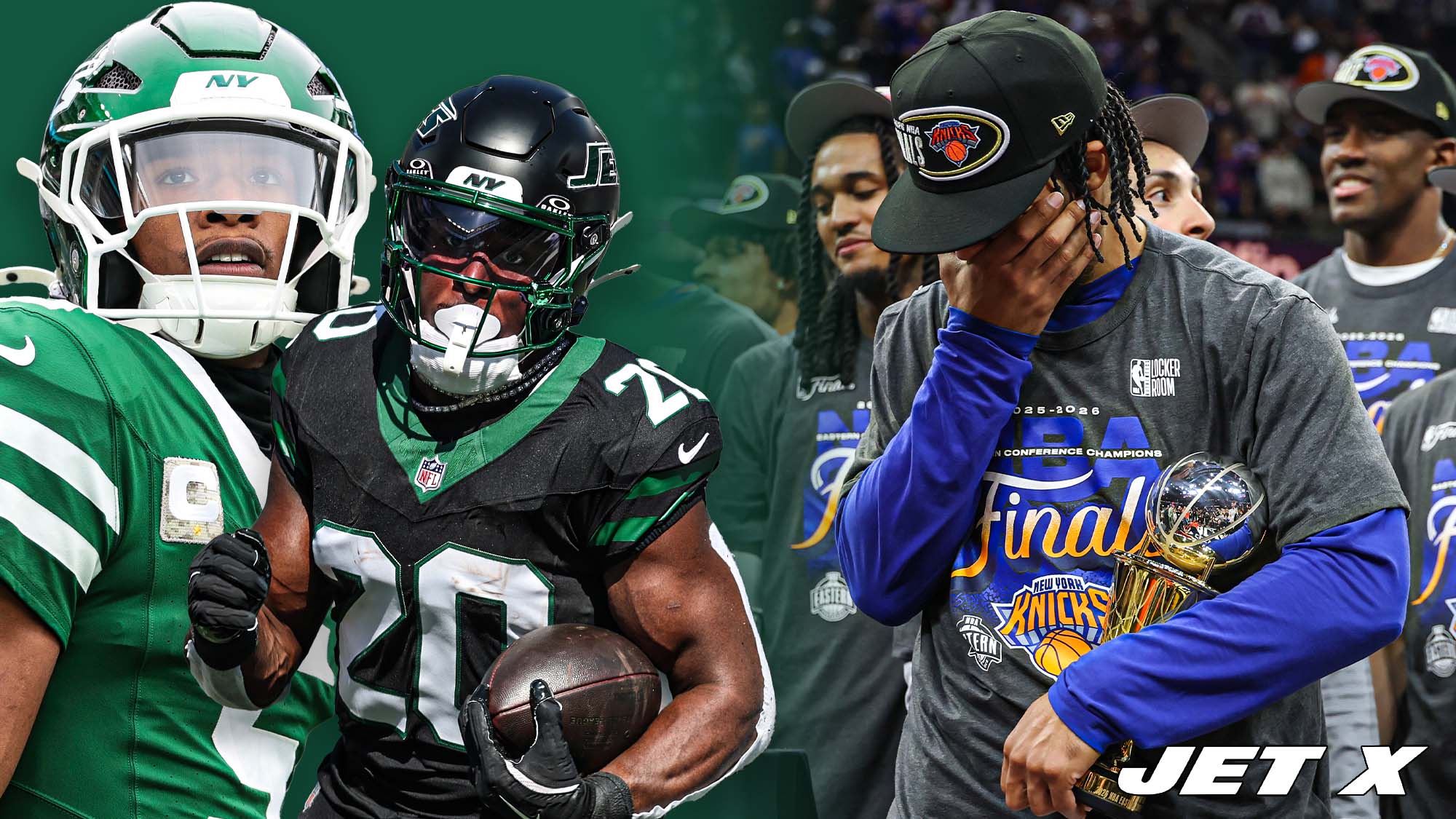
The New York Knicks are off to the NBA Finals, riding high on a wave of 11 straight playoff victories.
The New York Jets, meanwhile, haven’t even picked up 11 regular season victories over the last two years combined. You have to go back 898 days (to December 10, 2023) to find 11 Jets regular season wins.
The Jets haven’t made the playoffs in 15 years. They have barely won 11 playoff games in franchise history (12). Their last championship-round appearance was in the 1968 season.
Still, it wasn’t long ago that you wouldn’t have been laughed at if you suggested that the Jets were closer to a championship than their basketball brethren across the Hudson River.
We could go back to the summer of 2010, when the Jets were fresh off an AFC championship appearance under a first-year head coach and a prized rookie quarterback, while the Knicks were coming off their ninth consecutive losing season and got spurned by LeBron James.
Or, we could go back to the summer of 2016, when the Jets were coming off a 10-6 season led by the NFL’s Executive of the Year, Mike Maccagnan. The Knicks were coming off their third straight losing season, had just fired their head coach in-season (Derek Fisher), and were a complete circus under Phil Jackson’s leadership.
The point is, as bleak as things look for the Jets relative to the boys in orange-and-blue, there can still be light at the end of the tunnel. In fact, the Knicks’ run is as good a reason as any for Jets fans to believe that championship-caliber success is within the realm of possibility for their favorite football team.
As the Knicks prepare to compete in the NBA Finals, it is a fascinating exercise to compare their roster and organizational structure to the Jets’ current setup. Of course, these are two different sports that operate very differently, but at the end of the day, many of the same core elements are required to achieve glory in a team sport.
Let’s see how the Jets stack up against the best franchise in New York sports.
Franchise player: Jalen Brunson
As their captain, leading scorer, and leading assist man, Jalen Brunson is the face of the New York Knicks.
Every championship-caliber sports team needs a franchise player. Some teams, though, rely less on their franchise player than others.
In the Knicks’ case, Brunson is on the lower end of franchise players for an NBA Finals team. He is a superstar and arguably a top 5-10 player in the league, but he isn’t quite the MVP-caliber player who typically carries his team to the Finals, such as recent champions like Shai Gilgeous-Alexander (that’s not to say Brunson cannot outplay SGA in a series), Nikola Jokic, Giannis Antetokounmpo, or LeBron James.
The Knicks’ run is as much of a team effort as any Finals run we’ve seen in NBA history. They made it this far with one All-NBA player and zero first-team All-NBA players. While Brunson has been outstanding, he has not been required to carry the Knicks on his own—and they probably wouldn’t be here if that was how their team was constructed.
Through a football lens, Brunson can be seen as a franchise quarterback who is well beyond good enough to win a championship, but needs a great team around him to do so. He can get you there if you give him the pieces, but he isn’t dragging a sinking ship to shore. Think Jalen Hurts of the Philadelphia Eagles.
Hurts is undoubtedly a great quarterback, even if he is clearly not on the same level as world-beaters like Patrick Mahomes, Josh Allen, or Lamar Jackson. But with a phenomenal roster around him, Hurts proved worthy of leading his team to a championship (and two Super Bowl appearances).
As we recently broke down, Hurts and Sam Darnold exemplified over the last two years that a world-beating quarterback is no longer a necessity to win the Super Bowl in today’s NFL. It’s a lesson that the Jets should heed as many fans and analysts implore them to tank in 2026.
Over in the NBA, Brunson is proving the same thing: it’s a team sport. If the roster is strong enough from top-to-bottom, you can compete for a title without a superhuman as your best player. The Indiana Pacers also proved this in 2025 with Tyrese Haliburton as the face of their team, reaching Game 7 of the NBA Finals.
The Jets currently do not have their Brunson or Haliburton. But with three first-round picks in 2027 and a clean cap sheet moving forward, they have the draft picks, trade assets, and cap space to find their man when the opportunity presents itself.
What Jets fans can take solace in is that the Knicks, just like this year’s Seahawks and last year’s Eagles, prove that you don’t need a “savior” as your franchise player to win a championship. You need a great player who is also a great leader and a great fit in his team’s system and culture, but you don’t need to perpetually tank until you land the most unbelievable talent your sport has ever seen.
Co-star: Karl-Anthony Towns
Beside Brunson is Karl-Anthony Towns, the Robin to Brunson’s Batman.
Towns is not only a unique, All-Star-caliber talent, but his skill set is the perfect complement to Brunson’s. Their complementary play styles elevate both players to the highest peaks of their careers.
In addition to finding their Brunson under center, the Knicks need their version of Towns. From an NFL standpoint, this can be seen as a non-quarterback offensive star who fits impeccably with the signal-caller.
The good news for New York is that they may already be set in this department with Garrett Wilson. Once Wilson has a quarterback who can get him the ball downfield, he will finally post numbers that reflect how gifted he is.
You can easily picture Wilson being the best receiver on a Super Bowl team.
All-world defender: OG Anunoby
Leading the Knicks’ defense is OG Anunoby, who earned second-team All-Defense honors this season (although he was snubbed for the first team).
In both basketball and football, winning a championship requires dominance on offense and defense. For all the attention directed at an NBA team’s leading scorer or an NFL team’s quarterback, the defense tasked with stopping these guys is equally critical in determining the outcome.
Anunoby’s playmaking, versatility, energy, and instincts make him a game-altering defender. Every time he steps on the court, the opposing offense has to design its game plan around him. They know where he is at all times and try to do everything they can to stop him from wrecking the game.
You need this type of guy in football, too.
The Rams had Aaron Donald. The Chiefs had Chris Jones. The Patriots had Stephon Gilmore.
When the Jets were last within striking distance of a championship, they had Darrelle Revis.
As of today, the Jets do not have their OG Anunoby on defense—at least, not a proven version. But they do have a potential version of Anunoby in edge rusher David Bailey, the second overall pick of this year’s draft. As the first non-quarterback chosen in the 2026 draft, the Jets hope that Bailey will become the nightmare-imposing defensive presence that Anunoby is.
Shutdown island defender: Mikal Bridges
It cannot go overlooked that New York has a second elite wing defender in Mikal Bridges.
While he has received praise as of late for his offensive surge, Bridges has been shutting down opposing lead guards for the duration of the playoffs. He shadowed Nickeil Alexander-Walker and Tyrese Maxey during the first two rounds and silenced both players while rarely switching off of them.
Whereas Anunoby’s best NFL comparison is probably a bulldozing defensive lineman who racks up sacks and forced fumbles, Bridges is more akin to a shutdown cornerback who mirrors speedy receivers down the field.
The Jets don’t have one of those at the moment. They do have some promising prospects, though, including 2025 third-round pick Azareye’h Thomas and 2026 second-rounder D’Angelo Ponds.
To win a championship, the Jets need a pass rusher who will wreck any one-on-one matchup if he is not doubled and a cornerback behind him who will snag interceptions galore off the pressured passes created by his partner in crime. They are hoping that Bailey and either Thomas or Ponds can form that pairing, replicating the complementary disruptiveness of Anunoby and Bridges on Seventh Avenue.
Glue guy: Josh Hart
Josh Hart is the glue that holds everything together for the Knicks’ starting lineup. His hustle, rebounding, transition offense, and passing are essential traits to tie everything together.
You can find this kind of guy on a football field at various positions. Perhaps he is a dirty-working slot receiver who grabs all of the tough third-down conversions and throws nasty crack blocks. Maybe he is a gap-plugging nose tackle who doesn’t get many of his own highlights but tees them up for his teammates. He could also be that one madman on special teams who is always flying around and taking people’s heads off.
Offensively, tight end Mason Taylor is a candidate for the role. Taylor was an outstanding contested-catcher in his rookie year and also improved greatly as a blocker. With athletic specimen Kenyon Sadiq likely taking over as the Jets’ long-term TE1, Taylor will assume more of a complementary, dirty-working role, akin to Hart, while Sadiq is more of a focal point.
Defensively, nose tackle T’Vondre Sweat projects as a fan-favorite dirty worker who earns no national praise, but is the heart-and-soul of the defense with his tenacity and physicality.
On special teams, Andrew Beck is returning after a fantastic all-around season in 2025, featuring many key blocks on long returns as well as eight tackles in coverage.
Since a football team has over three times as many players as a basketball team, and is also a far more physical sport, the reality is that you need a bunch of Josh Harts to anchor a championship-caliber team. Perhaps the most realistic goal is to find one Josh Hart for each phase.
Taylor, Sweat, and Beck could be those “glue guys” for their respective phases.
Depth
The Knicks got to the Finals this easily because of their depth. Whereas their opponents have gotten meager production beyond their stars, the Knicks’ backups have been just as effective as their starters.
Landry Shamet, Miles McBride, Mitchell Robinson, Jordan Clarkson, and Jose Alvarado have all had their moments in the sun. New York is 10-deep, and no team in the East could contend with it.
Depth is just as critical on a football field. You can’t rack up points by throwing to one receiver, and you can’t rack up sacks with one pass rusher. Waves of weapons are needed on both sides of the ball.
This is probably the area where the Jets are second-furthest away from matching the Knicks, after their obvious lack of a Jalen Brunson.
In 2025, the Jets won three games and were outscored by over 200 points. They shipped off two of their best players mid-season. The result was that by the end of the year, their starting lineup was largely composed of players who will either be out of the league or on practice squads in 2026.
That cannot be fixed in one offseason.
While the Jets used free agency and the draft to plug plenty of holes in their starting lineup, the team still looks weak in the No. 2 and No. 3 slots at most positions on the depth chart. It will take a few years to strengthen the back end of the roster.
For now, the Jets are too reliant on too few players at many positions, and that will limit their ceiling. From Wilson at wide receiver to Bailey in the pass rush, they still need to work on building the one-two-three punch combos that the Knicks have thrown at opponents in 2026.
Head coach: Mike Brown
The Knicks fired Tom Thibodeau after a successful five-year run in which he pulled the franchise out of the doldrums and led them to their best stretch of playoff success in decades.
Why? Because they felt as if the team had reached its ceiling under Thibodeau. The Knicks’ brain trust believed that another coach was necessary to push the ceiling up to championship-caliber.
It was a gamble. They had to accept the risk that a new coach might fall short of the high floor established Thibodeau. But the Knicks were willing to take that risk in pursuit of a title.
And Mike Brown has answered the call.
It remains to be seen if Brown can finish the job with a championship, but Brown has already proven that the Knicks made the right call when it came to raising the team’s ceiling. Despite barely eclipsing Thibodeau’s regular season win total, Brown proved in the playoffs that he is a better coach at preparing a team for playoff success and to raise their ceiling of potential dominance.
The Jets are in a strange position at the head coaching spot. They took a gamble on a first-timer in Aaron Glenn, only for him to have a disastrous debut season in which he looked lost in many aspects. To be fair to Glenn, he entered during a transitional stage for the franchise and was coaching a decrepit roster, especially in the second half of the year. Nonetheless, he showed obvious warts that had nothing to do with the talent at his disposal.
Glenn’s work in 2025 would have justified a one-and-done firing, but the Jets allowed him to stick around. Not only that, but they also allowed him to revamp the entire coaching staff.
The Jets have added enough talent for Glenn to prove that he is at least a competent head coach. If he cannot make strides in areas within his control (game management, player optimization, etc.), the Jets should be looking for a new head coach in 2027, regardless of their win-loss record in 2026.
What the Knicks’ Thibodeau-Brown swap should teach the Jets is the importance of having a coach who can raise a team’s ceiling.
Thibodeau was an excellent coach at getting his team to play hard, but he also ran his players into the ground during the regular season and lacked creative strategies to get the most out of his talent in the playoffs.
Brown did a much better job of pacing his team through the regular season to stay ready for the playoffs, and throughout the playoffs, he has been much better at constantly finding unique adjustments that keep his team a step ahead of the opposition.
There are many examples of this coaching dichotomy in the NFL. You see plenty of “rah-rah” coaches who are hired to “change a culture”, as well as plenty of coaches who are hired for their schematic acumen despite not seeming like the type of personality you would expect to lead a locker room of football players.
Glenn’s first season strongly suggested that he leans toward the Thibodeau end of the spectrum rather than the Brown end. As a former player who is overflowing with energy, he is the type of coach who you can tell that players love playing for, but there was little about his debut season that suggested he gives the Jets a strategic advantage. That is problematic in a league run by coaches like Sean McVay, Kyle Shanahan, Andy Reid, and so on.
We shall see what Glenn has to offer in 2026, but early signs indicate that he is unlikely to be a championship-caliber coach for the Jets.
However, perhaps Glenn can be the Jets’ version of Thibodeau.
If his culture-changing skills are strong enough to pull the Jets out of the gutter and get them back to being a consistent wild-card-caliber team, Glenn can at least get them to the doorstep of contention. From there, it would be up to the Jets’ ownership to have the guts to realize that a bold Thibodeau-for-Brown-esque swap is necessary to raise the ceiling to championship-caliber.
