

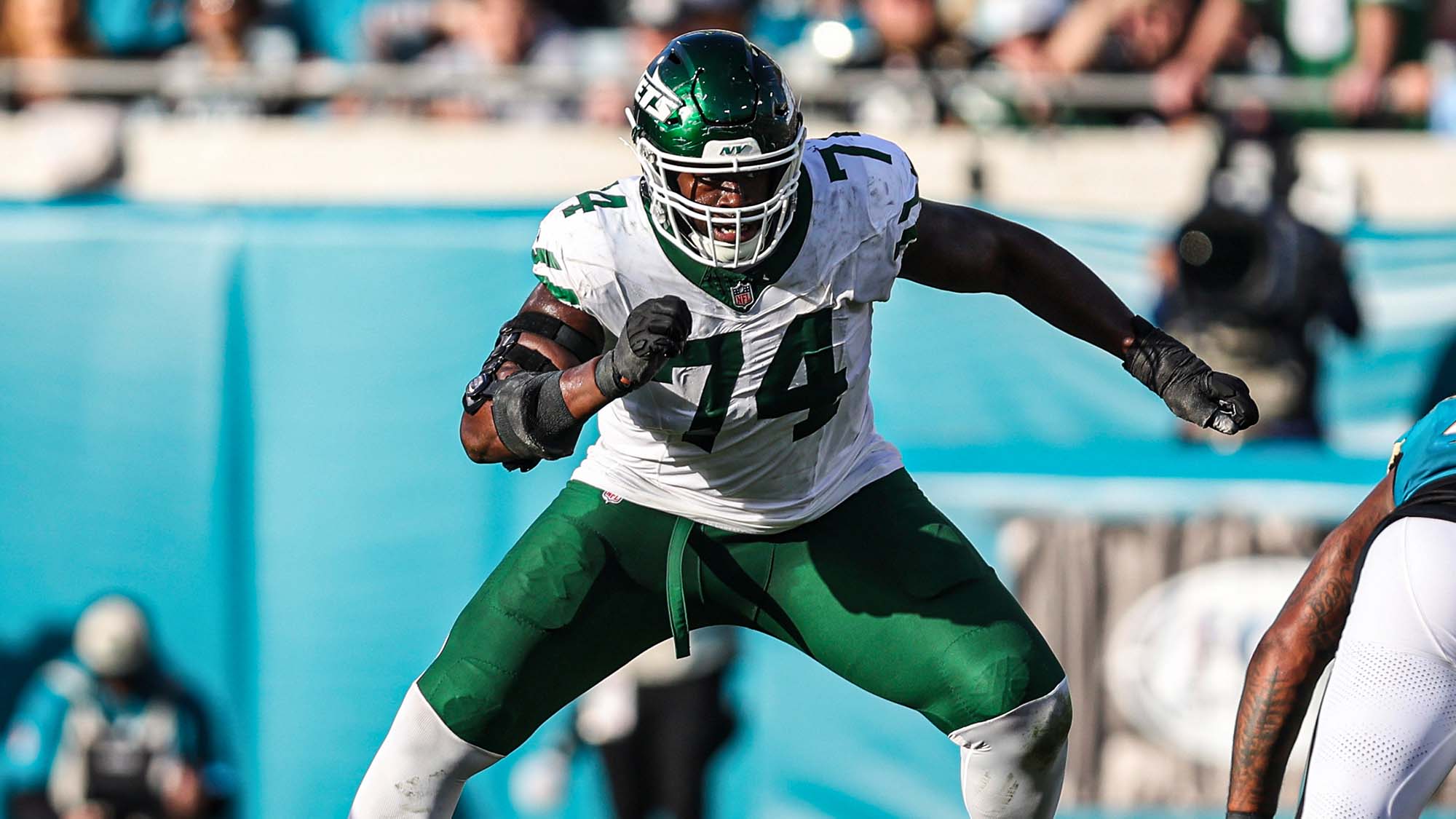
Preseason production in the NFL does not correlate with regular season production—this has already been established.
Therefore, nothing that happens in the New York Jets’ preseason opener against the Tampa Bay Buccaneers should be treated as a surefire prediction of what’s to come in the regular season.
With that being said, it’s still a “real” football game, the first we’ve seen from any of these players in over eight months. For that reason, there has to be some sort of value worth extracting, right?
Certainly—if we know what to look for.
Using players’ preseason stats to predict the future would be foolish, but if we watch closely and evaluate the finer points of a player’s game, we might glean meaningful takeaways. A player’s technique, tendencies, and fundamentals in the preseason should translate to the regular season—it’s still football, after all. The main differences lie in sample size and the complexity of the play-calling.
Preseason games are especially meaningful for tracking the progress of players who are expected to undergo significant changes in their performance compared to the previous season. On that note, here are three Jets starters with the most to prove in Friday’s preseason opener.
C Josh Myers
The Jets are taking a gamble by running it back with Josh Myers as their starting center for the 2026 season.
New York’s young offensive line is oozing with potential. They have two first-round tackles under 24 (Olu Fashanu and Armand Membou) and a 25-year-old second-round guard they signed to an extension (Joe Tippmann). Newly signed left guard Dylan Parham, age 26, also projects as a plus starter.
Yet, an offensive line is often as strong as its weakest link, and by sticking with Myers, the Jets have signed themselves up to have a very weak “weakest link”.
Starting all 17 games at center for the Jets in 2025, Myers ranked 33rd out of 34 qualified centers (min. 500 snaps) with a 52.9 overall grade from Pro Football Focus.
That performance was not far off from what the Jets should have expected from Myers, as his grades over his four seasons in Green Bay ranged from a low of 55.7 (29th among centers) to a peak of 60.4 (25th). After all, the Jets paid him as if they expected that level of play; he only signed a one-year, $3.5 million deal, as he was brought aboard to be a high-end backup.
Despite Myers producing like the backup he was paid to be, the Jets signed him to a two-year, $11 million contract extension during the 2025 season. They proceeded to ignore the center position throughout the 2026 offseason, which meant Myers would be handed the starting center job without a competition.
It’s been a strangely complacent process considering the Jets have a chance to build something special up front. Myers’ poor individual production could waste the potential of what might be the highest-ceiling unit on the Jets’ roster.
However, the Jets are banking on the value of bringing back four of the same five starters who started all 17 games last year, including Myers, the communicative leader of that group. They seem to believe that Myers’ low-level individual production can be outweighed by the chemistry that comes with retaining the center who started with three other linemen for the entirety of last season.
So far in training camp, that strategy seems to be paying some dividends. Jets X-Factor’s Robby Sabo shouted out Myers among his top six under-the-radar camp standouts, writing, “By and large, the first-team offensive line has played extremely well against the first-team defensive front in the run game (not enough is being made of this), so the leader of the OL deserves a tip of the cap.”
The obvious caveat is that the Jets’ defensive line is rife with both injuries and new faces, so the offensive line has a clear advantage in that regard.
On Friday, we will get our first glimpse of whether retaining Myers for the sake of continuity was a wise move. A couple of drives in the preseason won’t make or break the decision, but it is an opportunity for Myers to show that he can operate a well-oiled machine from a communication standpoint.
If the Jets’ starting offensive line can get through its short time on the field without any communication breakdowns, that would be a positive sign for the Jets’ decision to run it back with Myers.
LT Olu Fashanu
While he was not drafted by the current regime, the Jets have high hopes for Olu Fashanu, the 11th overall pick in the 2024 NFL draft.
As a player at a premium position who was chosen in the top-11 at just 21 years old, with uber athletic tools and a pass-game-leaning skill-set to boot, Fashanu is the definition of a high-ceiling prospect. He has a realistic ceiling as an elite pass protector on the blindside. It doesn’t get much more valuable than that among non-quarterbacks.
So far, though, Fashanu has yet to reach that ceiling. New York hopes that this is the year when everything comes together.
Fashanu started his rookie year out of position, plugging multiple holes for an injury-plagued Jets offensive line. He started two games at right tackle before filling in at right guard, struggling in both roles.
Then, Fashanu closed his rookie season with five starts at left tackle before missing the final two games. Over that five-game stretch, Fashanu earned a solid 75.0 pass-blocking grade from PFF.
That was a high floor for Fashanu to set as a rookie who bounced between three positions and did not get to start at his natural spot until late in the year. It seemed that he had set the foundation for a lofty leap in Year 2.
Instead, Fashanu plateaued. Across 17 starts, he finished the season with a 74.5 pass-blocking grade, almost identical to his end-of-season stretch in 2024. That was good enough for 15th among 31 qualified left tackles, so he was essentially a league-average starter in terms of pass protection. In the run game, though, he struggled, ranking 24th with a 57.1 run blocking grade.
Fashanu is no scrub, but with Year 3 approaching, it’s time for the former 11th overall pick to start playing up to his draft slot. That is not to say that Fashanu needs to turn into Laremy Tunsil this season, but the Jets need him to be more than an average pass protector and below-average run blocker.
As Jets X-Factor’s Joe Blewett broke down in his film review of Fashanu’s 2025 season, Fashanu has repeatedly shown familiar issues with certain aspects of his technique, including his punch.
This is why Fashanu can be fairly evaluated in Friday’s preseason opener. Preseason or not, it’s still a football game; Fashanu is going to put his technique on display. We will be able to see if Fashanu has made the necessary technical tweaks to become the best player he can be. If Fashanu continues showing the same technical issues in a preseason game, they will probably carry over into the regular season.
Jets fans should watch Fashanu’s technique closely on Friday night, especially his punch. If he looks noticeably smoother with his timing and hand placement, perhaps it indicates that Fashanu’s technique legitimately improved over the last eight months of work, which, if true, would prime him for a breakout year.
LB Jamien Sherwood
Despite the fact that he was selected by the previous general manager, the Jets’ new regime loved Jamien Sherwood’s 2024 season so much that one of their first moves upon coming to Florham Park was to extend him to a three-year, $45 million deal, which still gives Sherwood the eighth-highest salary among linebackers at $15 million.
Sherwood’s 2025 season did not justify that salary. He was benched at one point for underperformance and was ultimately far less productive than in the breakout 2024 campaign that landed him his lofty contract.
Sherwood became particularly exploitable in coverage. Take a look at the drop-off in his coverage production:
- 2024: 0 TD allowed, 435 yards allowed, 96.4 passer rating allowed, 66.2 PFF coverage grade
- 2025: 4 TD allowed, 578 yards allowed, 125.1 passer rating allowed, 46.1 PFF coverage grade
Earlier in training camp, Sherwood took accountability for his struggles in coverage and stated that he worked on it throughout the offseason.
“I feel like last year, where I struggled a little bit was in pass coverage. And I feel like this offseason, I took it upon myself to make sure I correct those things, so now, I’m put in a position to where, a lot of the times I’m put in those positions again, I’m out in coverage, it just gives me a chance to show my athletic ability and do better than I did last time.”
Part of the reason for Sherwood’s drop-off in coverage may have been his shift to assuming green-dot responsibilities for the Jets’ defense. With veteran linebacker C.J. Mosley retiring, Sherwood took over communicative responsibilities, which he did not have to worry about while Mosley was starting alongside him.
In 2026, though, those responsibilities will be taken off Sherwood’s plate, as Demario Davis will take over the role. That could allow Sherwood to fly around more freely, as he did back in 2024.
Friday will offer a chance to see how Sherwood looks in his first game without a green dot in two years. The Jets are expecting a significant bounce-back season from Sherwood, and it isn’t expected to happen out of nowhere—the green-dot shift, as a result of adding Davis, gives New York a legitimate reason to expect that Sherwood will look like a different player this year.
If this role change will be a true difference-maker for Sherwood, we could get a glimpse of it on Friday night. Jets fans should keep an eye on Sherwood, particularly in pass coverage, and observe whether he looks freer as he ranges from sideline to sideline without having to worry about getting his teammates into the right spots.
