
It’s the puzzle that may never be solved.
How, exactly, do we evaluate the NFL preseason?
We often rely on the evaluation of individual player performances. Oftentimes, though, we can learn even more by analyzing how the players are deployed.
The order that the players are sent onto the field, and the changes in that order compared to the previous game, can give us a peek into the coaching staff’s perspective.
A noticeable change to the Jets’ depth chart occurred in Week 2 of the preseason compared to Week 1.
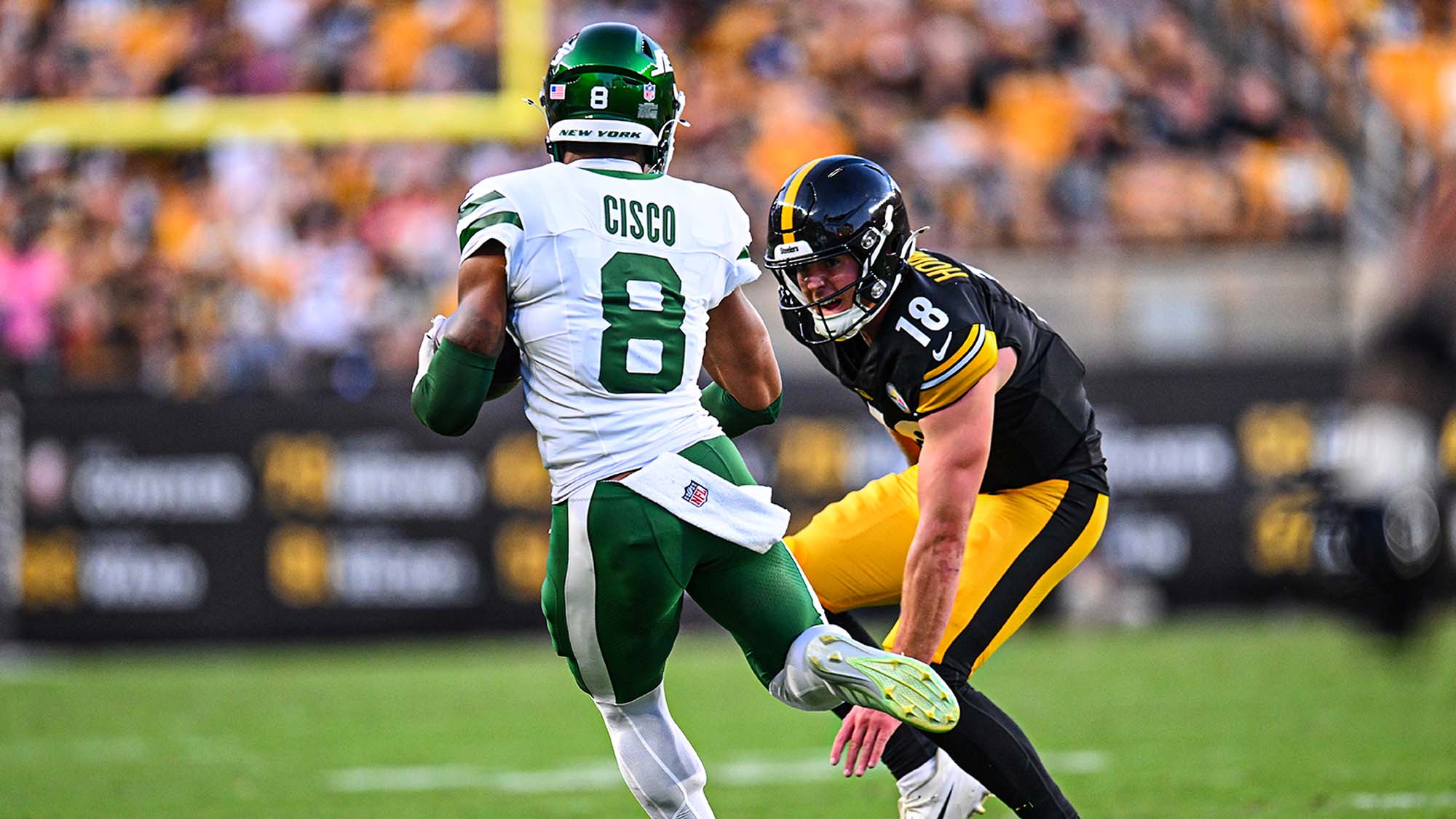
Dane Belton starts over Andre Cisco at safety
It appears that the competition for the Jets’ starting safety role next to Minkah Fitzpatrick has come down to Dane Belton and Andre Cisco, with 2025 fourth-round pick Malachi Moore dropping out.
In Week 1, Cisco started next to Fitzpatrick and stayed on the field throughout both of the first-team defense’s drives, but he stayed in with the second-team defense when Belton replaced Fitzpatrick. The duo played together into the second quarter.
In Week 2, though, Belton got the start next to Fitzpatrick. Belton and Fitzpatrick played together until a few minutes into the second quarter, when Cisco replaced Fitzpatrick mid-drive for the remaining three plays, capped off by a Cisco interception. From there, Belton sat and was replaced by Malachi Moore; Cisco played the rest of the second quarter with Moore.
This was a noticeable change compared to Week 1 because Belton stayed in the game with the starters longer than Cisco did in the opener, and when Fitzpatrick sat, they only played together for a few plays, whereas in the opener, the Jets tested Belton and Cisco together for an extended period.
While Belton arguably offers a higher ceiling than Cisco and has flashed more in training camp, the question here is which player fits better beside the Jets’ expected usage of Fitzpatrick.
As Jets X-Factor’s Robby Sabo pointed out, the Jets’ usage of Fitzpatrick in the preseason suggests they plan to use Fitzpatrick near the line of scrimmage, just as the Dolphins and Steelers did over the last few seasons, rather than move him back to the centerfielder role that he played earlier in his career.
In this case, Cisco would be a better fit than Belton. Cisco is a natural free safety with the necessary range to patrol the back end. Belton is not as rangy and is much better known for his skills near the line of scrimmage.
With that said, the Jets still utilized Belton as their primary back-end safety throughout his time on the field in Pittsburgh. Belton lined up as a deep safety on 63% of his snaps, compared to Fitzpatrick’s 44%. If there was a single-high safety when the two were out there together, it was typically Belton.
However, this would be a new and unfamiliar role for Belton, whose career deep-safety rate is 39%. Compare that to Cisco’s career rate of 69%.
Cisco might be the better fit to start next to Fitzpatrick, and his impressive drive on the ball for an interception was the perfect play to make the case for it. Belton, though, remains squarely in the mix, as shown by the fact that New York is curious enough in his capabilities as a starting free safety to start him next to Fitzpatrick over Cisco and give him extended reps in a deep role.
It is fair to question, though, whether starting Cisco as the deep safety and using Fitzpatrick near the line of scrimmage is actually the optimal way to deploy the talent in the safety room.
Are Jets properly optimizing their safeties?
At the apex of his impact in the NFL, Fitzpatrick was racking up takeaways as a roamer in the back end. Consider that in 2022, when he made his most recent of three All-Pro appearances and led the NFL with six interceptions, Fitzpatrick lined up as a deep safety on 68% of his snaps.
Since then, though, Fitzpatrick’s teams have moved him closer to the line of scrimmage. Last season with the Miami Dolphins, Fitzpatrick played deep on just 30% of his snaps. He still performed excellently in the role, but he wasn’t able to make as many splash plays, recording just one interception.
Relegating Fitzpatrick to a low-safety role limits his potential to maximize the skill that made him a household name: his ball skills. He can still be a difference-maker near the line of scrimmage, but he won’t get nearly as many opportunities to jump passes for interceptions.
Then the Jets have to consider who will start next to Fitzpatrick. The goal should be to start with the best pairing, not merely to choose a role for Fitzpatrick first and shove in whoever fits best next to that.
If the Jets plan to use Fitzpatrick as a box safety, Cisco is the better fit to start beside him than Belton. But Cisco was brutal for the Jets as their starting free safety in 2025; one preseason interception does not change that.
Across eight starts for New York, Cisco allowed a 152.6 passer rating on throws in his direction, per PFF, ranking fifth-worst among safeties. He also had nine missed tackles, an average of more than one per game.
Belton’s resume as a starting box safety is more appealing than Cisco’s production as a starting free safety over the last two seasons, in terms of both big-play production and consistency.
In 21 career games where he played at least 40 defensive snaps, Belton picked up six interceptions, two forced fumbles, and two fumble recoveries (10 total “big plays”) on 1,211 defensive snaps. That equates to an absurd 8.3 per 1,000 snaps.
Cisco, comparatively, has eight interceptions, two forced fumbles, and one fumble recovery (11 big plays) on 3,565 career defensive snaps, an average of 3.1 per 1,000 snaps, well below half of Belton’s rate in games where he played extensive snaps.
Fundamentally, Belton has been solid as a tackler and in coverage. Over the course of his four-year career, Belton has a missed tackle rate of 9.1% and an allowed passer rating of 92.4, per PFF. The 2025 NFL averages for safeties were 12.7% and 101.5, respectively. Cisco’s career averages are 14.2% and 103.4.
Statistically speaking, Belton as a starting strong safety is superior to Cisco as a starting free safety. Given that Fitzpatrick is the one player in this group who is versatile enough to play any role, why not use Fitzpatrick as the free safety so Belton can start over Cisco? This is especially appealing given that Fitzpatrick’s big-play ceiling has been at its highest when he plays free safety.
In fairness to New York, perhaps there is concern that Fitzpatrick, who will turn 30 in November, cannot hold up as a free safety anymore. This would probably be the most logical explanation for the Jets’ approach with him.
In 2023, Fitzpatrick missed seven games due to multiple lower-body injuries, including four games with a hamstring injury and three games with a knee injury that ended his season. Returning healthy in 2024, the Steelers continued using Fitzpatrick as a free safety, playing him deep on 69% of his snaps across 17 starts, but Fitzpatrick appeared to be declining.
Fitzpatrick allowed a career-high five touchdowns to just one interception in 2024, which was by far the worst ratio of his career to that point. He was traded to the Dolphins after the season.
In response to this performance, Miami moved Fitzpatrick to a slot and box-heavy role in 2025, which he thrived in, even if it resulted in a different type of impact than the interception-heavy numbers he was posting back in his prime days as a free safety.
So, the Jets certainly are not out of their minds to consider using Fitzpatrick in this way. Fitzpatrick had an excellent 2025 season in a low safety role; his 81.9 overall grade at PFF ranked sixth-best among safeties. Plus, he showed signs of possible decline as a deep safety in 2024, coming at a point where he was entering his late twenties and coming off lower-body injuries.
There is plenty of sound logic at play here. With that said, it would be premature to completely rule out Fitzpatrick’s potential to continue thriving as a deep safety and to pigeonhole him as a low safety for the rest of his career. He had one bad season in 2024; it could have easily been a mirage. Not to mention, he’s 29 as we speak, not 39. The guy can still move.
Have we really seen enough to be convinced that Fitzpatrick’s days as a premier ball hawk in the back end are over?
Heck, Kevin Byard just led the NFL with seven interceptions as a 32-year-old free safety, coming on the heels of back-to-back one-interception campaigns. Who is to say that Fitzpatrick cannot engineer a similar bounce-back? He deserves a chance to pull it off, especially for a Jets organization that only just remembered that their defensive players are, indeed, allowed to catch footballs.
The Jets’ true defensive plans remain unknown—teams do not show their cards in the preseason—but what we do know is that the Jets’ safety competition is still red-hot after two preseason games, with Belton seemingly gaining some steam, even if it might mean the Jets are considering playing him out of position.
On paper, the starting duo of Fitzpatrick (FS) and Belton (SS) looks much more appealing than Cisco (FS) and Fitzpatrick (SS) or even Belton (FS) and Fitzpatrick (SS), but perhaps the Jets know something that the people up here don’t.
