

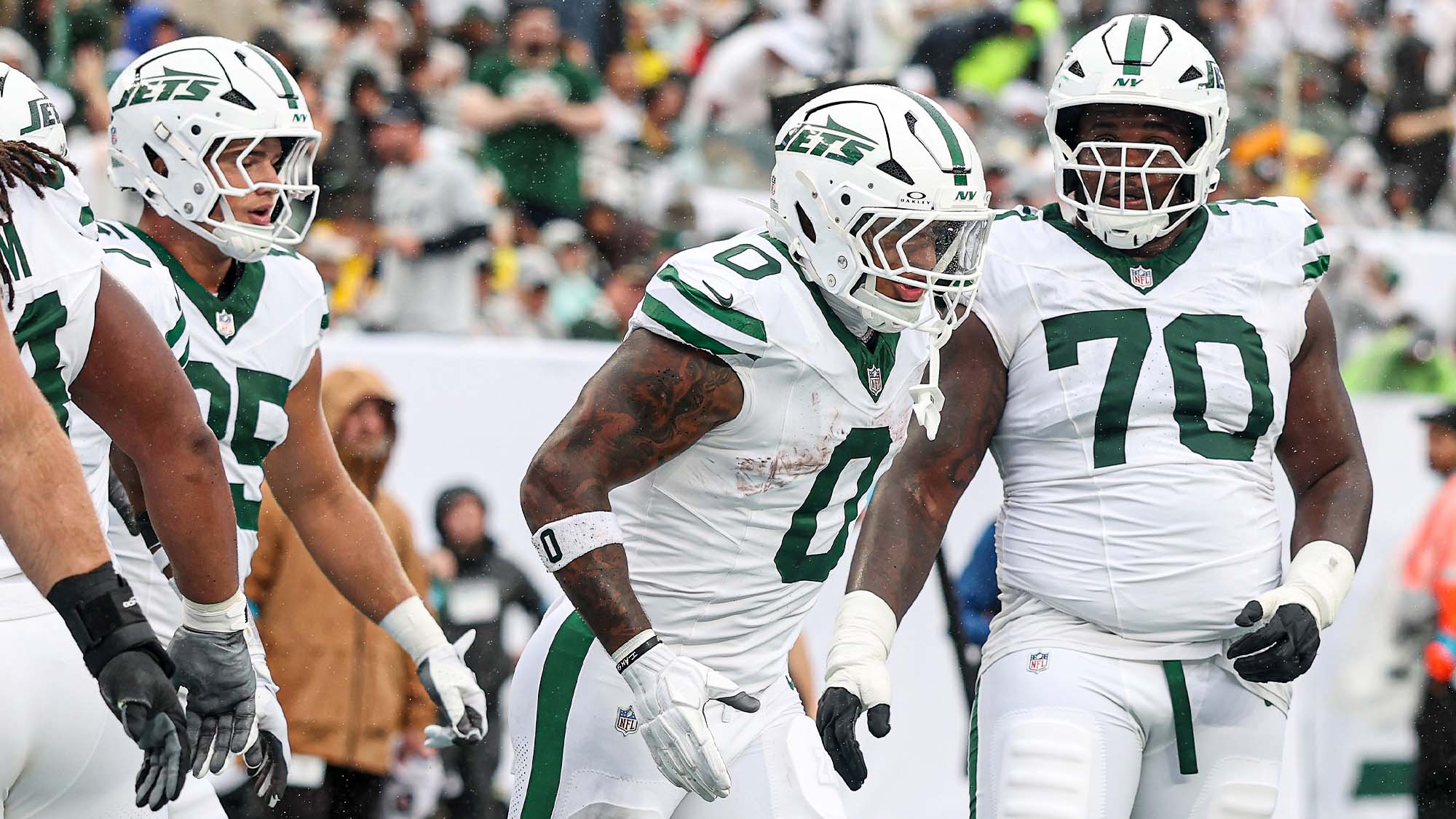
When the New York Jets stomped the Tennessee Titans in Week 1, one of the most lauded aspects of the performance was their run game.
New York ran all over Tennessee, to the tune of 152 yards and two touchdowns on 39 attempts. The Jets racked up a whopping 11 first downs on the ground.
It was a promising start for a run game that was expected to be the focal point of New York’s offense in 2026. With the freshly extended Breece Hall and a healthy Braelon Allen running behind a young, up-and-coming offensive line, the Jets were expected to provide a steady run game to support Geno Smith.
Two weeks later, though, the Jets’ rushing attack has suddenly become a major problem.
New York rushed for just 125 yards over the last two games, fewer than they accumulated in Week 1 alone. The designed run game out of the backfield has been particularly horrendous; running backs Breece Hall and Braelon Allen combined for 82 rushing yards on 38 carries, an abysmal 2.2 yards per carry.
Rather than support Smith, the run game has forced Smith to carry the offense on his own. The veteran quarterback has been up to the task, throwing the ball with excellent precision over the last two weeks, but the non-existent run game continues to hold the Jets back from scoring as many points as they should, given the efficiency of their quarterback.
It’s not often that you see a two-game stretch during which a quarterback throws for 568 yards, four touchdowns, no interceptions, and a 111.5 passer rating, but his team scores only 41 points (20.5 per game) and loses both games.
Points have been left on the board in high-leverage spots because of short-yardage failures, either in the red zone or on fourth down. At pivotal points of games, the Jets have been allowing costly sacks, due much in part to passing situations becoming predictable as a result of the brutal run game forcing the Jets into obvious pass mode.
No matter how good Smith and the passing game look, the offense will continue to have a firm cap on its ceiling if the run game continues to be this useless.
So, what has caused the Jets’ run game to fall off the face of the earth?
Multiple problems are contributing
The main problem is that the Jets simply aren’t giving their backs any room to work with.
Over the last two games, Breece Hall and Braelon Allen have combined for 20 yards before contact on 38 carries, according to Pro Football Focus. That just 0.5 yards before contact per attempt.
Essentially, Hall and Allen are only getting 18 inches past the line of scrimmage before a defender touches them. That… isn’t ideal.
Compare that to Week 1, when Hall and Allen combined for 65 yards before contact on 32 carries, a fantastic 2.1 yards before contact per carry. For reference, the 2026 league average for running backs is 1.2.
What has caused the drop-off?
Firstly, the Jets have seen a few blockers go cold, namely right tackle Armand Membou. From Weeks 2-3, Membou had a 45.0 run-blocking grade, via PFF, a steep drop from his 72.2 mark as a rookie.
Dating back to his days at Missouri, Membou’s pass-blocking technique has been well ahead of his run-blocking technique, contrary to popular narratives that spawned from highlight reels. Membou has been a significant contributor to the Jets’ solid pass protection this season, but his consistency in the run game is still a work in progress.
The Jets also need more from their skill-position blockers. They continue to rely heavily on multi-tight end sets, but that strategy has been counterproductive in the run game, considering that the bigger bodies on the field aren’t actually blocking well.
Over the last two games, tight ends Kenyon Sadiq and Jelani Woods have run-blocking grades of 39.0 and 39.7, respectively, which is extremely poor. Jeremy Ruckert has a mediocre 60.0 grade over the last two games, as he has thrown some solid blocks, but he also had a major mistake on the most critical run play of the Jets’ Week 2 loss.
Another issue is that opponents are game-planning to take away the Jets’ run game.
In their Week 3 loss to the Detroit Lions, the Jets faced a stacked box on 47.4% of their rush attempts, according to NFL Pro, the third-highest rate of the week. This shows that the Jets were at a numbers disadvantage on nearly half of their carries.
The best way to make teams stop stacking the box is to beat them through the air. The Jets eventually did that, as Geno Smith completed 31 of 37 passes for 321 yards, three touchdowns, and no interceptions, but much of that success did not come until the Jets were trailing in the second half and had already chosen to mostly abandon the run game.
When the Jets were trying to establish the run early, they weren’t punishing the Lions for committing extra resources to the run game, save for one touchdown drive over the first three quarters. If the Jets want to re-establish a consistent run game throughout four quarters, they need to generate explosive passing plays earlier in the game to make opponents think twice about stacking the box.
It is also fair to point out that the Jets’ running backs have not been impressive as playmakers. Granted, there is only so much they should be expected to do in certain situations, but overall, Hall and Allen have done little to outperform the blocking.
As a duo through three games, Hall and Allen have combined for -4 RYOE (rushing yards over expected), per NFL Pro. Hall is at -8, while Allen is at +4.
Coming over 70 combined carries, Hall and Allen are averaging a combined -0.06 RYOE per carry, which essentially means they are getting exactly what they are expected to on each carry—nothing more, nothing less.
Everyone has to pitch in
When a team generates 125 rushing yards over two games, it does not fall on one person or one unit. That’s a team-wide failure.
Many blockers need to step up their games, both within the offensive line and at the skill positions. Offensive coordinator Frank Reich must find ways to give the Jets better numbers in the box, both by punishing stacked boxes through the air and setting up more creative run concepts when teams do stack the box. It’s also fair to say that the Jets’ playmakers should, well, make more plays.
Smith deserves immense credit for the way he overcame the total lack of a run game over the past two weeks. The Jets shouldn’t expect him to do that forever, though.
A big reason that Smith had a promising outlook in 2026 was that New York was supposed to provide him with a better supporting cast than the 2025 Las Vegas Raiders. In some ways, they’ve pulled that off, but in terms of the run game, they have failed miserably over the last two weeks.
If the Jets want Smith to maintain his success over the rest of the year, they must get back to running the ball at a high level, taking the pressure off him to carry the offense each week.
And if Smith does continue playing this well in spite of the run game, it’s even more reason for the Jets to emphasize getting the ground attack back to par. Imagine what the Jets’ offense would be capable of if they complemented Smith’s dominant Week 3 passing efficiency with even just a league-average run game.
Everyone involved in the Jets’ offense must do their part to revive the rushing attack.
