
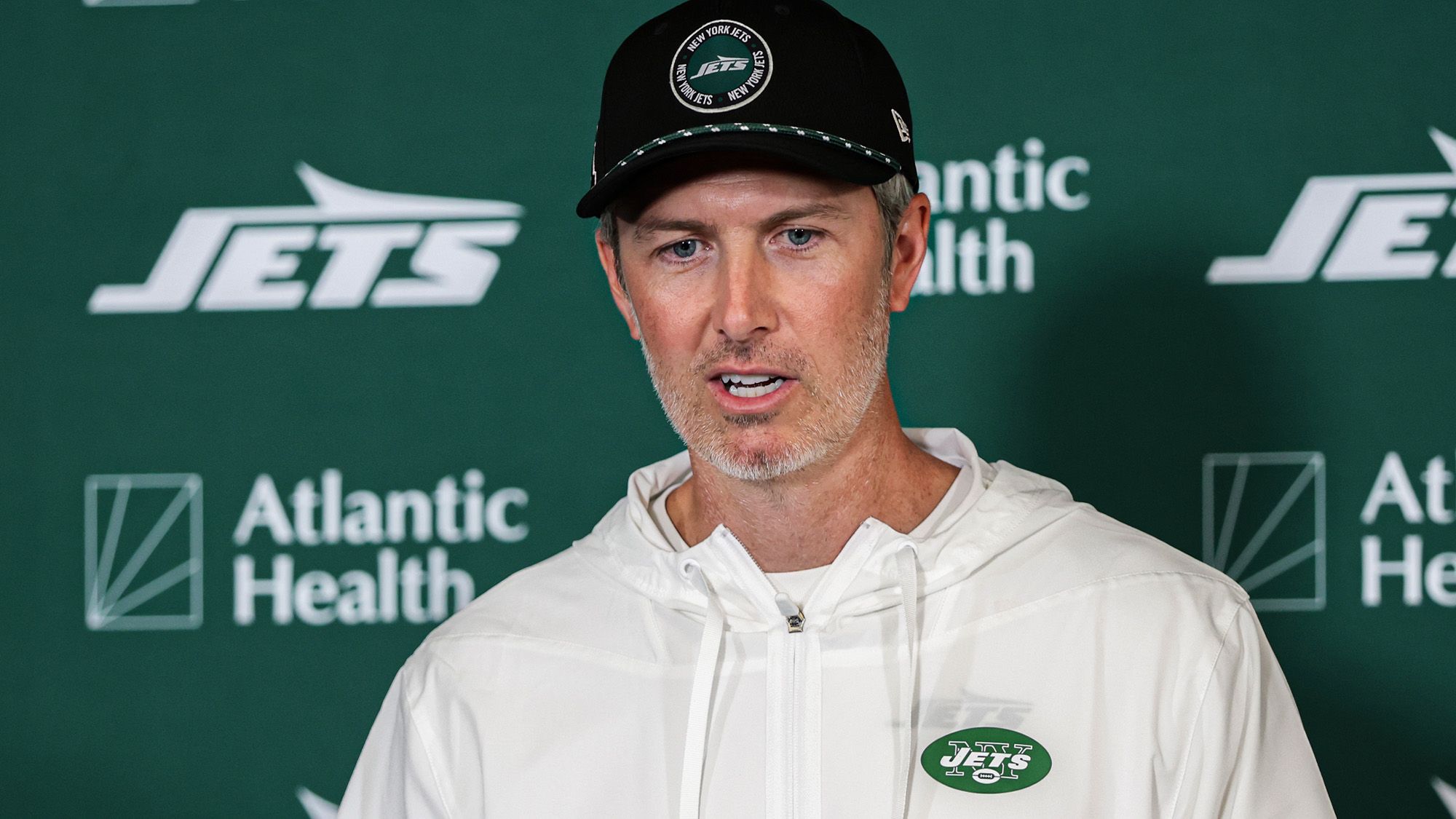
Following the New York Jets’ rough 23-12 Week 4 loss to the Chicago Bears, conversations around the job security of head coach Aaron Glenn are back, and rightfully so. The team is 1-3 on the year and now 4-17 throughout Glenn’s tenure.
General manager Darren Mougey has also started to take some heat from Jets fans, although his approval rating seemed much higher entering the year than Glenn’s.
How much blame does Mougey deserve for the Jets’ shortcomings compared to Glenn?
Separating Glenn and Mougey
Let me be clear: Mougey and Glenn share the same record. The 1-3 start to the season and the 4-17 overall record belong to both of them, and neither one should be shielded from criticism.
As someone who has defended Mougey, I want to be clear: At the end of the day, his job is to build a roster that wins football games. His teams have won just four games since he was hired.
However, while Mougey certainly deserves some blame for that, he should not be evaluated the same way as Glenn. When you look at the individual moves Mougey has made, there are many more reasons to give him more time than there are for Glenn.
Let’s start with the obvious: the Sauce Gardner and Quinnen Williams trades yielded New York three first-round picks, a second-round pick, and wide receiver Adonai Mitchell, who has looked like a legitimate building block for the team.
Then, there are the moves on the margins. Acquiring Harrison Phillips and Jowon Briggs around last year’s cutdown day in exchange for Day 3 pick swaps was shrewd. The acquisition of Briggs is probably the least talked-about big move of Mougey’s tenure. Briggs has shown flashes of becoming an elite pass-rushing DT, and the Jets got him in just a late-round pick swap. Even Phillips is a captain and has been valuable in run support.
The addition of Jarvis Brownlee Jr. has developed into an underrated pickup. A few weeks into the 2025 season, Mougey exchanged a Day 3 pick swap for Brownlee, who has settled in pretty nicely as a starting piece in the Jets’ secondary this season.
Mougey has been excellent on the trade market. His draft classes, though, are an interesting study.
The Day 3 results have undoubtedly been disappointing, especially in 2025. Arian Smith, Malachi Moore, and Tyler Baron do not appear to be long-term contributors. Mougey deserves blame for that, but his results near the top of the draft have been more promising.
Armand Membou has looked every bit of a long-term building block at right tackle. He has the potential to be the best at his position by the end of the year.
Mason Taylor, the team’s second-round selection, flashed during his rookie season, catching 11 of his 14 contested targets for a 78.6% conversion rate, the second-highest in the NFL, trailing only George Kittle. He is currently out with a thumb injury, but his rookie campaign, despite playing with three different QBs, showed that he has what it takes to be an impact piece on offense.
Then, there is Azareye’h Thomas, Mougey’s third-round pick that year. He passed the eye test in his rookie season, and this year, he has emerged as one of the Jets’ starting boundary corners, alongside Brandon Stephens. So, each of Mougey’s first three picks from his debut class are second-year starters.
You can’t completely neglect the late-round misses, but if the top three picks hit and become building blocks, like Membou and Thomas have looked like in particular, that creates more margin for error on Day 3. Put it this way: it’s much more beneficial to nail the top picks than to struggle there and come away with a few Day 3 finds here and there.
Now, let’s take a look at the additions Mougey made in free agency this year.
Demario Davis has been asked to carry a significant load for the Jets’ defense. Through four games, he has played every defensive snap (93) while taking over the green-dot responsibilities. While he hasn’t always made the splashy plays, he has played a significant role in the team’s operation.
Then, there is Dane Belton. He has arguably been one of Mougey’s most savvy additions throughout his tenure with the Jets. Signed to a one-year, $4 million deal this offseason, he ranks 11th among 92 qualified safeties in Pro Football Focus’ defensive grade (77.0).
Over the first two weeks of the season, left guard Dylan Parham, another of Mougey’s free agent additions, led all offensive linemen in PFF’s overall grade at 92.8. The process behind the Parham signing was sound; when he was initially signed, it appeared that Mougey had found an upgrade over John Simpson at a younger age and for a cheaper cost, and so far, that has proven to be the case.
Before landing on injured reserve, defensive tackle David Onyemata showed some encouraging signs. In Week 1, he tied for 11th among defensive tackles with three pressures. He was playing the most snaps among New York’s interior defensive line and seemed poised to make a big impact.
Edge rusher Kingsley Enagbare logged six pressures and two sacks throughout the first two games of the year. He also tied for fifth among defensive linemen in total pass-rush wins (10), per ESPN, over that span. That’s an excellent start to the year for a player signed to a one-year, $10 million deal. He has looked to be more than just a rotational piece off the edge.
Even the decision to replace Nick Folk, which was rightfully criticized at the time, has actually panned out. Through Week 4, Jason Sanders has made seven of his eight field goal attempts (87.5%), compared to Folk, who has made six of his nine FG tries (66.7%).
Mougey’s most questionable signing from this offseason has been Joseph Ossai. He was signed to a three-year, $34.5 million deal, but injuries forced him to miss most of the summer and the first two games of the season. Through his first two outings of the year, he’s left a lot to be desired.
Beyond free agency, Mougey also brought in Minkah Fitzpatrick and T’Vondre Sweat via the trade market. Fitzpatrick is a key piece in the Jets’ secondary, as shown by his interception in Sunday’s loss to the Chicago Bears, which broke the Jets’ grueling INT drought. Sweat has also done an excellent job of settling into his role as a space-eater, and his 78.9 PFF defensive grade ranks eighth among 92 qualified IDL (minimum 100 snaps).
Let’s move on to this year’s draft class, where Mougey had four top-50 picks, including the No. 2 overall selection. Four career games is way too small a sample size to fully evaluate his top picks, but it’s worth checking in.
Second-overall pick David Bailey has had an up-and-down start. Some feel he has been an impact player, while others disagree. Bailey’s fate will end up being a crucial part of Mougey’s resume; at the end of the day, it’s his pick, even if Aaron Glenn certainly had input.
His No. 16 overall pick, tight end Kenyon Sadiq, has already flashed. In Week 3 against the Detroit Lions, he caught seven passes for 105 yards and a touchdown, becoming the first Jets rookie tight end with a 100-yard game since Dustin Keller in 2008. Consistency will be key for him, as he didn’t catch a pass in Week 4, but the Jets completed just eight total passes. His freakish athleticism and impact have already flashed.
The Jets traded back into the first round to grab Omar Cooper Jr. with the 30th overall pick. He has only played five snaps, so there is nothing to evaluate. In Week 1, his only NFL reception went for 30 yards and set up a Sadiq TD, but he has been sidelined with an ankle injury. When he gets healthy, though, he is expected to contribute immensely within the Jets’ passing attack.
Mougey’s second-round selection, D’Angelo Ponds, has played only 20 defensive snaps after missing training camp and the preseason with a calf injury, as well as the first two weeks of the year. Playing 18 snaps against the Bears in his first extended appearance, Ponds went through expected rookie bumps, allowing his lone target in coverage to be completed for 21 yards while committing two penalties. However, the sample size is still ridiculously small.
Meanwhile, the Jets’ Day 3 selections haven’t been relied upon in big roles yet, and that’s for the best. It’s typically good not to see those guys much in year one. Fourth-round pick Cade Klubnik is the QB2, while fellow fourth-rounder Darrell Jackson Jr. has been an end-of-the-rotation DT. The final two picks, IOL Anez Cooper and S VJ Payne, are still recovering from injuries and remain on injured reserve.
Mougey has been nowhere near perfect. He has made moves that certainly deserve criticism, and he shares the same record as Glenn. He is also to blame for giving Justin Fields $30 million guaranteed a year ago. Eventually, his work has to lead to wins. Just ask Joe Douglas.
But when you analyze the process behind Mougey’s decisions, there are considerably more reasons for optimism than there are with Glenn. Mougey has been excellent on the margins while also landing several promising pieces throughout his draft classes so far. His veteran pickups on the free agent market have been solid. There is enough there to believe he is capable of building a core that anchors success.
This year’s draft will play a major role in determining his future. The rookie seasons of his top picks will be crucial in establishing his capabilities. With the significant amount of draft capital the Jets had in April and coming up, Mougey needs those picks to pan out.
Mougey still has a lot to prove, but he has earned way more benefit of the doubt than Glenn has. If the Jets decide to move on from Glenn, Mougey’s track record so far leads me to believe that he should have the opportunity to hire New York’s next head coach.
I understand why fans are growing frustrated with the whole regime, given their awful 4-17 record since being hired. However, based on what Mougey has shown so far, he deserves an opportunity to stick around, even if Glenn is canned.
