

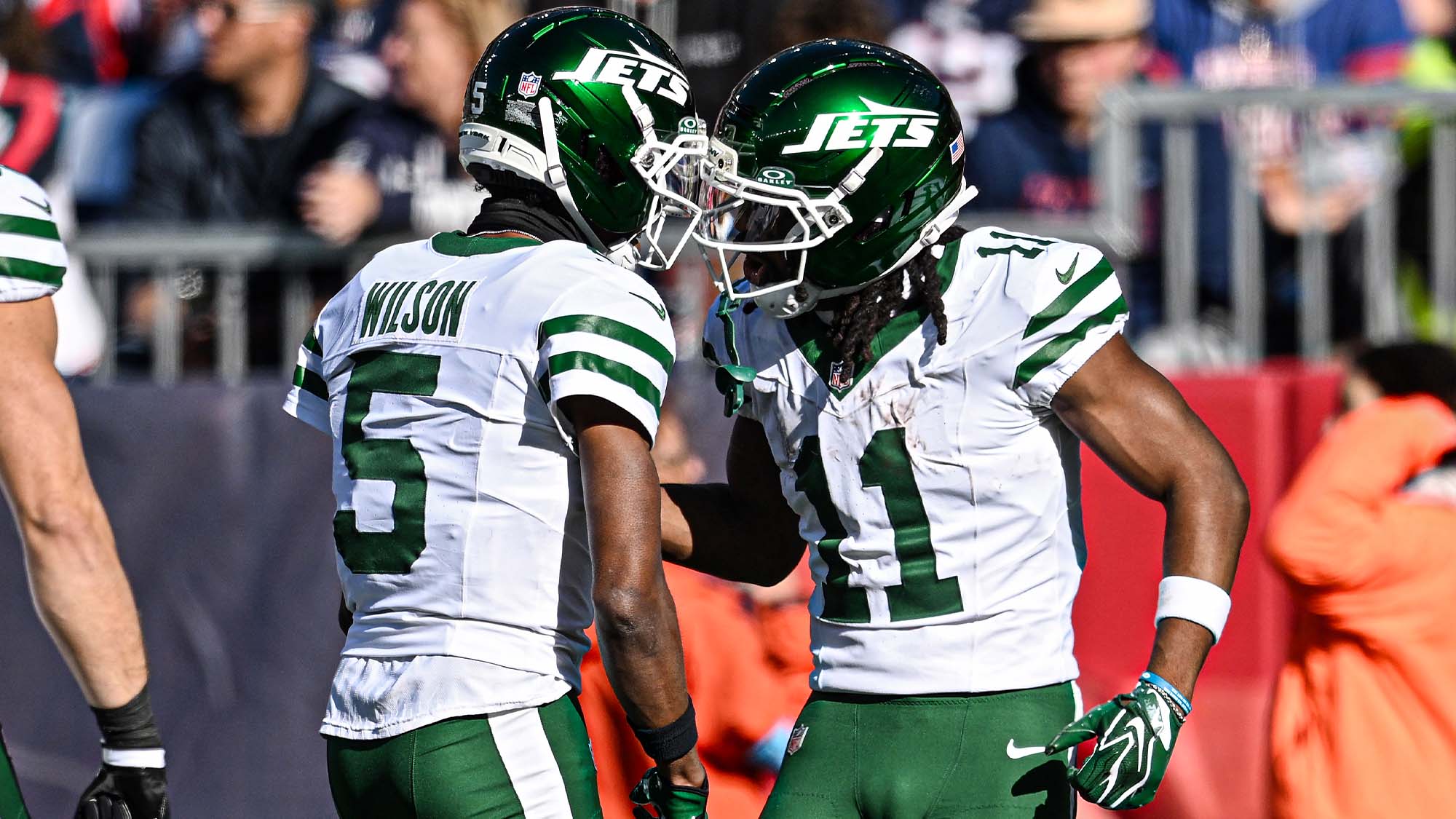
Throughout the New York Jets’ 2-4 start to the 2026 season, there has been a recurring theme over their four losses: the offensive weapons being a silver lining.
In the Jets’ Week 2 overtime loss to the Green Bay Packers, third-year receiver Adonai Mitchell continue building on the potential he had shown in Week 1 and throughout the summer, catching six passes for 63 yards and five first downs in the rain, including some difficult grabs.
When the Jets lost a Week 3 thriller against the Lions in Detroit, rookie tight end Kenyon Sadiq broke out with seven catches for 105 yards and a touchdown.
Then, this past Sunday against the New England Patriots, rookie wide receiver Omar Cooper Jr. returned to the lineup with a bang, catching six passes for 103 yards and a touchdown, while a 14-yard touchdown reception was wiped out by an unrelated penalty.
Meanwhile, Garrett Wilson spent the first five weeks playing like the NFL’s best receiver before a quiet Week 6 in which the Patriots focused on taking his targets away. Additionally, running back Braelon Allen has stepped up in a major way since taking over for an injured Breece Hall, tapping into a level of play he had never shown before in the NFL.
Amidst all of these positive flashes from numerous weapons, the Jets have yet to get them all on the field at the same time, save for the first five plays of the season opener. Cooper missed most of the opener and the following four games, while Mitchell has been out since Week 3. Hall has been absent since Week 4.
Thinking about this raises a question: Could the Jets have one of the most talented skill groups in the league once they get everyone on the field?
Ceiling of Jets’ offensive weaponry
Wide receiver
It all starts with the Jets’ offensive anchor: Garrett Wilson.
Where you place him is debatable, but within the things he can control, Wilson has spent the first six games playing like a top 10 receiver at the very least, and there is a case to put him much higher than that. He’s separating at an elite level and catching almost everything thrown his way.
From there, you have Mitchell, who generated optimism with an impressive summer and built on it through the first two games of the season. Mitchell was showing legitimate WR2 chops, catching 9 of 15 targets for 123 yards and 7 first downs.
Mitchell is a former second-round pick who only turned 24 years old this month. His tape over his first two NFL seasons was littered with moments in which he separated for potential deep receptions but was missed by one of his many poor quarterbacks. Now that Mitchell has a competent, accurate starter in Geno Smith, we were seeing him put up high-level WR2 numbers for two games before he went down with a finger injury.
Even though his sample size of production is currently small, it isn’t too much of a stretch to expect that what Mitchell was doing can be sustained. He is a second-round talent who remains early in his career, and his first two seasons featured constant flashes of this potential.
Then you have Cooper, who has done nothing but make plays in his very limited time on an NFL field. Across just 29 routes run through his two NFL games, Cooper has caught 7 of 8 targets for 133 yards and a touchdown, plus a 14-yard touchdown wiped out by a penalty that did not affect the play.
If you add in the called-back touchdown, Cooper has eight receptions for 147 yards and two touchdowns on 29 routes run, an average of 5.07 yards per route run, which is insanity. He will not maintain that number, but the frequency at which he has made big plays during his brief time on the field is an extremely promising sign regarding his potential.
A Wilson/Mitchell/Cooper trio is well-rounded and highly explosive. Wilson is an all-around WR1, while Mitchell brings field-stretching speed that defenses have to respect. Cooper is a physical YAC threat out of the slot, with no shortage of his own separation skills and field-stretching potential, as he showed in New England.
Tight end
Taking it to the tight end position, the Jets have one of the higher-ceiling one-two punches in the league.
Kenyon Sadiq, the 16th overall pick this year, has arguably the best athletic profile for a tight end in NFL history, and he’s shown it at times this season, namely on an end-around touchdown in Week 1 and throughout a 105-yard explosion in Week 3. The Jets are still trying to find ways to get him consistently involved, but the ceiling is obvious.
Mason Taylor does not have Sadiq’s athleticism, but he is a well-rounded TE1, offering solid blocking skills, soft hands, and toughness in contested-catch scenarios. Taylor has caught 11 of his 16 career contested targets (68.8%), and he’s been a sure-handed safety blanket since returning from injury two weeks ago, catching 7 of 9 targets for 57 yards with no drops.
New York has been inconsistent at getting these two players involved in the passing game, and they will often step on each other’s toes from a target standpoint, but both have typically delivered when called upon in their short careers. Whether they are eventually recognized as one of the league’s top duos will depend on whether their production volume eventually spikes, but in terms of efficiency, reliability with the opportunities presented them, and potential, they are one of the more exciting pairings out there.
Running back
In the backfield, the Jets will have somewhat of a controversy once Breece Hall returns from his quad injury, but it’s a good type of controversy, as Braelon Allen has shut up his doubters (i.e., me) by going on an absolute rampage over the last two weeks.
Allen’s previous two games featured 41 carries for 194 yards and a touchdown, impressive averages of 20.5 carries for 97.0 yards. His 4.7 yards per carry don’t jump off the page, but it’s a solid mark on high volume.
That YPC number doesn’t do Allen’s breakout justice, though. The impressive truth is that Allen created nearly all of those rushing yards by himself.
The Jets’ run-blocking has struggled for much of this season, including the last two games. Allen, though, has taken matters into his own hands, single-handedly saving the Jets’ run game from total dormancy.
Over the last two weeks, Allen leads the NFL with 14 missed tackles forced, three more than any other player and at least double every player except Bucky Irving (11) and Rhamondre Stevenson (9). To boot, a mind-boggling 185 of Allen’s 194 rushing yards came after contact. That gives him an average of 4.5 yards after contact per carry, compared to 0.2 yards before contact per carry, with 95% of his rushing yards coming after contact.
That… is elite running back play.
And it came out of nowhere for Allen, who never showed anything close to this level of play over his first 25 career games.
Allen’s 14 missed tackles forced over the last two games are just three shy of the 17 that he had over his first 25 games. On a per-carry basis, Allen’s efficiency at making men miss has nearly tripled; he went from 17 career MTF on 143 carries (0.119 per attempt) to 14 MTF on 41 carries (0.341 per attempt) over the last two games.
In the past, it had felt as if Allen’s massive frame did not make much of an impact on the field, but over these last two games, Allen has finally figured out how to maximize it, consistently trucking defenders over and running through arm tackles. He also looks shiftier and more decisive in his reads than he ever had before.
It’s been a stark overnight turnaround for Allen, and now, the Jets have to weigh what to do with Hall upon his return. Of course, fresh off a three-year, $43.5 million extension, Hall won’t receive anything less than half of the snaps and touches, but will the Jets go back to using Hall as the clear-cut No. 1, or will they switch to essentially a 50-50 split?
Hall had been having a shaky start to the season as a rusher, averaging 3.2 yards per carry with just 1.9 yards after contact per carry, but the Jets know that he is an explosive-play threat who needs a high volume of carries to maximize his chances at racking up those explosive plays. He’ll eventually hit a home run or two to spike that YPC average, so he needs his carries to get them.
As opposed to Hall’s boom-or-bust approach, Allen brings a completely different style. He will never be a home-run hitter; the longest play of his career went for just 22 yards, and it’s apparent whenever he hits the second level that defenders can easily catch up to him. But what he’s done extremely well over the last two games is consistently churn out one positive chunk after the next.
Hall, though, brings receiving abilities that Allen does not. Hall is an all-around receiving threat who can run routes out of the backfield, split out wide, and take a screen pass or checkdown for 40-plus yards. The Jets also have a lot of trust in his blocking. Allen, though, is extremely drop-prone (6 career drops for a 16.7% drop prone), has not shown route-running chops, and doesn’t have the same potential to take a short reception the distance.
New York trusts Allen’s blocking, too, which kept him on the field for third downs in Hall’s absence, but Allen has been inconsistent in that area. His size makes him a formidable presence when he engages with a defender, but he has been inconsistent at diagnosing blitzes and getting to the right spots; one sack in Sunday’s loss to New England appeared to be on him.
Ultimately, though, these are all good problems. The Jets have two talented backs to mix-and-match, allowing them to have ideal options for most situations, while keeping both backs fresh.
From a league-wide ranking standpoint, the main concerns are Hall’s health and the sustainability of Allen’s recent spike in performance.
Hall was already struggling a bit before his quad injury; will he be 100% upon his return? As for Allen, his last two games have been outstanding, but for now, they stand out as an enormous outlier compared to his first 25 games, so we still have to find out if he’s really turned a corner or if he was merely on a hot streak.
This duo’s ceiling, though, is quite lofty, even if it does have a somewhat troubling floor.
Verdict
Yes, this can be one of the most talented skill-position units in the NFL when everyone is active.
Here is what the Jets’ 11 personnel package could look like in a passing situation:
- WR Garrett Wilson
- WR Adonai Mitchell
- WR Omar Cooper Jr.
- TE Kenyon Sadiq
- RB Breece Hall
In a four-minute situation as the Jets look to chew clock, they can throw this 12 personnel package out there:
- WR Garrett Wilson
- WR Adonai Mitchell
- TE Kenyon Sadiq
- TE Mason Taylor
- RB Braelon Allen
Based on what all of these players have done when healthy and given opportunities this season, both of those packages look pretty darn solid.
Each of the Jets’ top seven weapons have shown flashes of high-level potential in their respective roles this season. The challenge for each of them (besides Wilson) is to maintain it, but the potential is there, and that’s why it’s fair to say that this can certainly be one of the most “talented” skill-position units in the NFL when everyone is healthy. That’s different from saying “one of the best”—you have to produce for a long while if you want to be considered among the best. Until you produce, it’s all mere projection.
In the meantime, though, the collective talent of New York’s offensive weaponry is extremely intriguing.
