

Suffice it to say, the New York Jets’ offense is not very good.
Despite moving the ball fairly well (16th in total yards per game), the Jets are held back by a bafflingly inept red-zone offense (32nd with a 38% touchdown rate), causing them to rank just 26th in points per game.
The offense as a whole is clearly a liability, but that doesn’t mean there aren’t plenty of valuable individual building blocks within the unit. With nine games to go, the Jets need to evaluate how many useful pieces they have in every area of the sport. That includes one of the game’s most overlooked facets: skill-position blocking.
When fans and analysts discuss blocking, they usually focus on the offensive line, but it often goes overlooked that the tight ends, wide receivers, and running backs are involved in every blocking scheme, too. Collectively, they play a large role in determining a team’s blocking performance.
So, how has the Jets’ skill-position blocking looked through the first 10 games of 2026?
Let’s run through some numbers first, and then we’ll get to the film to see if it lines up with those numbers.
Your team. Your decisions.
Jet X Game Simulator
Win a lifetime membership
Beat any of the five Legend challenges without simulating.
Play the weekly matchup or relive a classic. Choose a current matchup or classic game, and log in to save Coach Points.
Explore Game SimulatorChoose your mode on the Game Simulator page. Full games · Weekly prep · Classic challenges.
Jets’ skill-position blocking numbers
Pro Football Focus’ grades are our only option for quantifying the Jets’ skill-position blocking. Of course, PFF grades have their flaws, so we’ll look at some film to see if the numbers hold up, but the grades give us a good starting point, as they allow us to compare the Jets against the rest of the NFL.
When it comes to run-blocking, the Jets’ skill-position players have combined for a 53.1 grade, ranking 28th in the league.
As much as this facet of the game is ignored, there is a noticeable correlation between PFF’s run-blocking grade and rush offense DVOA, suggesting that skill-position blocking affects teams’ overall rushing efficiency more than people realize. Overall, the Pearson correlation between the two is 0.537.
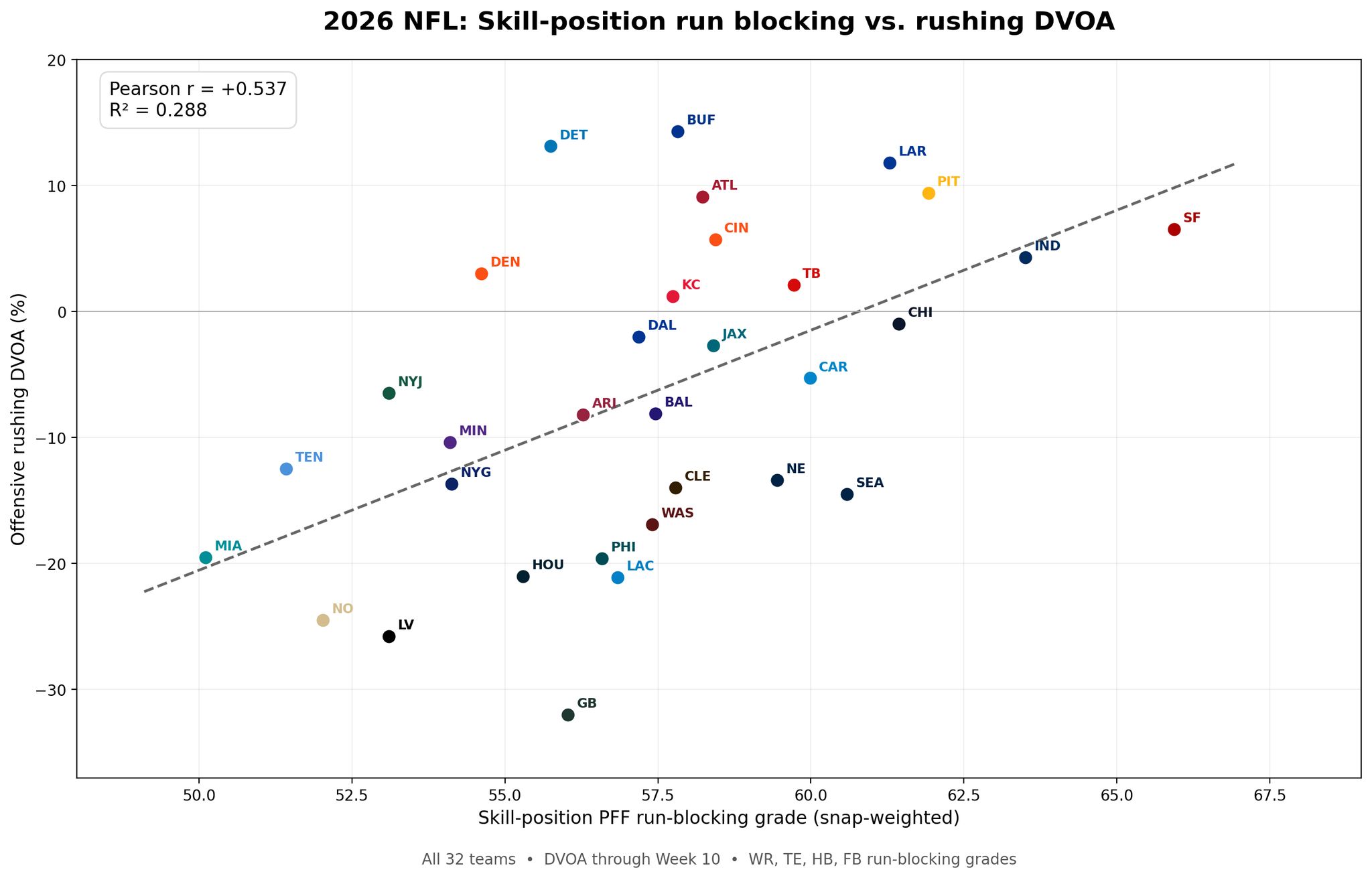
The Jets have actually managed to field the 16th-best rushing offense (based on DVOA) despite their 28th-ranked performance in skill-position run-blocking, but it seems likely that their skill-position players are holding the run game back from being much better.
When you dive into the Jets’ rushing success this year, much of it came from the individual brilliance of Braelon Allen. If the tight ends and wide receivers helped carve out bigger holes, the run game’s ceiling would soar. Each of the top five teams in skill-position run-blocking grade have posted a better rush offense DVOA than the Jets, despite Allen’s individual rushing creation this season being at least on par with most of the backs on those teams.
When it comes to pass-blocking, though, the Jets have fared much better. New York’s skill-position players have combined for a 67.3 pass-blocking grade, ranking third-best.
The correlation between skill-position pass-blocking grade and pass offense DVOA is not quite as strong (0.367 Pearson correlation) as the rushing side, but there is still something there.
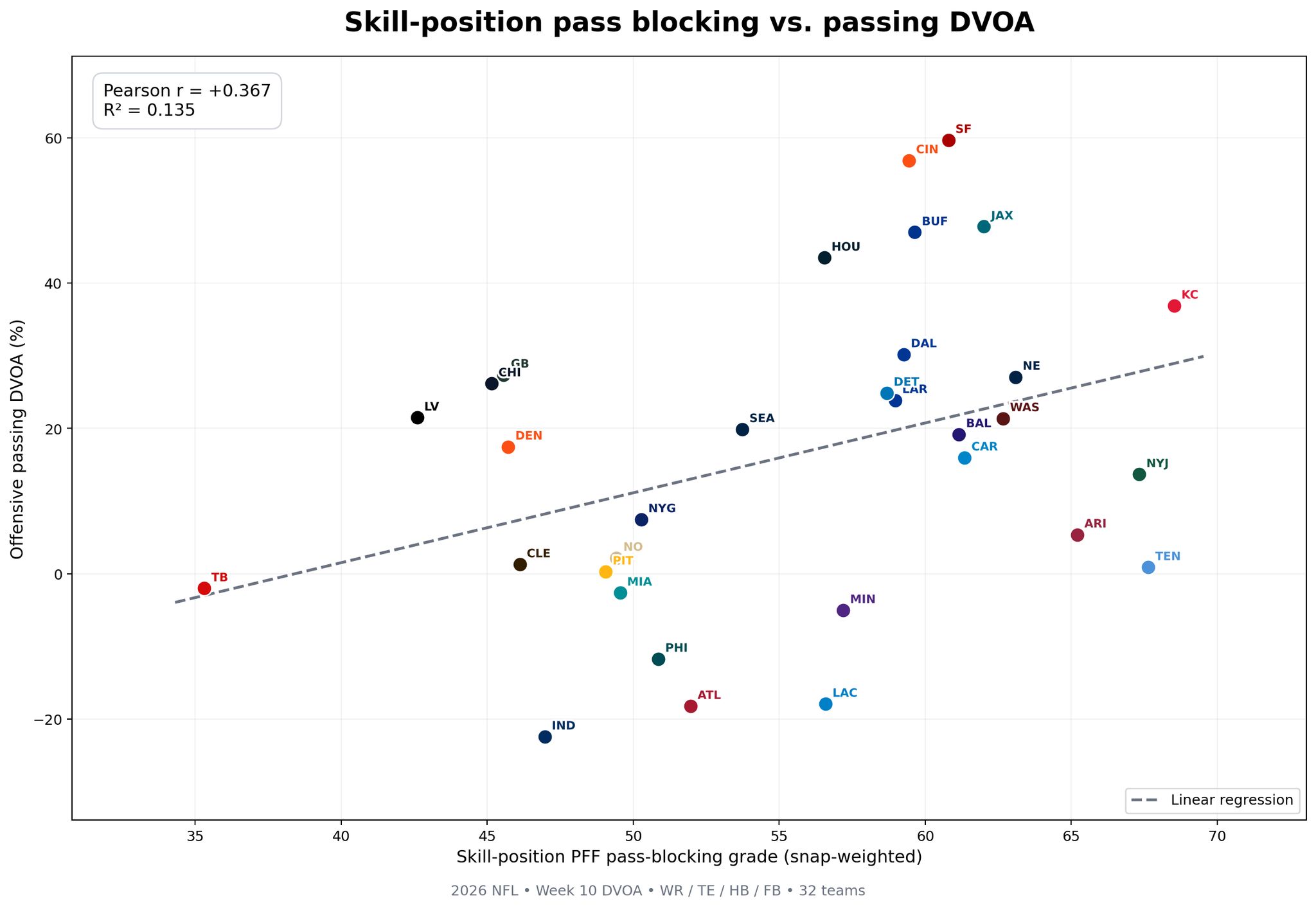
The most noticeable thing is that no elite passing offense has bad pass-blocking at the skill positions. You can see that each of the clear-cut top-six passing offenses (Cincinnati, San Francisco, Jacksonville, Buffalo, Houston, Kansas City) is on the right end of the chart.
While not all of those five teams enjoy great pass-blocking from the skill positions (Houston is 18th), none have poor pass-blocking from those spots, showing that, at the very least, you probably need your skill-position players to offer adequate pass protection for elite aerial success to be possible. A bad skill-position blocking unit can take that ceiling away.
The Jets can take solace in knowing they have a crop of strong pass-blockers at the skill positions, which helps them maintain an elite offensive ceiling moving into 2027 and beyond.
Now that we’ve looked at the unit’s numbers, let’s dive into the performances of individual players, using film to complement the stats.
Jets’ skill-position blocking
We’ll start with the run game: Who is at fault for the unit’s 28th-ranked run-blocking grade?
PFF’s biggest culprit is Isaiah Williams, who has a 39.7 run-blocking grade. That’s unsurprising; at 5-foot-10 and 185 pounds, you don’t expect him to be a force in this area. Plus, Williams is the Jets’ WR4, who is primarily on the roster for his special teams ability, so we shouldn’t expect much from him offensively in general, let alone as a blocker.
Perhaps the most notable grade belongs to rookie Omar Cooper Jr., who ranks second-worst among the team’s skill-position players with a 41.8 run-blocking grade.
Looking at the film, you can see why Cooper has a low grade. It isn’t for a lack of effort; it can actually be said that he plays with a little too much effort. There are a few examples of Cooper going into blocks too aggressively and getting shed, allowing his man to get involved in the tackle.
Due to sample size, the primary culprit for the Jets’ low skill-position run-blocking grade is Garrett Wilson. He has logged a team-high 180 run-blocking snaps, 56 more than any other player in the unit, so his 51.6 run-blocking grade carries a lot of weight in the unit’s overall grade, even if it’s less woeful than players like Cooper (41.8) and Adonai Mitchell (42.6).
I think Wilson’s grade might be a bit harsh, as he is rarely involved in the Jets’ run game at all, due to how far away from the ball that he usually lines up. His effort is fine, albeit unimpressive, but overall, he is mostly a non-factor in the results of New York’s rushing attack. However, a couple of mistakes can be found on his film, explaining why his grade is on the lower end.
On the positive end, tight end Mason Taylor leads the Jets’ skill-position players with a 68.9 run-blocking grade, good enough for 16th in the NFL among the 69 tight ends with at least 100 run-blocking snaps. For a player whose blocking was a question coming out of college, that’s an extremely promising place for Taylor to be in Year 2, especially at just 22 years old. He is developing into a well-rounded starting tight end.
The film backs up Taylor’s run-blocking grade. His run-blocking stands out more for its consistency than its pomp, but some standout reps can be found. Overall, Taylor has made great strides with his technique and positioning, making him a reliably consistent blocker from an in-line position.
Some Jets fans may be surprised to find out that the second-best run-blocking grade among the team’s skill-position players belongs to Kenyon Sadiq. His 63.9 grade places him 30th among the 79 tight ends with at least 80 run-blocking snaps, so he’s in the top half.
The Jets have seemed hesitant to trust Sadiq as a blocker, particularly in-line, which contributes to why his snap count has been fairly low (43%). PFF’s grading system doesn’t seem to think his blocking is too shabby, though. Does the film line up?
Surprisingly, yes.
Sadiq’s in-line blocking could certainly use work—that’s where the Jets have refrained from using him often—but they have maximized his athleticism by using him as a blocker on the move, and he’s made some great plays in that area. There are whiffs, too, but things tend to balance out; he is closer to a net-zero than a liability.
Moving on to the pass game, the Jets have some standouts.
Chief among them is Braelon Allen, whose reliable pass-blocking has earned him more third-down snaps than one would expect based on his lack of receiving production (particularly compared to Breece Hall). Allen’s 71.9 pass-blocking grade ranks third-best among 35 qualified running backs, trailing only Tony Pollard and Kenneth Walker III.
The Jets trust Allen immensely in pass protection; his 79 pass-blocking snaps are the fourth-most among running backs, behind Kyren Williams, Chuba Hubbard, and Javonte Williams. His pass-blocking grade is at least 10 points better than all three of those players, so no running back has maintained high-quality pass protection on a high volume of reps quite like Allen.
The 250-pounder has learned how to combine his massive frame with proper technique to become a brick wall in pass protection.
Most of the credit for the Jets’ third-ranked skill-position pass-blocking grade goes to Allen, whose 79 pass-blocking snaps make up 45% of the unit’s total pass-blocking snaps.
Breece Hall hasn’t been a standout or a liability; he owns a middle-of-the-pack 59.8 grade on 28 reps, and the film seems to line up. He is prone to costly mistakes, including a critical sack he allowed in overtime of Week 2, but his consistency is mostly solid overall.
Credit is also due to the tight ends; all three of Kenyon Sadiq (75.4/8 snaps), Mason Taylor (71.4/12 snaps), and Jeremy Ruckert (70.4/22 snaps), have executed well when called upon, although each has played a small sample of reps in this area. Collectively, though, the trio has been excellent, combining to yield no sacks, no hits, and one hurry on 42 pass-blocking snaps.
Where does the Jets’ skill-position blocking stand?
In the run game, there is plenty of room for improvement, particularly at wide receiver. In some ways, the wide receiver unit’s current makeup is limited in the run-blocking facet, but in others, there is potential.
Players like Isaiah Williams, Adonai Mitchell, and Garrett Wilson probably won’t get much better as blockers, given their frames, but Omar Cooper Jr. has the potential to become a great blocker if he cleans up his technique, which would go a long way in raising the unit’s collective performance.
In the offseason, though, the Jets should focus on replacing Williams with a fourth receiver who offers more as a blocker. Mitchell and Wilson seem locked into key roles, and the Jets will live with their blocking deficiencies for what they bring in the passing game, but a WR4 should be able to do the dirty work well.
At tight end, the Jets’ top three players have done a decent job in the run game. Mason Taylor is solid, while Kenyon Sadiq and Jeremy Ruckert have been fine. TE4 Jelani Woods is a liability, but the Jets shouldn’t be counting on him so much. Overall, the unit is probably slightly below-average, given its lack of a standout blocker, the alignment limitations of Sadiq, and Woods’ struggles.
In the pass game, the Jets are in a nice spot. Allen gives them a reliable pass protecting back going into 2027, while the tight ends have been fairly trusty as a unit, even if none in particular stands out as a high-end pass protector for the position. Hall is fine enough to complement his high-level receiving capabilities.
Don’t forget about the blocking game when evaluating the Jets’ skill-position weapons, over the next seven games and beyond.
