
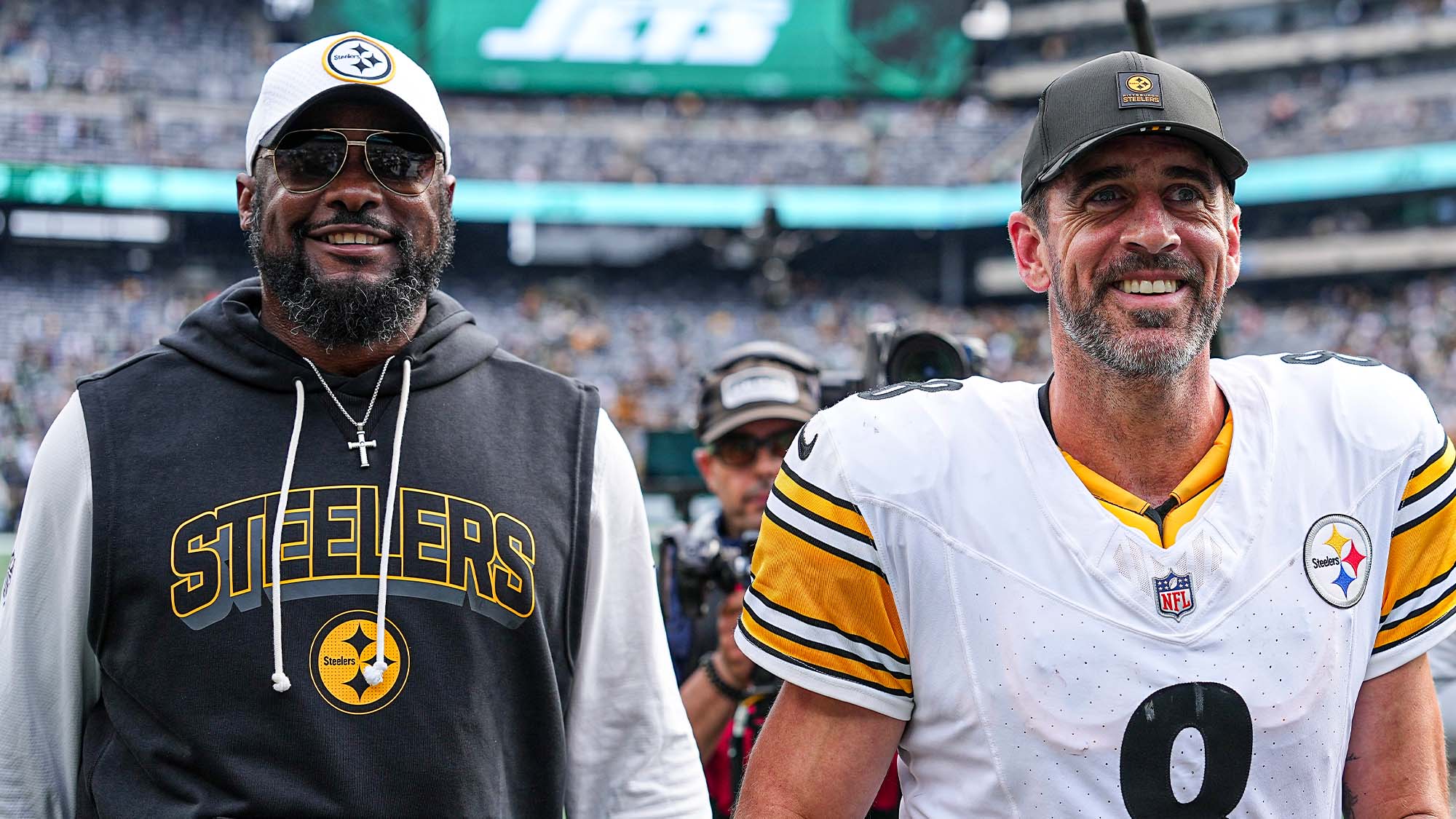
Yes, Mike Tomlin.
The Mike Tomlin who has no history of developing a young quarterback. The head coach who, for nearly a decade, was too good to lose but not good enough to win. That same Mike Tomlin whose offensive coordinator choices left much to be desired. The Mike Tomlin who last fielded a top-10 passing offense by DVOA in 2018, per FTN Fantasy, and ranked 20th or below in five of his last seven seasons as Steelers head coach.
So why on earth would the quarterback-starved, offense-hungry New York Jets hire Mike Tomlin as their perennially sought savior?
Organizational dysfunction
As Jets X-Factor’s Michael Nania pointed out, most of the Jets’ decisions during their 16-year funk have been at least somewhat defensible, even if they didn’t work out (save, perhaps, the hiring of Adam Gase). They win the offseason almost every year, which means that the consensus usually favors what they do with their roster.
No, the Jets’ woes run far deeper than just making individual bad decisions or even a collection of bad decisions.
Jets X-Factor’s Robby Sabo succinctly diagnosed the Jets’ woes: “At the end of the day, the New York Jets haven’t enjoyed success for so long because they have failed to recognize what the sport of football has become and just how drastically different it is now compared to the last time the organization experienced playoff football.”
Sabo has been pounding the table at Jets X-Factor about this since the hiring of Robert Saleh: the NFL is about offensive efficiency, defenses can no longer dictate the game, and the driver needs to be the offense.
In other words, the Jets have a core issue of organizational mindset. As long as that mindset doesn’t change, Sabo wrote, “If the New York Jets were to hire Jacksonville Jaguars offensive coordinator Grant Udinski, it wouldn’t matter a bit — if the organization has not yet moved itself away from the football days of yesteryear, that is.”
Who can change that?
If the issue is at an organizational level, starting with the owner and his trusted hierarchy, then the only way to change that is to find a voice that is strong enough to stand up to the owner, that has enough cachet to come in and say, “We’re going to do things my way.”
Anyone else can come in with the greatest ideas in the world, but if they’re hamstrung by their own lack of authority, if they can and will be overridden any time someone within the organization pouts, they will not accomplish anything. This was Sabo’s exact point about Udinski.
To a large extent, we saw this issue hamper Joe Douglas and Mike LaFleur, both of whom came from excellent executive or coaching trees and had many modern ideas about the game but could not put their visions effectively into action.
Is there a single other coach who has an authoritative enough voice to do that besides Mike Tomlin?
The only man around town who will be able to demand that kind of authority from Day 1 is Tomlin. His record speaks for itself: a 193-114-2 (.628) regular season record, a championship in 2008, 13 playoff appearances, and not a single losing season in 19 years.
Tomlin could come into the room, look Woody Johnson in the eye, and say, “If we’re going to do this, I’m running the show.”
To be clear, this is not an argument in favor of a coach coming in to establish “organizational culture,” at least not with the implications that term typically has. It’s not about old-school football, “going back to basics,” or even accountability, really. It’s about pulling the Jets out of that mentality. It will likely take a unique voice to make that happen.
Of course, Johnson would need to agree to such a thing, and given his history, it’s likely he would not. If so, then it will be emblematic of the exact issue: a refusal to abandon the core organizational philosophy that has mired the Jets in this 16-year playoff drought in the first place.
But does Tomlin have a different mindset?
The concerns about Tomlin’s stick-in-the-mud offensive ways are not unfounded. He inherited a young Ben Roethlisberger, reached his peak of offensive success during Roethlisberger’s prime, and then never recovered once Roethlisberger fell off. His only real attempt at quarterback development was Kenny Pickett, which was an unequivocal failure.
Furthermore, after starting with highly respected offensive mind Bruce Arians as his offensive coordinator from 2007-11 and then seeing tremendous success with Todd Haley from 2012-17, Tomlin hired such luminaries as Randy Fichtner (2018-20), Matt Canada (2021-23), and Arthur Smith (2024-25). That’s a lot of uninspiring, run-first, non-innovative coaching on one list.
Wouldn’t that seem to indicate that the modern NFL did pass Tomlin by? Once he didn’t have the franchise quarterback, he reverted to the kind of stale coaching that the Jets have lived with for the last two decades.
I have more concerns about this than Sabo. He points to the differences in Ben Roethlisberger’s performance under Tomlin compared to Bill Cowher as evidence that Tomlin can develop a quarterback. However, neither the raw numbers nor the advanced statistics quite support this take.
For example, Roethlisberger was coming off an 18-touchdown, 23-interception campaign when Tomlin took over in 2007, and he had 32 TDs to 11 INTs in Tomlin’s first season. However, just one year later in 2008, the Steelers’ Super Bowl season under Tomlin, Roethlisberger had a 17:15 TD:INT ratio.
From an advanced metric perspective, here were Roethlisberger’s DVOA and DYAR rankings by year:
| Season | DVOA rank | DYAR rank | EPA per dropback | QBR |
| 2004 | 3 | 9 | 8 | (stat not tracked) |
| 2005 | 2 | 7 | Not qualified | (stat not tracked) |
| 2006 | 13 | 12 | 11 | T-12 |
| 2007 (first year under Tomlin) | 11 | 13 | 6 | 6 |
| 2008 | 25 | 23 | 22 | T-23 |
| 2009 | 8 | 8 | 9 | 10 |
| 2010 | 2 | 6 | 5 | 8 |
| 2011 | 10 | 9 | 8 | 7 |
| 2012 | 11 | 9 | 8 | 4 |
| 2013 | 13 | 12 | 11 | 15 |
| 2014 | 3 | 1 | 3 | 7 |
| 2015 | 4 | 5 | 4 | 2 |
| 2016 | 10 | 8 | 6 | 11 |
| 2017 | 7 | 4 | 7 | 5 |
| 2018 | 8 | 5 | 4 | T-4 |
| 2019 | Not qualified | Not qualified | Not qualified | Not qualified |
| 2020 | 17 | 17 | 18 | 22 |
| 2021 | 24 | 24 | 26 | 25 |
This does not support the narrative that Roethlisberger enjoyed significantly more success under Tomlin than Cowher. In fact, Roethlisberger seemed to heavily regress in Tomlin’s second season with the Steelers before rebounding.
Sabo provides John Harbaugh as another example of a defensive coach who has a modern NFL mindset. The fundamental difference is that Harbaugh has a very recent track record of fielding elite offenses, even if he did not personally architect them.
The 2024 Ravens were a historically dominant offense, and they had several other top-notch seasons before Harbaugh was fired. Even in 2025, the Ravens’ offensive DVOA ranked 11th, including 12th in passing DVOA.
You can choose to give credit for that to Lamar Jackson over Harbaugh. I would argue, though, that Harbaugh hired the correct coaches to maximize Jackson’s talent, given that Jackson is not an elite pocket passer.
So I agree that Harbaugh is a better example of a defensive-minded, CEO-style coach who can respond to the modern NFL, but I’m not sure if Tomlin falls into that same category.
If Harbaugh were available this offseason, he would be my No. 1 choice. But because the Jets foolishly hung on to Aaron Glenn last offseason, they did not allow themselves the opportunity to bring Harbaugh in.
That being said, the question for Tomlin is whether his offensive coaching hires and decisions were based on his mindset, or if his hires and decisions were based on his personnel. The Steelers haven’t had an above-average quarterback under center since Roethlisberger in 2018, so it’s not particularly surprising that they’ve struggled to field above-average passing offenses.
The fact that the Steelers’ passing DVOA currently ranks 25th with Mike McCarthy at the helm underscores what Tomlin’s predicament was for many seasons. The Steelers were never really in a position to acquire a better quarterback.
For all of his foibles, McCarthy has fielded many elite passing offenses in his career, but there may be only so much anyone can get out of a nearly-43-year-old Aaron Rodgers. This would seem to alleviate some of the responsibility for the Steelers’ passing woes from Tomlin’s shoulders.
That being said, you can strongly argue that Tomlin’s inability to draft a quarterback high was his own fault. He admitted publicly that he refused to entertain the notion of tanking for the No. 1 pick.
As long as Tomlin was with Pittsburgh, it was fair to wonder whether the team’s refusal to rebuild or at least retool was an organizational decision or Tomlin’s, but he made it pretty clear that it was his own idea. That could be seen as a lack of flexibility that is not responsive to the league.
Still, the Jets will likely have the opportunity to draft a quarterback in the top 10, so that particular concern does not carry over to New York.
The bigger question is whether or not Tomlin will bring in a staff to develop that quarterback and the entire offensive infrastructure based on modern NFL trends; namely, the recognition that offensive efficiency is king, that strategy dominates culture and fundamentals, that offense dictates games, and that defensive gap integrity is far more important than flashy box score statistics.
The answer to that question is simply not clear due to the various circumstances surrounding his tenure in Pittsburgh. It may seem obvious based on his selections of Matt Canada and Arthur Smith as offensive coordinators, but perhaps he was looking for coaches with a history of maximizing offensive efficiency while lacking a top-tier passer — something Smith, in particular, was known for.
It is also worth noting that from a defensive perspective, Tomlin brings a modern NFL mindset that Glenn and Robert Saleh do not. Although T.J. Watt and others reached elite sack totals under Tomlin, his defenses always emphasized gap integrity over individual pass rush statistics.
The most obvious example of this is the fact that Watt has long been known as one of the best edge-setters in the NFL in addition to his sack mastery and havoc-wreaking on pass plays.
In many ways, Watt is the anti-David Bailey, emphasizing his particular defensive assignment over a sole focus on getting to the quarterback. He has posted a PFF run defense grade of 80.0 in six of his 10 NFL seasons, and he has never graded lower than 67.7, even when playing through various injuries.
Tomlin’s approach in this area would be a refreshing change from Saleh’s attack-at-all-costs mindset or even Glenn’s attempts at react-attack that are completely unsupported by the personnel he targeted, starting with Bailey.
Although Jets fans are far more focused on the offense, and rightfully so, it is worth keeping in mind that the majority of the losses this season have fallen largely on the defense’s shoulders.
There is no Ben Johnson in this coaching class
The clinching point in favor of a more established coach, even if he does not run the offense, is that there is no Ben Johnson or Liam Coen in this coaching cycle. As Nania highlighted, there is no young, innovative play-caller who would be a slam-dunk hire.
The most intriguing play-calling names are the Ravens’ Declan Doyle, whose track record is uncertain given the injuries to Lamar Jackson, and the Texans’ Nick Caley, who faces questions about whether he or C.J. Stroud is responsible for Stroud’s resurgence.
The other offensive coordinator names most bandied about, Grant Udinski (Jaguars), Klay Kubiak (49ers), and Nate Scheelhaase (Rams), have never called plays in the NFL. They work under three of the best play-calling head coaches in the NFL in Coen, Kyle Shanahan, and Sean McVay.
No matter how highly they may be regarded, calling plays for the first time as the head coach of the New York Jets, with all the pressure that entails, when you have never even set up offensive architecture on your own, is a daunting task, indeed.
If there were a Johnson or Coen available, there would be a good reason to overlook concerns about their ability to instill their own philosophies in favor of their track records as innovators. However, given the significant uncertainty surrounding the other available coaches, the need for a leading voice in the organization should take precedence over the desire for an offensive guru.
What about McDermott?
However, if the Jets want a more established voice, isn’t Sean McDermott a better option than Tomlin? Jets X-Factor’s Connor Long made just this argument, noting that McDermott turned the Bills into perennial winners and was instrumental in hiring and changing the offensive coordinators who developed and got the most out of Josh Allen.
His primary objection to Tomlin was the lack of track record in developing a quarterback, as Roethlisberger was already several years into his career when Tomlin was hired.
While those are valid points, there is some evidence to push back on them, as well. First of all, when talking about a truly generational quarterback, how much credit does his head coach or coordinator receive for his development?
Allen did not turn into the elite Josh Allen until his third season in the NFL, which would make it seem like Brian Daboll should take the credit for his development and McDermott by extension for hiring Daboll. However, the fact that Daboll has mostly been unable to replicate a fraction of that success with the Giants and Titans calls into question his offensive genius.
Replacing Ken Dorsey with Joe Brady was a savvy move, but the Bills haven’t missed a beat with Brady in the head coaching seat — so how much of anything in that organization was really McDermott?
Furthermore, how many coaching jobs have been lost attempting to find the next Josh Allen? He truly is one of one. Can we really place the credit for Allen’s ascendance on McDermott’s shoulders? This is where McDermott differs from Harbaugh: as gifted as Lamar Jackson is, he requires a much better coach to maximize his talents than Allen, who can succeed far more as a traditional pocket passer.
Additionally, blaming Tomlin for Pickett’s lack of development seems a little harsh. If Pickett were truly such a special talent, wouldn’t the Philadelphia Eagles have been able to develop him and then set him on a positive trajectory, the way Kyle Shanahan did with Sam Darnold?
Rather, the Steelers got stuck needing a franchise quarterback in a draft that was utterly bereft of such options, and they took the best that they could find. The other graduates of the 2022 quarterback class include the esteemed Desmond Ridder, Malik Willis, Matt Corral, and Bailey Zappe.
Of course, Mr. Irrelevant in that draft was Brock Purdy, but all 32 NFL teams passed on Purdy at least five or six times, including the 49ers. Tomlin could hardly be blamed for that.
To be fair, though, the Bills traded up five spots to select Allen, something Tomlin never did. Buffalo was more aggressive about their need for a franchise quarterback, whereas Tomlin seemed content to try to proceed with aging retreads and win with his defense and run game.
The reality is that we don’t have much of an idea whether or not Tomlin can develop a quarterback because he never had the opportunity to draft a highly regarded one. On the flip side, knocking McDermott for drafting one who is “too” good and thus, perhaps, not a credit to the coach is not fair, either; from that perspective, maybe the score is McDermott 1, Tomlin no opportunity.
My primary objection to McDermott is not even the Josh Allen conundrum, though. It’s simply this: if the goal is to bring in an alpha in the room who can truly establish a different organizational mindset, I am not convinced that McDermott is that person.
McDermott certainly has plenty of success to fall back on, but he is not respected in NFL circles in quite the same way that Tomlin is. On the surface, McDermott was more successful than Tomlin: better regular-season win percentage (.662 vs. .628) and a better playoff win percentage (.500 vs. .400). McDermott also had only one losing season out of nine, which is not quite the same as zero out of 19 but still carries plenty of weight.
However, there is something different around the NFL when you say “Mike Tomlin” vs. “Sean McDermott.” Tomlin’s name commands more respect. As much as Tomlin was part of an elite organization, no one mistook anything Tomlin said as coming from anyone other than him. That may be in part because Tomlin has a ring and McDermott, as much as it may not be his fault, does not.
Perhaps this is conjecture, but my belief is that Tomlin could do things his way with the Jets the way McDermott could not. Considering that both of them are defensive-minded head coaches, it may be wiser for the Jets to go with the dominant voice rather than the coach who may not be able to implement his vision.
The concern about OC poaching
One of the biggest fears for teams with a head coach who does not call offensive plays (including the Lions and Eagles, whose head coaches have offensive backgrounds but do not call the offense) is that the play-caller will be poached if the offense is successful.
Ben Johnson made waves by staying with the Lions for one extra season even when his star shone brightly, but ultimately, the Lions lost him and then had several big offensive setbacks the following season. The Buccaneers’ offense has not been the same since Coen left. This year, the Seahawks are learning this the hard way after losing Klint Kubiak.
This is certainly a legitimate concern. However, as previously explained, there is no great play-caller option for the Jets to hire, which means that this issue likely cannot take precedence in their head-coaching search, no matter how much fans may want it to.
Not an unequivocal Tomlin endorsement
To be clear, the goal of this article is not to state that Tomlin should unequivocally be the Jets’ No. 1 target this offseason. There are plenty of yellow flags in his profile, at the very least. Furthermore, there are many signs that Tomlin is very happy in the media and isn’t in any rush to return to coaching right now, so he may not even be an option.
Rather, the point is simply to shed light on an overlooked advantage that Tomlin may bring over every other coaching option, including McDermott. Tomlin’s cachet in the NFL should carry weight when Jets fans evaluate their preferred coaching options for 2027.
