
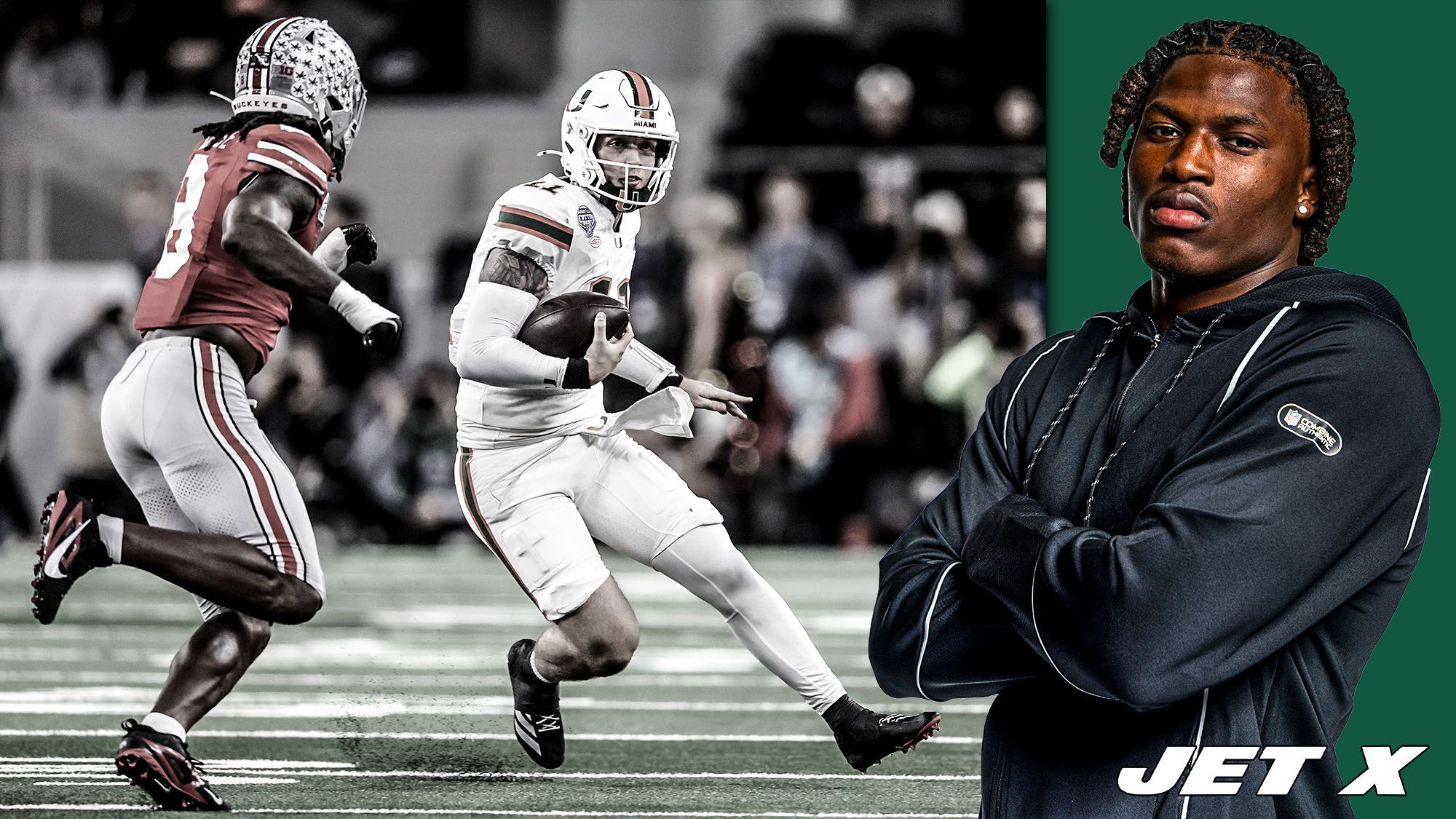
So, everybody’s suddenly on the David Bailey bandwagon, huh? From NFL Network’s Daniel Jeremiah to Sports Illustrated’s David Breer, the Bailey-at-No. 2 reports slung mud in the face of a particular type of football fan everywhere.
I don’t buy it.
Remember, this was around the same time some of the same NFL media members reported that Penn State tight end Ty Warren was destined for the New York Jets a year ago. The Warren-to-Jets rumors routinely featured the word “infatuation.”
At the end of the day, the Jets selected Armand Membou in 2025, which made sense given Aaron Glenn’s often-proclaimed vision (i.e., a physical, rush-first offense). Nonetheless, those Warren rumors and reports ran rampant at the time.
This year, the previously mentioned Bailey suddenly leapfrogged Ohio State edge Arvell Reese just a couple of weeks ahead of the NFL draft. Yet, it makes absolutely no sense from most angles.
Most importantly, it’s a mind-boggling notion when thinking about the nature of today’s National Football League.
Modernizing the defense
Pro football defenses face around 11-to-13 third downs per game. Slimmer yet, third-and-long situations dwindle down to a handful. An NFL defense faces 60-66 plays per game, and yet, third-and-longs are a handful — if that.
While sure, getting off the field is a critical goal for the defensive unit, the type of third down matters greatly. A defensive unit that cannot stop the run won’t find itself in nearly as many advantageous third-and-longs.
Defenses that fail to create third-and-long scenarios are destined to stay on the field. Playing the chain game has become increasingly popular. Los Angeles Rams head coach Sean McVay lives by the “set up third-and-short” bible, as does Chicago Bears sideline boss Ben Johnson.
That notion, paired with the quicker, three-step passing, has decreased the number of opportunities for pass-rushers to pin their ears back and attack the quarterback. It’s not that there are no opportunities, only that the instances of the one-track pass-rush mindset are becoming fewer.
Mobile quarterbacks can break backs by squirming out of the pocket, only to scamper for a huge chunk — even when the defense executes perfectly. Look no further than the Jets’ Week 2 matchup against the Buffalo Bills last season, when Josh Allen destroyed Glenn’s defense at MetLife Stadium.
What about curl-to-flat play? What about playing in space?
Jets fans’ raging frustration anytime Micheal Clemons was fooled on a zone-read, RPO, or couldn’t handle a 1v1 tackle in space was constant and unavoidable. Even when the defensive play was designed to slant him inside, with somebody else replacing him off the edge (gap exchange, scrape exchange, etc.), the fans’ blood boiled.
More than ever, each defensive position must feature a versatile, all-around feel.
The media misconception
Fear is the motivating factor for New York Jets fans who don’t like Arvell Reese. Let’s just speak honestly, here, shall we? Nightmares of Vernon Gholston dance in heads, while the “projection” and “hybrid” buzzwords force some to think of Isaiah Simmons.
These easily repeatable media thoughts have created the perception that Reese is a guy who needs guidance (a team with a firm plan), whereas Bailey is the more NFL-ready prospect.
That idea, my friends, is what we have no problem labeling as a complete falsehood.
What’s frustrating can be put extremely simply with one question: How could the prospect whose all-around game is more dominant, also be the prospect who’s riskier and needs a firm plan?
Folks, Reese can beat the opponent in a multitude of ways. It can be about speed, his freakish athleticism, or physicality. (Reese’s hands are heavier, per pound, than anybody seen on college tape in years, perhaps even longer.)
Meanwhile, Bailey wins just one way. He wins with a first step, with his speed and quickness. Considering he cannot hold up at the point of attack — not even against the competition in the Big 12, a conference whose prestige still doesn’t line up to the lower level it now belongs — Bailey’s defensive coordinator will have to work overtime to make it work.
Firstly, there’s the matter of his specialist nature. Can he even play all three downs? For those who believe he can, how does the defense work? How much action needs to be installed for it to work?
In other words, Bailey’s suspect point-of-attack play demands a defensive play-caller to use action with him as much as possible. That means slanting him inside, with somebody replacing him off the edge, or stunting/twisting on balanced downs — which is hardly an enviable position.
The all-around monster
Reese’s skill set does not demand this strategy. Glenn can use the Ohio State kid however he wishes. He can line him up as the Jack (weak-side 3-4 outside linebacker), as a 4-down defensive end, or even as a second-level linbacker.
Moreover, no matter the position, Reese can be great in action or at the point of attack, meaning Glenn isn’t forced to call something elaborate against the run. (And yes, playing it straight against the run is a requirement for elite-level defenses.)
He can also play in space (which is a dominating factor against bubble screens and any three-step-designed play to the flat), key in on his reads against the read-option, mug the A- and B-gaps as a second-level backer, and — believe it or not — rush the passer.
Bailey’s quickness allows him to rush the passer and affords him the opportunity to play in space, but defenses simply won’t have the ability to play it straight with him on the field against the run. Also, in terms of 1v1 in-space tackling, it’s not even close (Reese is by far the better player).
Oh yeah, Reese can also spy the quarterback in an elite way. For those who believe that’s an overrated aspect of the game, please recognize what football has become.
The very same reason traditional, specialized pass-rushing is diminishing is the very same reason spying the quarterback and versatility are on the rise: Mobile quarterbacks and the absurd efficiency of the short-passing game have backed defenses into a corner.
Instead of trying to dictate the terms of engagement, defenses have become more defensive. Instead of raging towards the quarterback with a one-track mind, pass-rushers must maintain their rush-lane responsibility. Instead of playing everything vanilla in the front seven, players are asked to be versatile.
Arvell Reese’s hybrid nature doesn’t make him a project; it makes him the ideal choice for the New York Jets. It makes him the perfect selection for Aaron Glenn’s defense — one that needs to modernize itself as soon as possible.
