
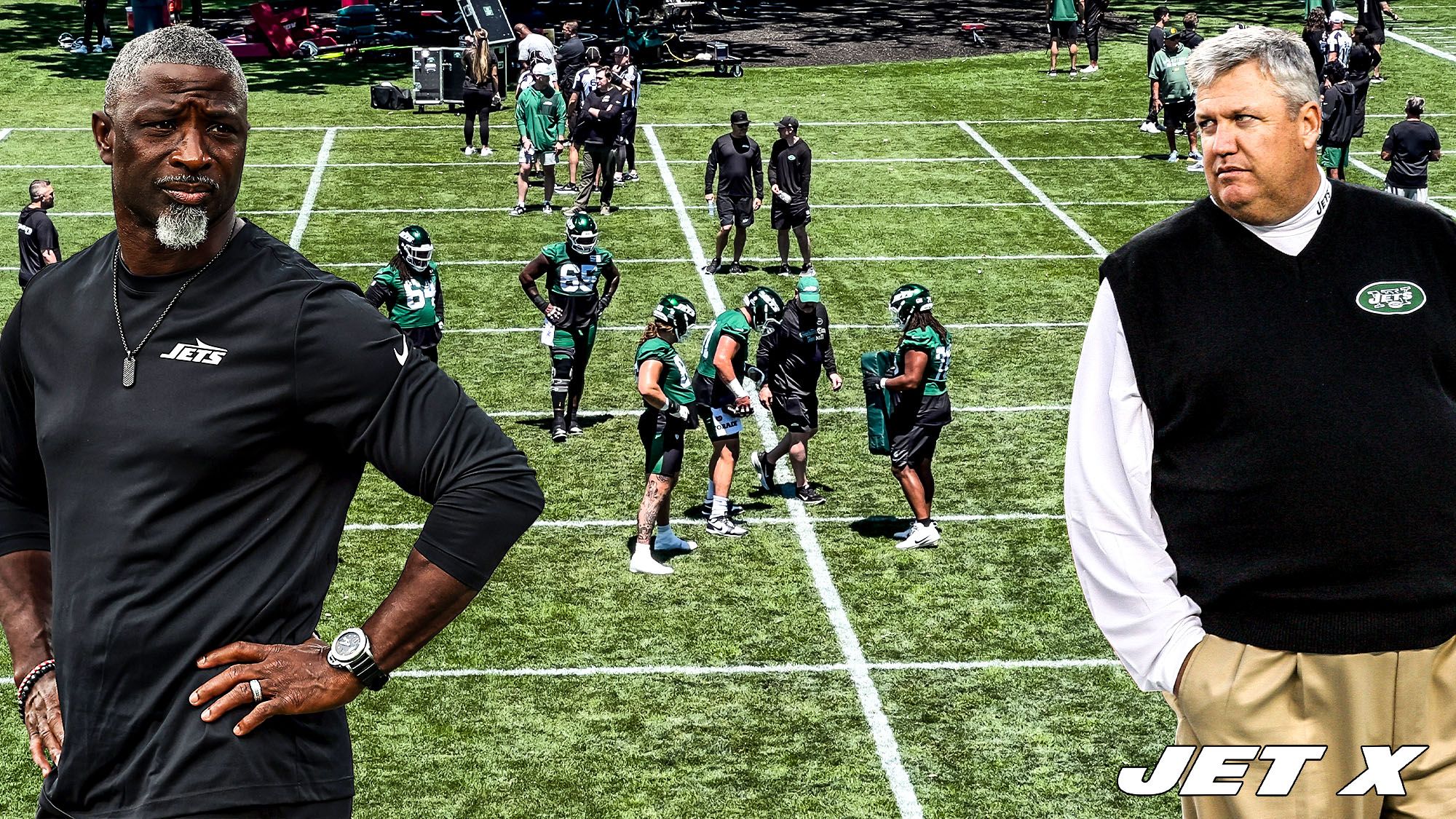
New York Jets fans fondly remember the 0-tech clash that shook a usually unassuming Upstate New York town…
The time? August 2010. The place? Cortland, N.Y. The vehicle? HBO’s “Hard Knocks: Training Camp with the New York Jets.”
Then-head coach Rex Ryan dripped giddiness when announcing his intention to run goal line. Suddenly, with the rain falling hard and Joe Namath (and his daughter) looking on from the sidelines, the likes of Kris Jenkins and the late Nick Mangold were banging as if each represented the core of a planet in our very solar system.
The Jenkins-Mangold battle was just the origin of this party. New York’s first-team offense battled the first-team defense in live, to-the-ground, big-boy football.
Yes, ladies and gents, Mr. Jenkins is, as the kids say these days, a “grown man.” Also, yes, as Charles Barkley has uttered in the past, two grown men were banging bodies.
Body banging aside, the Jets offense made no bones about its intentions, and the defense wouldn’t have it any other way — particularly Rex, the defense’s unabashed leader. That day of football, along with that Hard Knocks episode, featured the very best of what professional football could potentially offer in August.
Not even a year later — in July 2011 — the NFL and the NFLPA ratified a new Collective Bargaining Agreement that would go into effect the following season. Thus, the 2012 CBA went into effect, drastically changing the sport.
This backdrop is essential to posing the following question: Is Aaron Glenn’s decision to cancel the third practice of the New York Jets minicamp a curious case or a moot point?
Bye-bye, football
Here’s the exact verbiage as it relates to the number of padded practices allowed during the season, courtesy of Article 24, Section 1(a) of the 2012 CBA (h/t Over the Cap):
“During the regular season, padded practices for all players shall be limited to a total of fourteen, eleven of which must be held during the first eleven weeks of the regular season, and three of which must be held during the remaining six weeks of the regular season. The Club may choose the days of the week on which such practices shall be held. Subject to the foregoing rules, each Club may hold two padded practices during the same week during one week of the regular season, provided that such week falls within the first eleven weeks of the regular season.”
The word “outrageous” doesn’t even begin to serve justice.
Previously, there was no cap on padded practices during the season. Each organization’s head coach decided what was right, serving as a much more critical decision-making category in the game.
Padded practices count as days in which only shoulder pads and helmets are worn, no more than three hours per day (which include team stretches), and teams may only hold one padded practice per week when playing in the postseason.
Things become more extreme in the lead-up to the season.
Absolutely no live contact is permitted on days No. 2 through 5, and under no circumstances are consecutive padded practices allowed for two-a-days.
Article 23, Section 7(a):
“On days two through five of preseason training camp, no live contact shall be permitted. Players may be on the field no more than 3.5 hours. Two on-field sessions are permitted as follows: one session may be a full-speed practice, which can be no longer than 2.0 hours. This session may include all customary practice activities at the head coach’s discretion. The other session on the same day may be for a maximum of the remaining 3.5-hour on-field time, and is limited to only walk-through instruction and drills and plays conducted at an acceptable walkthrough pace (i.e., Pro Bowl practice pace), as demonstrated in a video jointly approved by the parties, with offensive players lining up across from defensive players, or kicking team players lining up across from return team players. No helmets may be worn during the second practice. The two on-field practices may be conducted in either order.”
It continues with Article 23, Section 7(c):
“Following the five-day on-field acclimation period, two-a-day practices shall be permitted, subject to the following rules: (i) players may be on the field for a total of no more than four hours per day; (ii) players may participate in no more than one padded practice per day, which shall be no longer than 2.5 hours of on-field activities; (iii) there must be at least a 90 minute interval between practices; and (iv) the second practice on the same day may only be for a maximum of the remaining four-hour on-field time, and shall be limited to only walk-through instruction and drills and plays conducted at an acceptable walkthrough pace (i.e., Pro Bowl practice pace), as demonstrated in a video jointly approved by the parties, with offensive players lining up across from defensive players, or kicking team players lining up across from return team players. No helmets may be worn during the second practice. On days on which either a padded practice or a full-speed, non-padded practice is scheduled, but no second practice is scheduled, the padded practice or the full-speed, non-padded practice remains subject to the 2.5-hour time limit for on-field activities. The two on-field practices may be conducted in either order. The 2.5-hour limit on padded practices and full-speed, non-padded practices shall begin as soon as position coaches begin to coach a player or players on the field. Padded practices may not be held on more than three consecutive calendar days, and such three-day practice periods may not be held more than three times during preseason training camp. Additionally, none of the three permissible three-day practice periods may begin until at least three calendar days have elapsed since the conclusion of the Club’s previous three-day practice period. During the period between the mandatory reporting date for veteran players and the final day of preseason training camp, no Club may hold more than a total of sixteen padded practices.”
Suddenly, within the matter of the time it takes to stroke a pen on both sides, decades upon decades of football were washed down the drain.
Giving time back?
Suffice it to say, football coaches at all levels find it increasingly more difficult to master the art of team togetherness. While the 2012 CBA impacted just the NFL in technical terms, everything that happens at the highest level trickles down.
First, Roger Goodell and company had to contend with the concussion issue, and rightly so. That was the first shot to the old-school football solar plexus. Combined with technological advancement, the 2012 CBA cemented the sport’s about-face.
What we’re left with today is high-flying offense football that throws it all over the lot to wide receivers with alien-sticky gloves, more injuries than ever, a sloppiness that tells on itself in the yellow laundry on the field, and horrendous tackling that only has a chance to slightly improve throughout the course of a season.
Shoot, I’d even argue that the alien-esque sticky gloves — born from a substance I’d rather not assume — which were outlawed over 20 years ago (and didn’t even exist), have as much impact and intention on promoting defensive hand tackling as they do on scoring points offensively.
Either way, finding the time to work on the craft that is “team” becomes more challenging by the year.
Thus, a football coach actually giving time back to the league and its players is a tough contribution.
Aaron Glenn’s history and persona make the cancellation surprising. Not only is this a 3-14 team saddled with win-now pressure, who also happens to deploy a number of new pieces and fresh leaders on both sides of the ball, but Glenn is as “throwback” a head coach as there is in the league.
Remember, this is the same man who ran live tackling drills in 2025 — something that has become as rare as a Bigfoot sighting. Just two days prior to the canceled Thursday session, he spoke as if a cancellation wasn’t in the cards.
A new day?
Glenn didn’t cancel any of the three mandatory minicamp practices in 2025. The fresh-faced head coach took over with gusto by talking the talk in a way that announced the Jets’ intentions with authority.
The other side of this coin is pretty simple to consume: Today’s athlete is far different from those of yesteryear. Because each professional sports league has operated in ways that have reduced physicality, the modern athlete is different, to say the least.
LaMelo Ball and Dick Butkus could confidently be described as contrasting figures.
Perhaps Glenn, coming off an atrocious rookie season, is doing his best to change his ways and keep up with the times. Perhaps he believes this is the correct course to take.
Perhaps he’s right.
This isn’t the particular place on the World Wide Web where Aaron Glenn bashing is taking place. Nobody’s here to claim he made the incorrect decision by canceling the third day of minicamp.
We’re here to simply poke and prod at the narrative.
Anything but meaningless
Claiming that mandatory minicamp practice is meaningless holds no water. The frequently cited argument that non-padded practices don’t matter is bananas. If that were true, training camp practice wouldn’t matter either, thanks to how different today’s “padded practices” are from the actual live action of a regular-season game.
While camp practices more closely align with the full speed of the game, the difference is still massive — unlike the example at the top of this story, featuring Kris Jenkins and Nick Mangold moving mass humanity on the gridiron.
For the most part, the spring is mainly mental; it’s reserved for brainpower repetition and scheme prep to ready the troops for July and August. Yet, it’s still repetition, and repetition is precisely what practice is — in every sport.
Did Aaron Glenn take a misstep when canceling the New York Jets’ third mandatory minicamp practice?
I have no idea. Intricate knowledge of the team is required to even begin to offer hard stances.
Is the action of canceling practice worth a raised eyebrow and further discussion?
You better believe it is — at the very least.
