
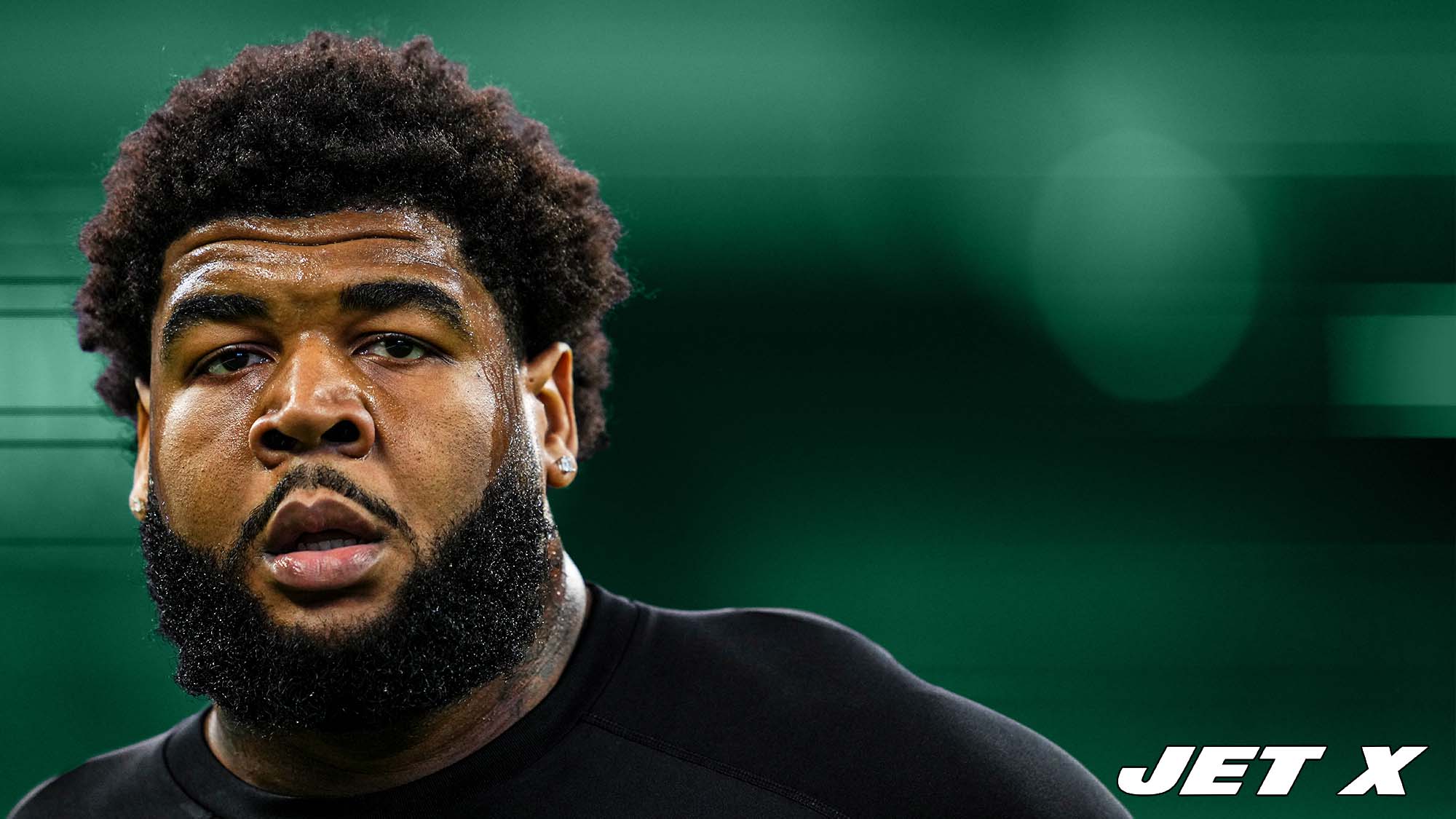
The New York Jets haven’t been too shabby at collecting premium offensive line talent in recent years.
First-round tackles Olu Fashanu and Armand Membou are at least solid starters, and both have the upside to rank among the league’s best tackles. Second-round guard Joe Tippmann is a solid starter and was rewarded for his efforts with an extension this offseason.
Where the Jets have long been coming up short is identifying offensive line talent past the first two rounds. It’s a major reason they have had to spend so many early picks rebuilding their line, and why their depth looks like a major concern heading into 2026.
Perhaps 2026 sixth-round pick Anez Cooper is the gem New York has been waiting for.
The Jets clearly saw something in Cooper during the scouting process. On Day 3 of the draft, New York sent a seventh-round pick (242nd overall) to the Seattle Seahawks to move up 11 spots and grab the Miami (FL) product with the 188th overall selection.
In his preseason debut, Cooper showed glimpses of why the Jets felt compelled to trade up for him.
Entering New York’s preseason opener at the start of the second half, Cooper logged 28 offensive snaps at right guard and was dominant during his time on the field. He earned a 90.9 overall grade from Pro Football Focus, the second-best grade among NFL offensive linemen in the preseason so far.
Cooper was a standout in both phases. He allowed zero pressures on 20 pass-blocking snaps, earning an 85.2 pass-blocking grade. In the run game, his 89.5 run-blocking grade is the best in the NFL among right guards so far. Cooper also committed zero penalties.
But we’re not just going to sit here and regurgitate PFF grades. We’re going to dive into the film to show that those grades were earned by the 22-year-old from Pleasant Grove, Alabama.
Let’s dive into the preseason debut of New York’s most promising developmental offensive line prospect.
Anez Cooper (RG #72) vs. Buccaneers
Cooper does a nice job working a double-team on the 3-tech with right tackle Landon Young, and he ends up driving him a solid four yards off the line of scrimmage.
Take note of how Cooper plays through the whistle, too, inciting a reaction from the defender. In his scouting report of Cooper, Jets X-Factor’s Joe Blewett noted this as a strength, writing that Cooper “has some nasty to his game.” You love to see it; eventually, he might draw some penalties through these annoying little moves.
Even outside of the extracurricular activity, it’s an extremely valuable trait for linemen to have the instinct to play long through the whistle. You never want to see a player lose a rep because he thought a play was over and gave up. The guys who have it in their nature to just go until long after the play is over will never lose because of effort; Cooper seems to have that.
It’s easy to categorize Cooper as a “mauling run blocker” because of his imposing 6-foot-6, 334-pound frame, but as Blewett’s scouting report details, Cooper is actually much further along as a pass protector. We’re going to see that in this review; he put some pretty pass-blocking reps on film, including this one.
In Blewett’s scouting report of Cooper, most of the strengths highlight Cooper’s pass protection. At 6-foot-6 with 34-inch arms, he is lengthy for the position, and he makes good use of it. As Blewett notes, Cooper “uses [his] length well in pass pro,” and we see that here.
Here’s another good pass protection rep from Cooper. He squares up the rusher well and then lands an accurate two-hand strike to the shoulders to slow the rusher’s momentum before he throws his move. Then, Cooper reworks his hands inside to anchor down and keep the rusher at bay. Cooper is able to get hands-on without leaning, which shows how nicely he uses his length.
Blewett’s scouting report highlighted Cooper’s “strike timing in pass protection” and “pop in hands” as strengths. Both of those show up here.
The ball is out quickly here, but Cooper shows excellent awareness against a stunt. He immediately recognizes that the 3-tech is knifing inside, so he works the defender’s outer half and passes him inside to the center. Once Cooper knows that his center has picked up the block, he pushes off and rotates his hips outside to pick up the looping nose tackle, where he’d be in perfect position to make the block if the rep continued.
The Jets get a big run to Cooper’s side as he drives the 5-tech multiple yards off the ball. He does a nice job of getting low, getting his hands inside, and then staying with the block as he continues to drive his lower body. This is almost a picture-perfect blocking sled drill.
Among the weaknesses listed in Cooper’s scouting report, Blewett mentioned that he “needs more foot drive in run game,” so this play is a promising flash of improvement in that regard. Of course, though, you need to see it for more than one rep in the third quarter of a preseason game for the weakness to be definitively addressed, but this play at least shows that Cooper is capable of that progress.
You also like to see Cooper following the play all the way through and then being there to help his buddy up. Cooper was a team captain at Miami, and this is a subtle example of his leadership.
On a third-and-1 play, Cooper works the inside half of the 3-tech on a double-team with right tackle Landon Young, and he generates substantial downfield push. Sam Scott runs straight into the hole created by Cooper for an easy conversion.
Here’s another solid stunt pickup by Cooper, this time as the player receiving a pass-off from the outside. After getting into his set, Cooper recognizes that the defender is disengaging to loop outside on a stunt, so Cooper instinctively turns his attention outside, just in time to pick up the OLB being passed off to him by Young.
Cooper is put in a tough spot here, as he has to absorb a defender who is aggressively crashing into his body the moment he turns his head, but he eats up the block nicely, anchoring down to keep the pocket secure. He does a great job of getting his right hand into the defender’s body and wrenching him inside to take away his angle to the quarterback.
Takeaways
It would be an overreaction to draw any sweeping takeaways from a sixth-round rookie guard’s performance in the second half of his first preseason game.
Still, this was an encouraging start for a player the Jets traded up to select. It’s especially intriguing because of how beneficial it would be to the Jets if Cooper were to keep this going. He is capable of providing an internal solution to a gaping hole on the depth chart.
The Jets are in desperate need of offensive line depth, especially on the interior. As of now, their backup interior linemen are Cooper, Xavier Newman, Marquis Hayes, Kohl Levao, Liam Fornadel, and undrafted rookie Xavier Hill.
Of those six players, only Newman has started an NFL game, and that’s with just five career starts. Each of those came in the 2023 season; he struggled mightily in those appearances.
If any of the Jets’ three starting interior linemen were to go down, they’d be throwing a practice-squad-level talent on the field. As things stand, one injury to either Dylan Parham, Josh Myers, or Joe Tippmann could be all it takes to sink the entire unit.
That is, unless Cooper is the real deal.
Of course, this is not to suggest that Cooper should be expected to take his dominant performance and translate it over 17 games as a starter. He shouldn’t be crowned as a future Hall-of-Famer whom the Jets stole in the sixth round just yet.
For Cooper, being the “real deal” as a rookie sixth-round pick would entail providing a league-average level of play for a backup guard. Compared to the Jets’ alternatives, that would be a significant upgrade. New York can survive if they have to throw a league-average backup guard into the starting lineup. They might not be able to survive if they have to throw a practice-squad-caliber guard on the field.
If Cooper establishes himself as a league-average backup guard in 2026, it would open up new options for the Jets to deal with potential injuries to the starting interior trio. If Parham or Tippmann goes down, Cooper could simply step into their shoes. But if Myers goes down, the Jets could put Cooper at right guard while sliding Tippmann to center, instead of being forced to go straight to Newman as the next center up.
The Jets are lucky that their depth was not tested much last year; Myers’ 17 starts were all they needed from their second-string unit. However, it is unlikely that the Jets will enjoy a second consecutive season in which they start the same five linemen in all 17 games. Most likely, their depth will be tested for significant stretches this year.
That’s why Cooper’s development carries a significant amount of potential value for the Jets. As a 22-year-old rookie, Cooper offers at least some semblance of upside, which does not exist in any of the Jets’ other backup linemen, who are mostly underwhelming veterans with little to no untapped potential.
If Cooper can be a surprise hit out of the sixth around—again, with a “surprise hit” constituting him being a league-average backup as a rookie—it would do wonders for a second-string Jets offensive line that is expected carry a much heavier weight this year than last.
If Cooper does not amount to a surprise hit in Year 1, it’s hard to see where the Jets can find any degree of faith in their backup unit.
That’s not to say there is “pressure” on Cooper; that would be unfair. He’s a sixth-round rookie. Rather, it’s merely the reality of the bed that the Jets made for themselves by neglecting their backup interior offensive line throughout the offseason. Now, they’ve reached a point where their only realistic hope of fielding competent second-string play on the interior is a sixth-round rookie.
Fortunately, though, that sixth-round rookie looked pretty damn good in his first NFL action. Time will tell whether that is a sign of things to come or a second-half preseason mirage, but the Jets will happily take it for now.
