
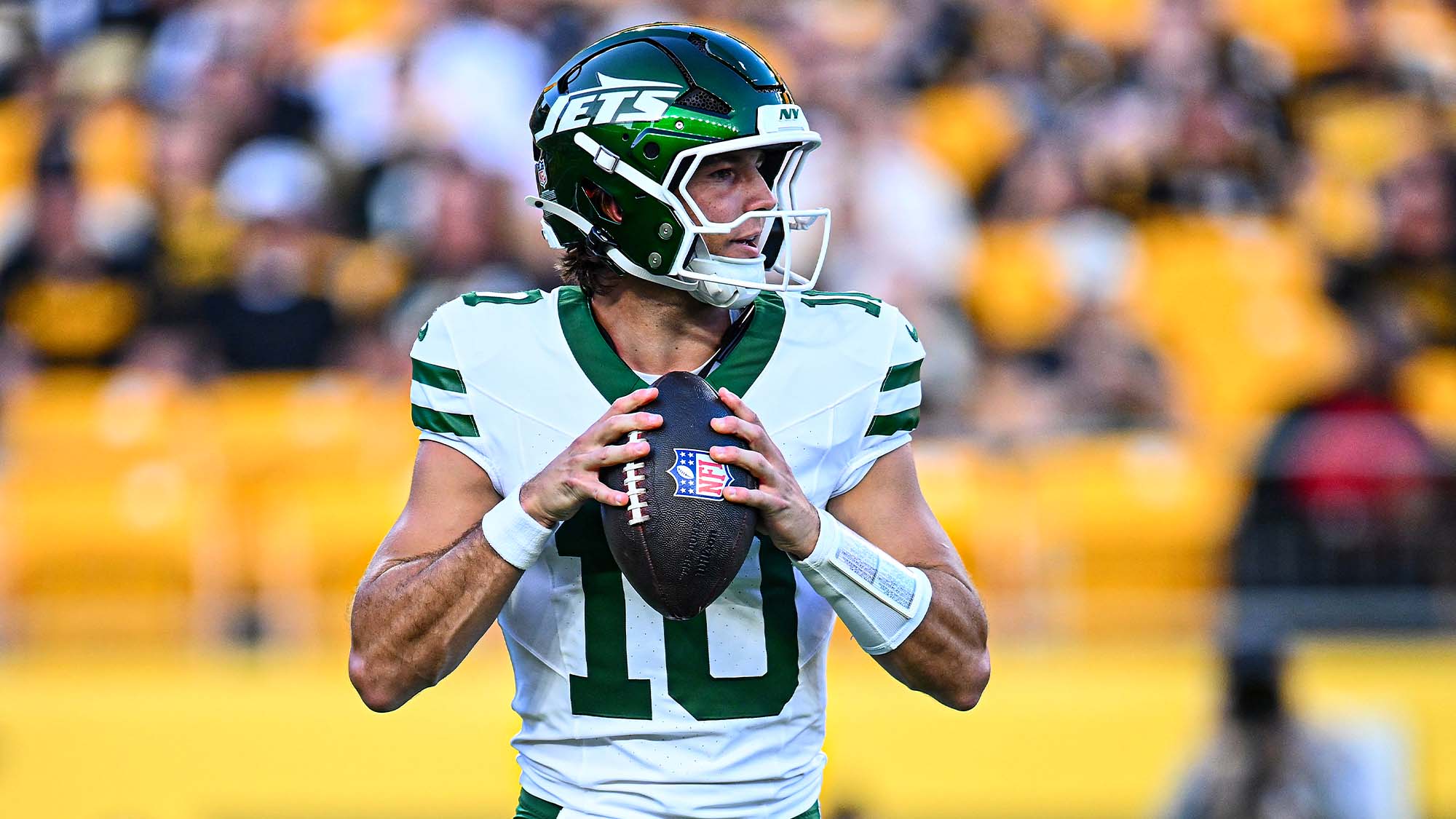
The 2026 edition of the “Snoopy Bowl” won’t have as much drama as some previous iterations.
A game that has featured highlights such as Aaron Rodgers’ first touchdown pass as a Jet and lowlights such as Mark Sanchez’s torn labrum will be kept ho-hum tonight (7:30 p.m. EST) by New York head coach Aaron Glenn. Starting quarterback Geno Smith will sit, as will most of the team’s starters.
That means the focus will be on the team’s backups and bubble players.
It will also be an excellent showcase opportunity for the Jets’ Day 3 rookies before the regular season begins. These rookies are roster locks, but this could be their last chance to play extended football in 2026, depending on how the season plays out, so both they and the team would love to get some strong tape out of tonight.
We likely won’t see any of the Jets’ first or second-round picks tonight. Edge rusher David Bailey and wide receiver Omar Cooper Jr. were starters last week, while tight end Kenyon Sadiq and cornerback D’Angelo Ponds will continue preparing for Week 1 as they recover from injuries.
That means the focus will be on fourth-round quarterback Cade Klubnik, fourth-round defensive tackle Darrell Jackson Jr., and sixth-round guard Anez Cooper.
Here is what the Jets want to see from each of those players.
Cade Klubnik: Keep looking competent
The Jets have hoped Klubnik would win the backup quarterback job since training camp opened, and so far, things have gone according to plan.
The Clemson product has maintained second-team reps throughout camp and, across the first two preseason games, has been the best quarterback outside of Geno Smith.
Klubnik is no longer competing against Bailey Zappe and Brady Cook. Now, he has to prove that the Jets should trust him as the QB2 without adding an outside veteran to usurp him.
There is only so much that a fourth-round rookie can do in the preseason to prove that he should be trusted in the regular season, given the horrid track record of Day 3 rookie quarterbacks throughout NFL history. Nonetheless, Klubnik can stake his claim to the QB2 spot on the depth chart by simply continuing to do what he’s been doing: look like a competent NFL signal-caller.
Through two games, Klubnik has completed 15 of 21 passes for 138 yards, no touchdowns, and no interceptions. While he has yet to hurl a touchdown and has only completed one deep pass, his 71.4% completion rate, zero interceptions, and zero turnover-worthy throws are the types of numbers you want to see from a rookie quarterback being evaluated as a potential backup.
Better yet, Klubnik’s adjusted completion percentage jumps to 83.3% after accounting for two throwaways and a batted pass at the line of scrimmage.
The Jets are not looking for franchise quarterback potential out of Klubnik. They want to see if he can be competent enough to avoid sinking the team if called upon. Consistent accuracy and good ball security are the keys to pulling that off.
If Klubnik has another accurate, stable performance with no turnover-worthy plays, he will have done all he could to make his case for the QB2 spot. At that point, it would be up to the Jets to decide whether to roll the dice on Klubnik as their one-play-away quarterback to save a roster spot, or burn that extra roster spot for someone more trustworthy than a fourth-round rookie.
DT Darrell Jackson Jr.: Any signs of life
It’s been a rough start for Jackson, who was the third pick of the fourth round (103rd overall). As someone chosen just a tad outside the third round, he is expected to at least develop into a solid rotational player. So far, he has not shown flashes of that type of ability.
Across 51 defensive snaps in the Jets’ first two preseason games, Jackson recorded zero total pressures (34 pass-rush snaps) and just one tackle. His 32.3 overall grade from Pro Football Focus ranks 144th out of 152 qualified defensive tackles (min. 30 snaps).
Simply put, the Jets would love to see anything out of Jackson tonight. Despite ample playing time over the first two weeks, he was almost completely invisible.
The Jets have experimented with Jackson all over the line. He has primarily lined up over the guard* (50.9% of snaps), but we’ve also seen him on the edge (17.6%), over the tackle at 4 or 4i-tech (15.7%), and over the center (15.7%).
*-PFF charts “over the guard” snaps as a combination of snaps at 3-tech, 2i-tech, and 2-tech.
So far, none of those roles has unlocked any type of production out of Jackson. He’s listed at 6-foot-5 and 315 pounds, which is more of a traditional 3-tech build—it’s lighter than ideal for a nose tackle and much larger than your typical edge rusher. Yet, the Jets have been experimental with his versatility, which is something Aaron Glenn hinted at in May when he said that he sees Jackson playing “big end, so he will play a 5-technique, a 4-technique.”
At some point, it might be best for the Jets to pick a home for Jackson to focus on. Versatility is a valuable trait if a player can be effective in multiple roles, but if he merely lines up in different places without actually doing anything useful in those spots, it does not help the team.
Perhaps Jackson will eventually settle in as a natural 3-tech. It will be fascinating to see tonight whether the Jets continue experimenting with him in different positions or if his unproductive first two games prompt them to try him out in a more focused role.
G Anez Cooper: Settle in with the second-team line
After a dominant preseason-opening performance with the third-string offensive line, sixth-round pick Anez Cooper was promoted to the second-team offensive line in Week 2.
It was a reality check for the Miami product.
After allowing zero pressures on 20 pass-blocking snaps in Week 1, Cooper was beaten up in Week 2, yielding a sack, a hit, and a hurry (3 total pressures) on 17 pass-blocking snaps. That’s a 17.6% pressure rate, which is untenable, even for a backup guard.
The Jets are desperate for offensive line depth, especially on the interior. Cooper is the only young player with any semblance of untapped potential behind the starters. His Week 1 performance suggested that he might be surprisingly capable of providing competent backup-level play as a rookie, but the encore poured cold water on those dreams.
An improved performance in his second game with the second-team offensive line would put Cooper on a promising trajectory. It won’t be enough on its own to definitively label Cooper a sixth-round steal just yet, but it could determine whether the Jets feel comfortable about rolling with Cooper as their primary backup guard or if they feel the need to add someone else via trade, waiver claim, or free agency.
The Jets could also elect to keep Marquis Hayes as a 10th offensive lineman if they would rather stash Cooper in a developmental role than have him one play away from starting at guard. Hayes is 27 and has never played a regular season game, but he has been the team’s most consistent backup lineman through two games.
Cooper’s performance tonight could have a domino effect on how New York handles the back of the offensive line depth chart.
