

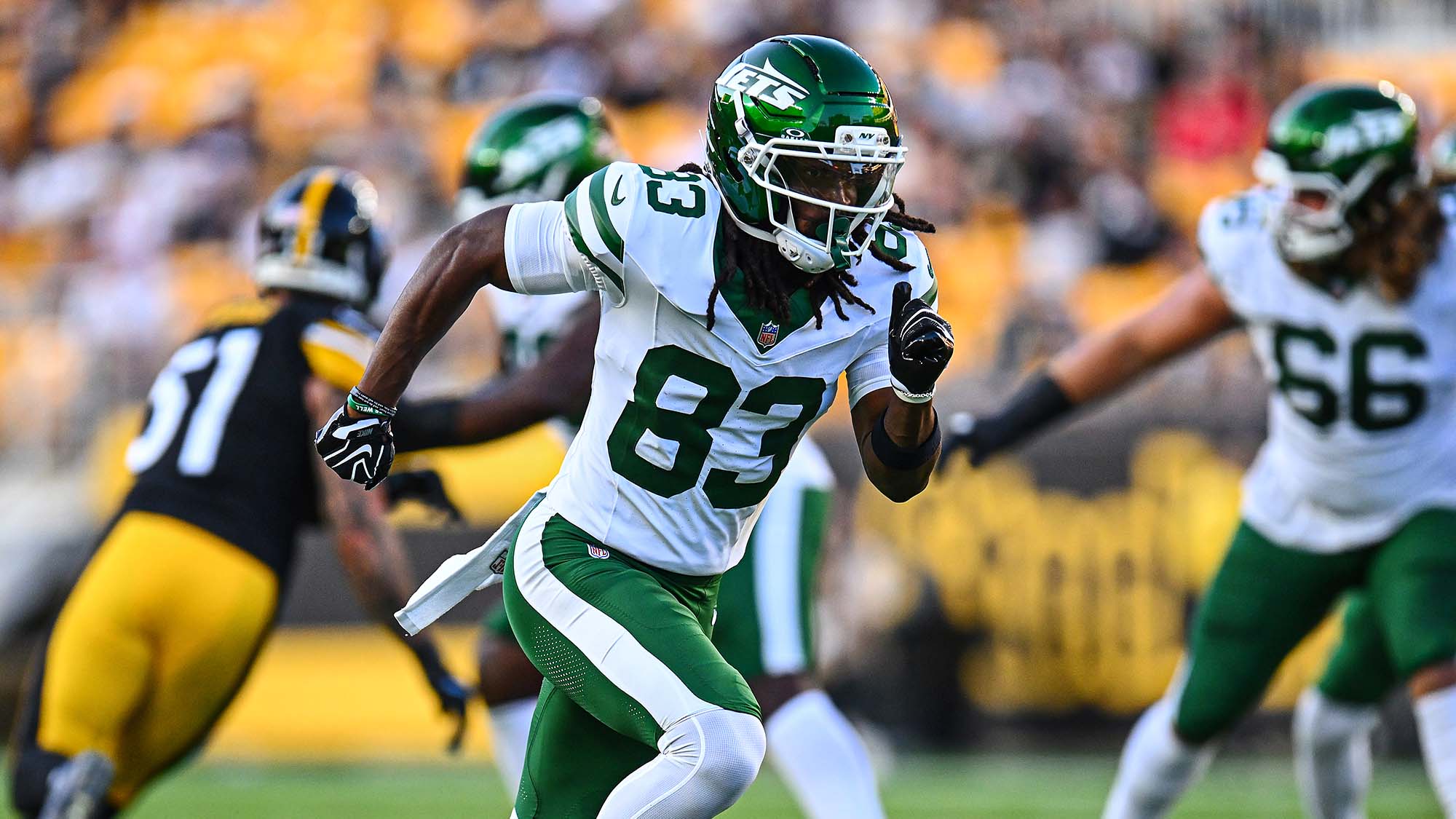
Last week, New York Jets fans indicated in a poll that they have collectively grown more confident in the team’s 2026 outlook since the start of training camp.
More than 65% of voters said they were at least “slightly” more confident in the team’s chances of winning at least eight games, which would be the franchise’s best mark since 2015. Over 98% were at least “unmoved” by the events of camp and the preseason, while a microscopic 2% said their confidence had “decreased” since camp opened.
So, what happened in August to raise Jets fans’ confidence?
Here are three ways the Jets’ depth chart looks more promising now than it did in late-July.
1. Positive development at wide receiver
Throughout July and August, it seemed like the Jets’ social media accounts were posting a video of Geno Smith completing a bomb downfield nearly every day.
It was an unfamiliar feeling for Jets fans to hear so many positive things about the offense’s performance on the practice field. Typically, the training camp highlight reels are dominated by the defense, with an occasional clip of Garrett Wilson making an absurd catch to bail out a bad throw.
That wasn’t the case at all this summer. On a daily basis, Smith would drop a dime in the bucket, and the receiver would convert with an excellent catch.
Notice anything about those clips?
They feature catches by five different players: Garrett Wilson, Adonai Mitchell, Omar Cooper Jr., Isaiah Williams, and Mason Taylor.
Training camp and the preseason saw the Jets spread the ball all over the place, deviating from the “spam targets to Garrett Wilson” strategy that has been their prevailing game plan over the past few years. Smith confidently took shots in camp to anyone who had a one-on-one matchup, and on his lone preseason drive, he completed passes to four different receivers on a touchdown march.
After the events of the past month-plus, Jets fans must be feeling a lot more confident when looking at the wide receiver depth chart than they did at the start of camp.
Beyond Wilson, this unit is built around youth, athleticism, and upside, with legitimate concerns about experience, hands, and proven production. A month of practices and preseason games cannot change that makeup, but the progress we saw from multiple players throughout camp should have Jets fans seeing the glass as half full regarding this unit’s outlook heading into the season.
Third-year man Adonai Mitchell seemed like Smith’s favorite target at certain points of camp. That was backed up in the preseason, when Mitchell caught two passes for first downs on Smith’s lone drive. Mitchell’s overall activity throughout the summer is a positive sign for his 2026 outlook.
First-round rookie Omar Cooper Jr. trended up as camp and the preseason progressed. After playing with the second-team offense to open the preseason, Cooper was promoted to the starting slot receiver position with the first-team offense in Week 2, and he sat out the final preseason game.
Cooper’s preseason was not explosive statistically, but he did his job and looked the part. He caught three of his four targets for 40 yards with no drops, and he also had an impressive route-running rep in which he created multiple yards of vertical separation for a potential touchdown, with the ball going elsewhere.
In practice, Cooper did not make the noise that Mitchell did, but he made his share of plays, and you rarely heard noise about him struggling with drops, route-running, or other noticeable blunders. He came along slowly, just as you expect from a late first-round rookie. Now, the team has seen enough to seemingly trust him as the starting slot man.
On top of Mitchell and Cooper’s development, the Jets saw a surprising breakout from Isaiah Williams, a nice added bonus.
Williams is a roster lock because of his return skills, but he rotated first-team slot reps with Cooper throughout the summer as the Jets continued evaluating the rookie. Out of nowhere, Williams, a 5-foot-8 jitterbug who has never been known for his downfield prowess, recorded a plethora of contested catches downfield in practice.
The preseason was not as kind to Williams, who fumbled away one of his three receptions, but seeing him emerge in camp as a potentially solid backup slot receiver to Cooper was a welcome sign. In July, having a pure returner as your WR4 (potentially WR3) was concerning, but Williams seems slightly more viable as a receiving threat now, although the ball security will obviously need to be cleaned up.
While the questions around this unit cannot be disproven until the regular season, Jets fans are justified in being more optimistic about the team’s wide receivers than they were two months ago.
2. The Jordan Meredith trade
Interior offensive line depth was already one of the Jets’ most glaring roster holes after the 2025 season.
Strangely, the team did little about it. They chose to stick with Josh Myers, their backup center going into 2025, as their starting center, while adding no viable backup behind him. Meanwhile, their only notable addition to the second-string unit at guard was sixth-round rookie Anez Cooper.
Training camp and preseason mostly validated the idea that the team’s interior offensive line depth was poor. Save for Cooper’s excellent Week 1 performance in the second half against the Tampa Bay Buccaneers’ backups, which was washed out by a poor outing when he was promoted to the second-string lineup, nobody on the unit stood out enough to establish themselves as a player who should be considered reliable enough to start games in 2026.
It took them a while, but the Jets finally made a move to sufficiently address this problem on cutdown day, when they traded for Las Vegas Raiders guard/center Jordan Meredith.
The 28-year-old has 20 career regular-season starts; before his arrival, the Jets’ backup interior linemen had a combined five starts, all coming from Xavier Newman, who the team waived and signed back to the practice squad. Of those 20 starts, 11 came as the Raiders’ opening-week starting center in 2025, while another nine came as a backup guard from 2023 to 2024.
Meredith was a bottom-tier starting center in 2025, hence why the Raiders went out and signed Tyler Linderbaum to a record-setting deal and later released Meredith. However, he was decent enough to be considered a mid-to-high-end backup center; his numbers in 2025 were comparable to those of Myers, who will start for New York. That’s enough to make Meredith a significant upgrade over Newman, who is a practice squad-level player.
As a guard, though, Meredith could be considered a high-end backup. In the 2024 season, when he made eight relief starts at guard, Meredith finished as the NFL’s sixth-ranked guard in Pro Football Focus’ overall grade (80.8).
That number is probably something of a misleading oddity, as if Meredith were actually that good, the Raiders likely would have kept him as a starting guard the following season. Still, it’s enough production to suggest that he should be a decent backup guard at the very least, which is all the Jets need from him to be considered an upgrade over the alternative of trusting a sixth-round rookie or veterans like Kohl Levao or Marquis Hayes, who have never played in the regular season.
Earlier today, New York agreed with Meredith on a revised one-year contract worth up to $2 million, with $1.9 million guaranteed. It shows their commitment to him as their primary backup on the interior for the 2026 season.
With Meredith aboard, the Jets don’t have to worry about an interior offensive line injury potentially being catastrophic enough to ruin the entire offense. Meredith is experienced and competent enough to keep the machine churning.
3. Azareye’h Thomas’ emergence at cornerback
Cornerback is an area of major uncertainty for the Jets. Across the board, they are banking on improvement from both developing youngsters and seasoned veterans.
It all starts at the top with CB1 Brandon Stephens.
The 28-year-old always seemed locked into a starting job, which was expected given that he signed a three-year, $36 million contract with this regime one year ago. While he had flashes of brilliance throughout 2025, he ultimately allowed eight touchdowns and no interceptions on throws into his coverage (per PFF), which is downright brutal for a starting NFL corner. It was the worst touchdown-to-interception ratio of any defensive player in the league.
Yet, somehow, Stephens is still the surest thing on this unit going into 2026.
That’s why Azareye’h Thomas’ standout summer is a big deal.
Thomas secured the starting outside cornerback spot opposite Stephens with an impressive performance in training camp and the preseason. Part of that was due to Nahshon Wright’s injury, but Thomas did his part. He recorded plenty of deflections on the practice field, and in his brief preseason action, Thomas was targeted just once across 13 coverage snaps, forcing an incompletion with tight press coverage on a downfield throw.
Training-camp flashes and 13 good coverage snaps in the preseason are not enough to guarantee that an unproven third-round pick will suddenly become a stud in his second season. It was enough to inspire optimism that a breakout year might be coming, though, which sure beats the alternative of a summer full of struggles.
And considering how important it is to the Jets’ defense for Thomas to emerge as a quality starting corner, Jets fans should be excited about the fact that he had the summer his coaches were expecting.
The Jets had high hopes for Thomas when they selected him in the third round of the 2025 draft. Many scouts and analysts had him as a first-round talent until a poor forty-yard dash time (between 4.57 and 4.59 at his pro day) tanked his stock. Even after that, the consensus big board had him in the No. 52 slot, equivalent to the value of a mid-second-round pick.
Instead, the Jets nabbed Thomas at No. 73, making him one of the popular choices as one of the best value selections in the 2025 draft. That value, coupled with the fact that he was still only 20 years old on draft weekend, made him the type of prospect with an extremely tantalizing long-term developmental ceiling.
Thomas began his rookie year as a backup. But once injuries and the Sauce Gardner trade thrust him into action, he began showing flashes on a weekly basis.
Before suffering a season-ending shoulder injury, Thomas closed his rookie year on a six-game streak with at least one pass defended. It ties Darrelle Revis for the second-longest streak by a rookie in Jets history, trailing only Gardner’s seven-game run in 2022.
Thomas had his share of rookie bumps, as you would expect from a kid who only turned 21 that July, but his peaks were high. Thomas showed the ability to use his 6-foot-1 frame and 78-inch wingspan to jam receivers at the line and make plays on the ball in contested-catch situations.
With the likes of Stephens being the Jets’ most reliable corner going into 2026, the Jets are banking heavily on Thomas to raise the ceiling of the cornerback unit. They need someone to emerge who can go toe-to-toe with physical boundary receivers on their schedule, like A.J. Brown and Courtland Sutton. Thomas is their best bet.
As we sit here today with Week 1 on the horizon, Thomas’ chances of emerging as the Jets’ top cornerback sure seem at least slightly peachier than they did when camp began.
He inspired hope, and hope is all fans can ask for at this point in the calendar.
