
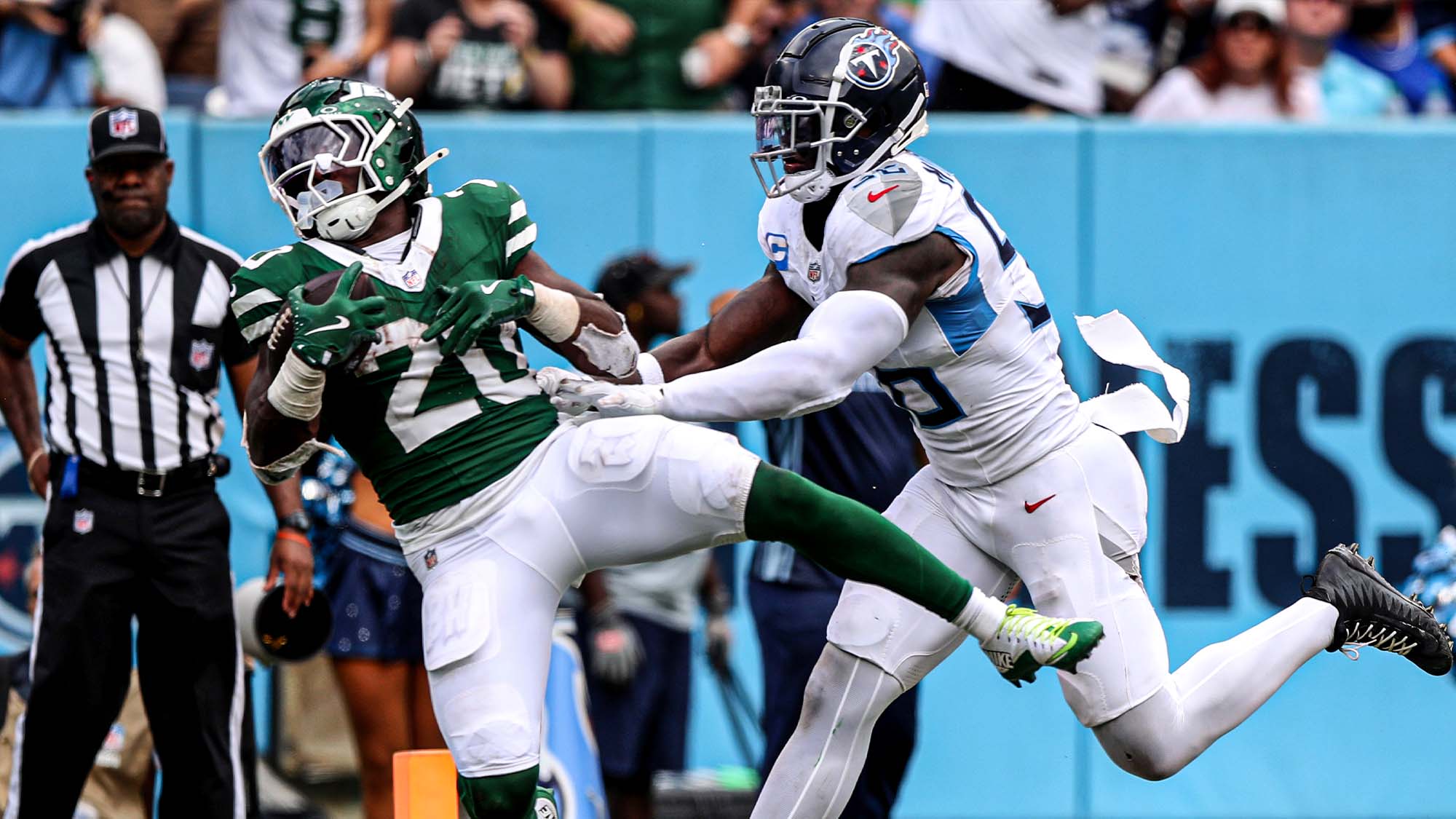
Even after his first career 1,000-yard rushing season, Breece Hall is aiming for new heights in 2026.
Hall is 11th in the NFL and ninth among running backs with 4,359 scrimmage yards since 2023. Yet, it feels like the Iowa State product’s best days could still be ahead of him. Hall has yet to play with an ideal supporting cast to put him in the best position for success, and the running back himself has occasionally struggled with consistency.
In 2026, the New York Jets hope to unleash Hall to his full potential, fresh off signing him to a three-year, $43.5 million contract extension.
The Jets have a perfect opportunity to maximize the most unique aspect of Hall’s game in their season opener against the Tennessee Titans.
A big game in store for Breece Hall?
In their Week 1 matchup with the Jets, Tennessee will be debuting their new-look schemes and culture under head coach Robert Saleh.
One of the vulnerabilities of their defensive scheme could be their pass coverage against running backs.
In 2025, with Saleh as their defensive coordinator, the San Francisco 49ers allowed 94 receptions to running backs (5.5 per game), tied for the second-most among NFL teams.
Now, Saleh is taking his patented 4-3 scheme over to the Titans, where the starting linebacker duo carries question marks in coverage.
Tennessee is projected to start Cody Barton and Cedric Gray, the same pairing they used last year. Neither player was a complete liability in coverage, but both were mediocre; Barton posted a 56.9 coverage grade in Pro Football Focus’ system, while Gray was slightly better with a 59.0 coverage grade.
Between Saleh’s susceptibility to allowing running back receptions in 2025 and the Titans’ uninspiring coverage skills at linebacker, the Jets have every reason to emphasize featuring Breece Hall as a receiver on Sunday.
Hall has been one of the NFL’s best receiving backs since he was drafted in 2022. Over the past four years, he ranks sixth among running backs in receiving yards per game (29.3) and is tied for seventh in total receiving touchdowns (9).
Looking forward, Hall has the potential to be even more productive in this phase. His efficiency as a receiver demands more involvement in the passing game.
For his career, Hall is averaging 6.6 yards per target, an elite number for the running back position. It places him eighth among the 47 running backs with at least 100 targets since 2022. Among the 16 running backs with at least 200 targets, Hall is third, trailing only Christian McCaffrey (7.0) and Bijan Robinson (6.7).
Hall is fourth among running backs with 250 targets since he entered the league, so he has hardly been deprived of targets for the most part. However, in the 2025 season, Hall was certainly underused as a receiver.
Under offensive coordinator Tanner Engstrand, Hall saw a career-low 3.0 targets per game, drawing just 48 targets in 16 games. With those targets, Hall averaged a career-best 7.3 yards per target.
Hall projects to see more usage in the passing game under offensive coordinator Frank Reich. Over his last six seasons in the NFL, Reich’s teams averaged a 20.9% target share to the running back position, which is comfortably above the 2025 NFL average of 18.2%.
Barton and Gray are not the only linebackers the Jets can target with Hall. They should also look to exploit Anthony Hill Jr., the LB3 on Tennessee’s depth chart.
Hill, a second-round pick in this year’s draft, will be making his NFL debut. It’s always a great idea to challenge inexperienced players with seasoned veterans, but the appeal goes beyond that.
The 6-foot-2, 238-pound Hill has a high ceiling thanks to his athleticism (4.51 forty, 125-inch broad jump), but his coverage is expected to be a work in progress in the NFL.
While Hill was an elite tackler at Texas, as evidenced by his paltry three missed tackles in 2025, his coverage was not where you’d like it to be for a second-round pick. Hill’s 63.6 coverage grade from PFF ranked just 114th out of 286 qualified FBS linebackers. Considering that mediocre number came against college competition, he should be expected to struggle against pro weapons as a rookie, especially in Week 1.
New York should have plenty of opportunities to go after Hill.
The Jets’ roster decisions this offseason suggest that they are planning to use heavy personnel packages more frequently than last year. They drafted tight end Kenyon Sadiq with the 16th overall pick after already taking tight end Mason Taylor in the second round of last year’s draft, while they elected to keep four tight ends and a fullback. These are the moves of a team that expects to run plenty of 12, 13, and 21 personnel.
When the Jets put those heavy personnel packages on the field, Tennessee will often counter with their base defensive package, which means a defensive back will come off the field, and their likely replacement would be the third linebacker, Hill.
New York can use heavy personnel packages to draw Hill onto the field and simultaneously convince the Titans to expect a run play. After establishing the run early, the Jets can use play action out of heavy personnel packages to exploit Hill’s inexperience, hopefully getting him to bite hard on play fakes, leaving Hall with easy separation in the passing game.
Look for Hall to make some noise through the air in Nashville.
