
What type of personnel packages will the New York Jets’ offense rely on in 2026?
Going into the season, there were plenty of mixed signals regarding the potential answer to that question.
On one hand, new Jets offensive coordinator Frank Reich has historically leaned heavily on 11 personnel (1 RB/1 TE/3 WR) packages, while mostly refraining from heavy personnel packages like 12 personnel (1 RB/2 TE/2 WR) and 13 personnel (1 RB/3 TE/1 WR).
Reich only increasingly leaned on 11 personnel in his most recent NFL seasons. Here is a look at the personnel-package usage rates of Reich’s teams across his six seasons as a head coach.
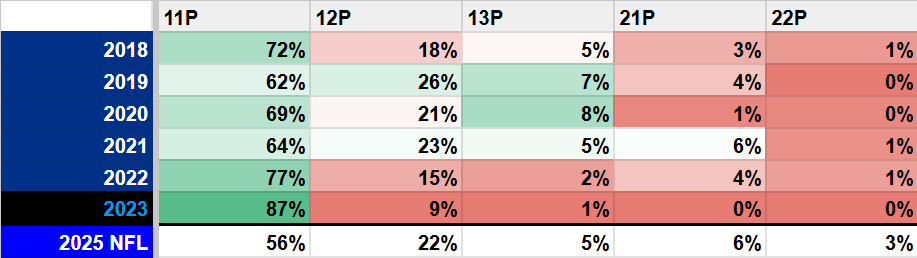
Based on these numbers, it would seem that the Jets were poised to lean heavily on 11 personnel in 2026.
But what if Reich, even at the age of 64, was willing to adapt his scheme to the modern NFL?
After all, Reich’s previous two NFL seasons, which featured spikes in 11 personnel usage, both resulted in him being fired before the year was over. So, it’s not as if his old strategy was working.
The days of the spread-out NFL have come to an end (for now, until the pendulum inevitably swings back). Offenses are using size to punish defenses for playing nickel or simply prioritizing speed over strength across the field. Then, they use the threat of physical dominance to create unpredictability and misdirection. Most of the top trail blazers in today’s NFL are doing this by leaning further on heavy personnel packages, i.e., packages featuring fewer than three wide receivers.
Take a look at the 2025 season, when most of the league’s elite offensive teams were notorious for relying on at least one heavy personnel package to a very high degree.
Sean McVay and the Los Angeles Rams led the NFL with a 31% usage rate of 13 personnel (1 RB/3 TE/1 WR), more than double any other team. The Super Bowl champion Seattle Seahawks used heavy packages (any type) on 55% of their plays, the fifth-highest rate, mixing it up between 12 personnel (28%), 21 personnel (14%), 22 personnel (9%), and 13 personnel (3%).
The AFC champion New England Patriots were third with a 19% usage rate of 21 personnel (2 RB/1 TE/2 WR) and ninth with a 49% usage rate of any heavy package. Kyle Shanahan’s 49ers led the NFL with a 37% usage rate of 21 personnel and were fourth with a 57% usage rate of any heavy package.
There are some exceptions, like Liam Coen’s Jaguars, but, clearly, the zeitgeist in today’s league is to go big.
So, if Reich were to make modernized adaptations to his offense, it would likely have to start with a shift in his personnel usage.
The Jets’ offseason moves strongly hinted that such a shift was coming.
Despite already drafting tight end Mason Taylor in the second round of last year’s draft, the Jets used the 16th overall pick on another tight end, Oregon’s Kenyon Sadiq.
Then, on roster cutdown day, the Jets surprised many by rolling with a big-bodied skill-position group. On top of keeping their expected top three tight ends (Sadiq, Taylor, and Jeremy Ruckert), the Jets kept a fourth tight end, Jelani Woods, and even a fullback, Andrew Beck.
That doesn’t look like the roster of a team that plans to rely on 11 personnel.
As it turns out, Reich has indeed made a significant shift to his offensive philosophy after the struggles of his recent NFL stints. He sent that message loud-and-clear in the Jets’ season opener.
A new offensive vision in New York
During their Week 1 victory over the Tennessee Titans, New York established an identity around heavy personnel packages. The Jets mixed-and-matched plenty of different heavy packages throughout the afternoon, with just about all of them yielding excellent results.
According to Sumer Sports, the Jets used a heavy personnel package on 56% of their offensive plays in Week 1. That would have ranked fifth-highest in the league last season, right between Kyle Shanahan’s 49ers and Klint Kubiak’s Seahawks.
Here is a breakdown of the Jets’ personnel usage rates in Week 1 and where they ranked across the league:
- 11 personnel (1 RB/1 TE/3 WR): 44.4% (23rd)
- 12 personnel (1 RB/2 TE/2 WR): 23.8% (13th)
- 13 personnel (1 RB/3 TE/1 WR): 17.5% (5th)
- 22 personnel (2 RB/2 TE/1 WR): 12.7% (3rd)
- 14 personnel (1 RB/4 TE/0 WR): 1.6% (Used once; one of only two league-wide uses in Week 1)
The Jets didn’t just keep four tight ends and a fullback for depth purposes. All five of the big boys were involved in the game plan.
Here is a breakdown of the Jets’ snap counts across the tight end and fullback spots:
- Mason Taylor: 44 (66%)
- Jeremy Ruckert: 29 (43%)
- Kenyon Sadiq: 28 (42%)
- Jelani Woods: 16 (24%)
- Andrew Beck: 9 (13%)
As expected, Kenyon Sadiq’s snap count was held back after he missed most of camp and all of the preseason, with Jeremy Ruckert out-snapping him by one. That shouldn’t be expected to hold up throughout the year, but Ruckert will clearly be featured.
The most interesting takeaway was the usage of Woods and Beck. Neither player appeared to be a roster lock going into cutdown day, and yet, they combined for 25 offensive snaps in Week 1, sometimes playing together. There was even a play where the Jets used all five of these players to fill the five skill-position slots, marking just one of two 14 personnel plays in the entire NFL this week.
New York counted on these packages to set up the play action game. When using heavy personnel packages, the Jets called play action on their 77.8% of their passing plays, the fourth-highest rate of Week 1. Those plays led to great success, as Geno Smith averaged 0.334 EPA (Expected Points Added) per dropback when using play action with a heavy personnel package, the 10th-best mark of Week 1.
The play action game was so successful because the Jets were racking up positive runs at will when they ran with multiple big bodies on the field. Through the first three quarters, the Jets had a 76.2% rushing success rate with heavy personnel packages on the field, which led the NFL in Week 1.
When the offense is dominating that thoroughly with extra tight ends/fullbacks on the field, the defenders are bound to bite extremely hard on play fakes whenever they see those packages. It then becomes quite easy for the OC to anticipate an ideal spot for a shot play and dial up a favorable play-action concept for the quarterback to throw behind the sucked-up defenders.
None of this is possible, though, if the tight ends can’t actually block. Throwing a bunch of tight ends on the field won’t accomplish the intended results if those tight ends are allowing runs to be stuffed.
That was not the case for the Jets in Week 1. Their tight ends came to play in the blocking game, which is what made the domino effect possible.
According to Pro Football Focus’ grading system, New York’s tight ends combined for a 67.3 run-blocking grade in Week 1, ranking seventh-best among tight end units. It’s worth noting that they did this while combining for 72 run-blocking snaps, the most in the NFL among tight end units and more than double three of the six teams with higher grades, so they maintained their efficient blocking on a very large workload.
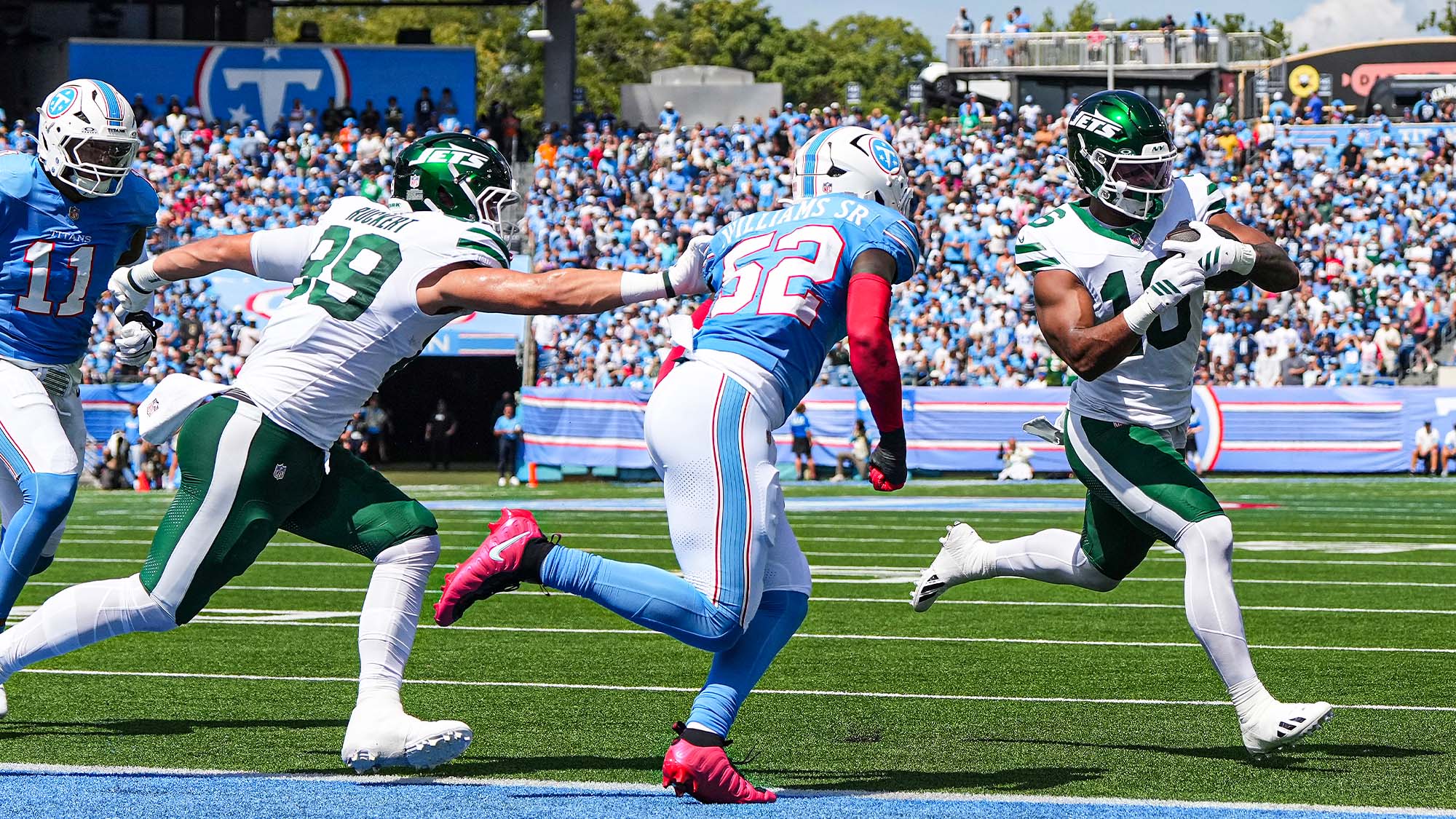
No play encapsulates the tight end unit’s outstanding opener than the Jets’ opening-drive touchdown. With 13 personnel on the field, Sadiq rushed in for a three-yard touchdown behind the lead blocks of Taylor and Ruckert, who drove their men into the end zone.
Jets fans were justifiably concerned about whether the 64-year-old Frank Reich would adapt to modern NFL trends after not leading a successful offense in the league since 2021. Well, at least for one week, he adapted marvelously.
The real test is how Reich responds now that opponents have film on him, especially since this Jets offense looked much different from any Reich-led offense of the past. For now, though, Jets fans should be excited about Reich taking the initiative to deviate from his historical tendencies to mold this offense to the modern game.
And since the Jets wisely built their roster to accommodate this philosophical shift, they are set up for sustained success if Reich is able to counter the adjustments that opponents throw at him throughout the year.
