
The New York Jets’ season-opening win over the Tennessee Titans was nearly flawless.
New York looked like a professional football team. Mistakes were uncommon, the trench play was physically overwhelming, and the game plans on both sides of the ball were excellent.
It’s hard to poke many holes in a performance that has New York walking out of Week 1 with the NFL’s fourth-best total yards margin (+171) and fifth-best DVOA rating (41.2%). But if the Jets want to maintain those rankings (or anything close to it) throughout a 17-game season, they need to remain endlessly unsatisfied, searching deep within themselves for every weakness that can be fine-tuned.
One of the areas that demands examination is the interior defensive line rotation, which featured a surprising snap-count distribution in Week 1.
Did the Jets stretch things too far? Or is Aaron Glenn onto something?
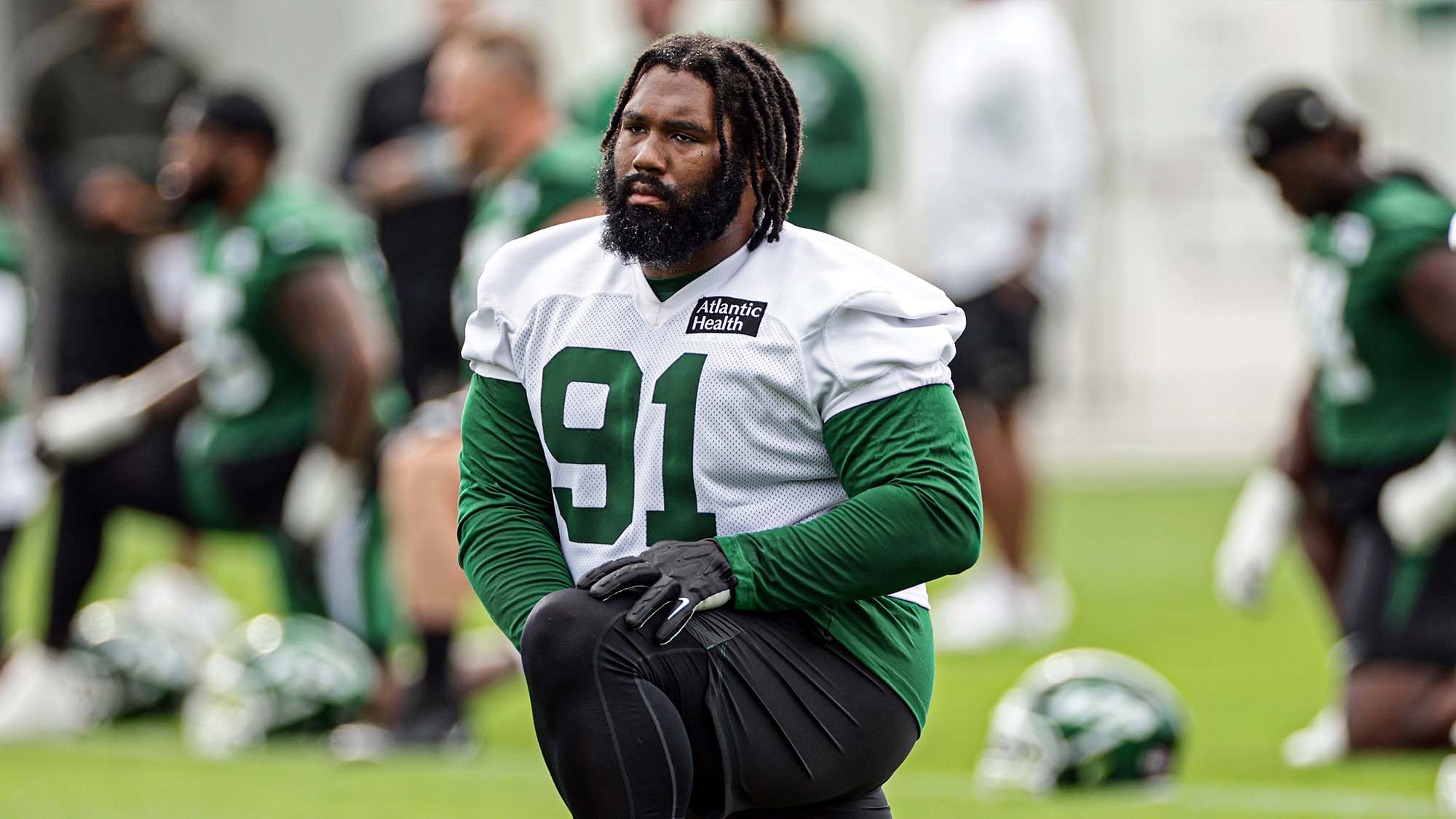
What’s the deal with Jowon Briggs?
Jowon Briggs was arguably the Jets’ most promising defensive standout of the 2025 season.
Of course, that isn’t a high bar to clear, considering how poor the Jets’ defense was. However, Briggs did not just stand out amongst his teammates—he was one of the NFL’s best pass-rushing defensive tackles.
After the Jets traded Quinnen Williams to the Dallas Cowboys, Briggs was elevated to a starting role, and he emerged as one of the league’s elite interior pass rushers over the back half of the season. At only 24 years old, these were Briggs’ pass-rush numbers and rankings among defensive tackles from Weeks 10-18, per Pro Football Focus:
- 2nd in PFF pass-rush grade (89.4)
- 3rd in pass-rush win rate (19.4%)
- 6th in pressure rate (14.4%)
- 7th in total pressures (29)
Briggs accrued those numbers over a sample of nine games, of which eight were starts, so it was hardly a fluky blip on the radar. Across that stretch, he ranked 14th among defensive tackles with 354 defensive snaps, which is a plenty good enough sample size to buy into his production.
What made the stretch so impressive is that Briggs continued excelling week after week, rather than ballooning his numbers in a game or two despite struggling otherwise. From Weeks 10-18, Briggs recorded multiple pressures in all but one game.
Going into training camp in 2026, Briggs appeared to clearly be the best interior pass rusher on the Jets’ roster, and easily the highest-ceiling defensive tackle on the team overall. It seemed as if the Jets were poised to rely on him to anchor their interior defensive line, specifically the pass rush.
If Briggs could take what he did in the second half of 2025 and maintain it over a full season, he would establish himself as one of the league’s top players at his position. That, of course, would be a dream scenario for a 2024 seventh-round pick whom the Jets acquired through a Day 3 pick swap, but the Jets would be giddy if Briggs could be half as good as his numbers portrayed him to be in the second half of 2025.
But as we head into Week 2, the events of the past month suggest that New York doesn’t view Briggs nearly as highly as you would think based on his production last year.
Throughout the preseason, Briggs was playing surprisingly deep into games, rather than coming out with the first-team unit. That was a fishy sign going into the regular season.
Then, in Week 1, Briggs played a measly 10 defensive snaps, representing just 20% of the defense’s 50 plays. It was his lowest snap count and snap percentage since coming to the Jets, and it ranked fourth among the team’s defensive tackles in the game.
Here is how the Jets distributed their defensive tackle snaps in Tennessee:
- David Onyemata: 35 (70%)
- Harrison Phillips: 27 (54%)
- T’Vondre Sweat: 15 (30%)
- Jowon Briggs: 10 (20%)
- Darrell Jackson Jr.: 8 (16%)
Obviously, shrinking Briggs’ role did not hurt the Jets at all in this particular game, as they held the Titans to 10 points, including just three before garbage time.
Still, cutting Briggs down to a minimal role after he closed the previous season with nine games of elite pass-rush production is a shocking lineup decision that deserves attention. In the long run, it’s fair to wonder if this could hurt the Jets’ defense.
None of the other defensive tackles on the Jets’ roster are capable of coming anywhere close to the pass-rush ceiling that Briggs displayed in 2025. Briggs (38) had more total pressures than Onyemata (21) and Phillips (11) combined in the 2025 season, despite playing less than half as many pass-rush snaps as the duo (320 vs. 668).
Sweat is a very good pass rusher relative to his size and role as a 366-pound run-stuffing nose tackle, but with 42 career pressures in 30 games, he is only expected to produce about 24 every 17 games.
For a few reasons, the Jets were able to live without Briggs’ pass-rush juice in Week 1. First and foremost, Onyemata had a surprisingly strong game, recording three total pressures, a number he reached just once over 17 games in 2025. The Jets will be fine if Onyemata keeps doing that, but, again, it was an outlier for him.
Additionally, Aaron Glenn deployed a blitz-heavy game plan, ranking third in the NFL as he blitzed Cam Ward on over 46% of his dropbacks, so the Jets weren’t counting much on their four-man rush to create pressure in this game. They relied on schemed-up pressures combined with quality coverage in the back end.
That won’t be the case every week, though. The Jets will face teams with better quarterbacks and stronger offensive lines, challenging them to create pressure by winning one-on-one matchups at the line of scrimmage.
As the season progresses, the Jets will probably accumulate a plethora of lost pressures by allowing other defensive tackles to take Briggs’ snaps. It is extremely unlikely that any combination of the Jets’ other defensive tackles could rack up as many sacks, hits, and hurries over a given sample of 100 pass-rush chances as Briggs would.
It all begs the question: If Briggs’ pass-rush production is so blatantly ahead of his teammates, why has Aaron Glenn buried him on the depth chart since the summer?
Most likely, the answer is that Glenn prioritizes run defense above anything else with his interior defensive line.
While Briggs was electric as a pass rusher in 2025, he showed warts as a run defender. Over that Weeks 10-18 stretch when he lit up the pass-rush columns, his PFF run defense grade was a lowly 48.9.
During the same span, the Jets allowed a league-worst 1.95 yards before contact per rush attempt on first down. Of course, Briggs is not the only person responsible for that, but he played a big role in it as a starting defensive tackle.
Meanwhile, Onyemata, Phillips, and Sweat each graded out amongst the league’s elite interior run defenders in 2025. All three players ranked in the top eight of PFF’s run defense grade among defensive tackles.
This seems to be the clearest explanation for Briggs’ snap count. His run defense is what separates him from all three of the players who out-snapped him in Week 1.
What makes Briggs’ designation as a run-stopping liability interesting, though, is that before the 2025 season, he actually had the opposite reputation.
When the Jets acquired Briggs from the Browns, he was viewed as a situational run stopper with little pass-rush potential. During his 2024 rookie season for Cleveland, Briggs had a solid 66.5 run defense grade, but recorded no sacks and just four total pressures over six games.
In fact, Cleveland’s usage of Briggs suggested that they saw him as a run-stopper first and foremost. A very high 53% portion of his defensive snaps came on run plays.
But in 2025, Briggs’ reputation as a player seemed to flip. While he exploded as a pass rusher, it seemed to come at the cost of his run defense.
Perhaps, then, it stands to reason that Glenn and the Jets did not view Briggs’ pass-rush production as legitimate, in the sense that he could only accrue it by sacrificing his run defense. Some players are like that. They can rack up pressures all day by exploding off the ball and shooting gaps with reckless abandon, but it causes them to abandon gap integrity in the run game, leaving giant holes for teams to run through.
If this is how the Jets see Briggs, it makes sense why they aren’t valuing him the way that you would expect a player with his pass-rush numbers to be valued. Coaches gravitate to players who can be trusted to do their jobs. That’s the case with any football coach in America, but especially one like Glenn, who clearly places an emphasis on run defense over pass rushing when it comes to his interior linemen.
Glenn is seemingly willing to trade Briggs’ plethora of pressures for sturdier run defenders who he can trust more confidently to maintain gap integrity. So, if Briggs wants to get his snap count back up and have a chance to build on the gaudy numbers that he racked up in 2025, he’ll have to prove to Glenn that he can be an aggressive pass rusher without compromising his run defense.
For now, expect Glenn to continue relying on the run-stopping Big 3 of Onyemata, Phillips, and Sweat to anchor the interior, while the pressure-producing responsibilities fall on the blitz packages and the speedy edge duo of Will McDonald and David Bailey.
