
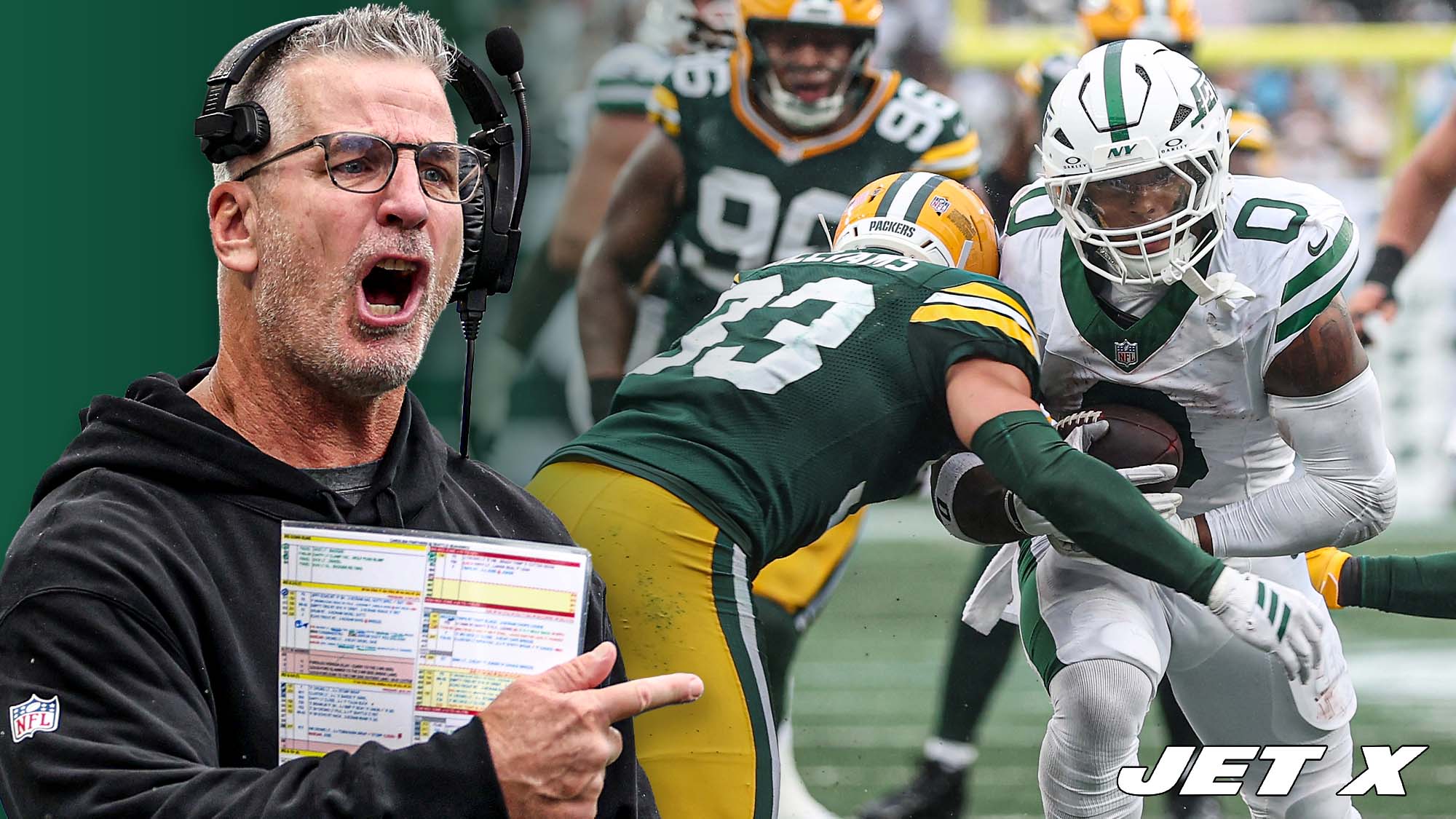
“Transparent” is a word you don’t often hear used to describe NFL coaches.
New York Jets offensive coordinator Frank Reich displayed transparency in spades during his Thursday press conference. The 64-year-old offensive coordinator was more than willing to pull back the curtain on his most controversial decision in the team’s Week 2 collapse, even bringing up historical data to back himself up.
In doing so, though, did Reich reveal that his thought process was flawed?
Or, did Reich reveal that the Jets’ staff put together a sound, well-thought-out process, only to be done in by poor execution from the players?
Reich’s explanation of his infamous fourth-down decision brings up a nuanced discussion about “process vs. results” and the logic behind play-calling decisions in general.
The play in question
Before diving into Reich’s explanation, we have to understand the play itself and what led up to it.
The Jets had blown a 17-7 lead and possessed the ball in a 17-17 game at their own 30-yard line with 2:54 remaining in the fourth quarter. Reich called three straight passes to begin the drive: an 11-yard completion to Garrett Wilson, an incomplete deep shot to Adonai Mitchell, and an 8-yard completion to Wilson.
This set up third-and-2 at the Jets’ 49-yard line at the two-minute warning.
So, Reich had a break in the action to set up two plays. Let’s take into account how the game had gone to this point.
Including Green Bay penalties, the Jets had generated 14 first downs on passing plays compared to five first downs on designed run plays. Their running backs, Breece Hall and Braelon Allen, had combined for 35 rushing yards on 19 carries, an embarrassingly poor 1.8 yards per carry.
The inside run game was particularly woeful. New York managed to collect two 14-yard runs to the edge, one by Hall and one on a jet sweep to Isaiah Williams, but if you take out those two plays and scrambles by Geno Smith, the Jets’ run game finished with 28 yards on 20 carries, an even more gruesome 1.4 yards per carry.
Meanwhile, the Geno Smith-led passing game was picking up steam. Smith entered the two-minute warning having completed 8 of his past 10 attempts for 64 yards, a touchdown, and no interceptions, including the two completions to Wilson on that very drive.
Controversially, Reich went against the grain and called two consecutive inside runs, straight into the teeth of a Packers defense that was clogging up the middle all game long, particularly because of consistent stacked-box looks.
On third down, Hall was stuffed for one yard, bringing up fourth-and-1. Then, on fourth down, Reich called a shotgun run up the middle for Allen, which was stuffed, leading to the turnover on downs.
Fans already chastised Reich in the moment, both for calling two straight runs in general and for the design of the fourth down call (running out of shotgun and targeting the middle). The vitriol only increased once the decision ultimately went down as one of the pivotal moments in a defeat.
Four days later, Reich was transparent about the data that went into the call.
Reich’s explanation
Reich went into great detail on the call, even offering insight into how he approaches decision-making in general.
“The framework and the perspective that we go in with, the analytics behind those calls, particularly the fourth-and-1 call and the shotgun run, is over a three and five-year study, excluding quarterback sneak, gun runs on fourth-and-1 are 71% conversion. Under center are 67% conversion. So, the gun run is actually better.”
The basis of Reich’s decision lies in those two numbers: league-wide, gun runs on fourth-and-1 have been about 4% more successful than under-center runs over both three and five-year samples.
Reich continued to explain why he believes that disparity exists.
“The reason it’s better, percentage-wise over a five-year period, is because there is a threat of a pass. And they (the defense) don’t get so tight. So, we have that perspective going in.”
Reich addressed the idea of a pass or a quarterback sneak in that situation, citing further data to support that a gun run was actually the best call.
“We also have the perspective of, over a five-year study, the conversion rate on pass is 57%, compared to 71%. Trust me, we’re going to throw it on fourth-and-1 some, maybe this week, maybe not. But unless you’re an elite quarterback sneak team, and there’s only three or four of those, or however many there are. There’s a couple, and they’re really elite at it. But if you’re not one of those, the analytics would say, a gun run, a gun-direct run, is the best percentage call in that play. And for us, that’s what I have the most conviction in. We didn’t make it. So, you got to live with it.”
There is a ton to unpack here—some promising for Jets fans, some concerning.
Having a coach who makes analytically backed decisions is a great sign
Reich deserves credit for being transparent with the media and fans by thoroughly explaining his decision instead of being coy. It’s refreshing to see a coach walk the outside world through his thought process instead of defending a negative result with no basis.
Still, NFL coaches don’t owe that to the media; they are within their rights to give cookie-cutter answers and avoid the risk of tipping off their plans to opposing teams. Reich being transparent with the media isn’t going to help the Jets win games.
The takeaway with real on-field value is that the Jets—yes, the New York Football Jets—have a coach who stood on a podium and provided data to back up his play-calling decisions.
That’s a huge step forward into the modern world for this organization. The closest thing to “analytics” spoken by a Jets coach in this decade was Robert Saleh’s “60%” mantra, and, no, it does not count.
It’s an even more startling sight because the coach in question, Reich, is 64 years old. When Reich was initially hired by the Jets, his attunement to the modern NFL was one of the major concerns. Aside from his age, Reich had not led a semi-successful NFL offense in five years. He had been fired in-season during his each of his two most recent NFL seasons, leading him to be out of the league for two years.
So, to know that the Jets’ OC is making analytically backed decisions is a major sign of progress for the organization. It shows that the organization itself has invested in an analytics staff to help supply the coaches with useful information, and it also shows that Reich is certainly not the dinosaur that many critics (myself included) feared he might be.
And you know what?
While there are some legitimate gripes with Reich’s fourth-down call, which we will get into, we probably wouldn’t be having this discussion if a basic assignment was executed by one of the players.
Bad play-call or bad execution?
If tight end Jeremy Ruckert did not briefly lose connection to the server, the play probably would have worked.
Ruckert, who was tasked with sealing off the back side edge, was extremely late off the ball relative to his teammates. The ball is almost in Geno Smith’s hands by the time he moves. He was so late that by the time he moved a muscle, his matchup, Lukas Van Ness, was already crossing the line of scrimmage.
Van Ness easily clears Ruckert and makes the stop.
All Ruckert had to do here was get off the ball on-time and get enough of Van Ness to prevent him from affecting the play from the back side. Instead, he is so behind the play that he actually ends up pushing Van Ness into Allen.
That’s not what you pay your blocking tight end $10 million to do.
Should Reich really be getting the flak? His play call wasn’t “run up the middle and get stuffed”. It was “trust that our 250-pound running back can get one yard as long as he gets semi-adequate blocking”.
Sometimes, a sound thought process by the coaching staff is undermined by poor execution.
With that said, Reich’s call was far from perfect. While it may have worked if Ruckert executed better, it can also be argued that, despite the data he cited, Reich did not actually make the most favorable call for his team in this situation.
Game context should not be tossed aside in favor of league-average historical data
Reich’s primary defense was the three and five-year data samples that suggested fourth-and-1 runs from shotgun had a 71% success rate, compared to the 67% success rate of under-center runs and a 57% success rate of passes.
Here’s the problem: differences of 4% and 14% in league-wide conversion rates are not significant enough to override the context of the game happening in front of you.
If football games were played in a vacuum, then, yes, calling a shotgun run would be the right move every single time. They aren’t played in a vacuum, though. They’re played on football fields.
And on that wet, pilly MetLife Stadium field, we had seen 58 minutes of the Jets’ run game consistently hitting brick walls at the line of scrimmage, while the pass game had begun picking up steam as the rain started to let up.
Based on what had been happening throughout the game, passing was arguably the best call, even considering the 57% success rate that Reich cited compared to the 71% success rate of shotgun runs. The Jets’ pass game was clearly their best weapon on a day when Green Bay was frequently stacking the box.
And if the Jets did run, it arguably would have been better to go under center and target the outside, as they had started having success on outside runs in the second half. Running outside would be an ideal way to avoid the congested interior looks that the Packers kept throwing out, especially if they did it under center, as it would only further squeeze the defense (opening up the edge).
A historical 4% league-wide drop-off in success rate by going under center is too marginal to override the advantages that it presented in that specific situation.
Running up the middle should not have been on the table given how unsuccessful the Jets had been in that area all game long, particularly in a situation where the Packers expected them to do so, given the down-and-distance. Doing it out of shotgun made it even less favorable, as it forced Allen to cover more ground on a day where getting a single yard up the middle was a colossal struggle for New York’s offensive line and tight ends.
You should not toss aside the context of your own game in favor of data that relies on hundreds of other games that occurred in completely different contexts with completely different players. That’s not what data is for. Data is useful, and it should be taken into account, but only to provide a baseline. The final decision must be made by adjusting off that baseline using present context.
Reich’s explanation implies that he made the call based primarily on historical league-wide conversion rates without accounting much for the context of what his own players were doing in that particular game against that particular opponent. It’s concerning that his explanation to the media did not include any context about the Jets-Packers game itself; he only cited historical data.
That would be a prime example of overreliance on analytics.
The design itself is questionable
Again, though—even with all of the flaws in the thought process behind calling an inside run in that situation, it could have worked if Ruckert made his block.
But did Reich put Ruckert in the best position to succeed?
Having Ruckert in an offset alignment, rather than in-line, certainly made his job of cutting off the back side edge more difficult. Ruckert still could have executed it with proper snap timing, but there’s a good three-plus yards of separation between him and Van Ness pre-snap. It would be a lot easier for Ruckert to engage if he were closer to the line.
The other problem is that calling this run out of shotgun (rather than under center) made it easier for Van Ness to shoot inside with reckless abandon. Why? Because he doesn’t have to worry about any sort of RPO or read-option threat.
The Jets have not established either of those things with Geno Smith at quarterback. So, lining up in shotgun does not do much to keep the edge defender honest in the same way it would if you had someone like Josh Allen or Lamar Jackson (or even Justin Fields) lined up in the gun.
If the Jets ran the same play with Smith under center and Ruckert in-line, running up the middle would have been a much more favorable proposition. Having Ruckert offset and Smith in the gun made this a very favorable opportunity for Van Ness to blow up the play.
So, running up the middle, in itself, was not a completely indefensible idea, even given the context of the game. Reich’s historical data backs up that running a non-sneak on fourth-and-1 is decently more favorable than passing, evidenced by the fact that, even with a lot working against them, the Jets still seemed poised to convert if Ruckert executed better.
Therein lies the issue, though: Reich undermined that historical data by actively weakening the Jets’ odds through a play design that was suboptimal, considering the game context. He needed a better play design to justify running up the middle considering the Jets’ inside run struggles—it didn’t make sense to roll with an unfavorable look out of shotgun just because the analytics say so.
Once again, this is why historical league-wide conversion rates cannot be relied upon too strictly to influence play-calling decisions. That 71% mark drops very quickly as you start adding up the factors that were working against the Jets in this situation.
If Reich saw those historical averages and just picked the highest-percentage call (shotgun run up the middle) without considering how the context of the game and the layout of his play design would affect those odds, it’s troubling. The Jets have long waited for a coaching staff that prioritizes analytics, but this is overboard.
Why is the sneak off the table?
Reich suggested that only a handful of NFL teams are good enough at the sneak to make it a viable choice in that situation. That is not backed up by the data, though.
As pointed out by Ryan Paganetti, a former director of football analytics with the Jacksonville Jaguars, 26 NFL teams have converted at least 81% of their QB sneaks on 3rd/4th & 1 over the last eight seasons. So, Reich’s claim seems far-fetched in that regard.
Granted, the Jets had about a full yard to go, rather than mere inches. Still, it’s not as if Geno Smith is Aaron Rodgers-esque in that the sneak is completely off the table for him. Since 2022, Smith has converted 6 of 8 rush attempts on 4th & 1, including both of his attempts with the Raiders last year.
As Paganetti also pointed out in his tweet, lining up under center to pose the threat of a sneak opens up other possibilities for the offense to check into. If the defense sells out on the sneak, the offense should be able to move into a favorable play that targets a weakness. If the defense does not sell out, boom, first down.
Lining up in shotgun takes the sneak threat off the table. And, as we alluded to earlier, the Jets don’t have the QB or scheme to pose extra threats out of shotgun, the same way that a team with a mobile QB or RPO-heavy system would. That crucial piece of context is not accounted for by the shotgun-versus-under center metrics that Reich cited.
Paganetti noted that there is a stark difference in the success rate of fourth-and-1 shotgun runs depending on the threat(s) posed. Over the last eight seasons, fourth-and-1 shotgun runs with “a QB run, read option, or RPO component” had a 73.2% conversion rate, compared to 64.5% without those components.
Of course, the Jets fell into the latter category on that play. There was no threat of a QB run, read option, or RPO with Geno Smith under center.
These numbers quantify the things we have been talking about: The historical league averages change very quickly once you start applying context for what is actually happening in your game.
It’s why those numbers should be used as a mere baseline. The coach’s job is to use the context in front of him to adjust off that baseline and make the best decision with both sides of the coin in mind: what tends to work around the league and how the situation at hand affects those odds.
A good or bad sign for the Jets?
This entire topic is fascinating to unpack, and extremely nuanced. There is no right or wrong answer here.
Reich’s call was not a horrendous blunder, nor was it a wise call ruined merely by player execution. On one hand, he had enough analytical backing to craft a sound, well-thought-out process that he was prepared to thoroughly explain to the media. At the same time, there are plenty of valid holes to poke in that process, even with the analytical backing.
It’s promising for Jets fans to know that Reich is using data to influence his decisions; if you’re not doing that in today’s NFL, you will be at a significant disadvantage. After all, as much as a shotgun run up the middle seemed far-fetched, if Ruckert gets off the ball on-time, this 3,000-word article probably would not have been written, and Jets fans might be parading down the Canyon of Heroes at 2-0.
But it cannot be overlooked that Reich’s poor play design drastically undermined the very odds that he relied upon to call that play in the first place. Ruckert deserves flak, but Reich made things harder for everyone involved by failing to properly account for the context of what had taken place in the game up to that point, both in terms of the choice to call a run up the middle and in terms of the design itself.
While Reich’s usage of analytics is promising, there are also red flags suggesting that he relied on it too heavily and/or was fed misleading data that lacked the necessary context to be truly useful. Going forward, Reich and the Jets’ analytics staff must find ways to optimize their usage of data. In this particular case, it seems to have led them astray.
In the long run, though, this approach can turn out to be a net-positive if the team as a whole finds a healthy balance. These metrics are advantageous tools in decision-making, but they should only be a complement to the coach’s gut—they should not take his job entirely.
