
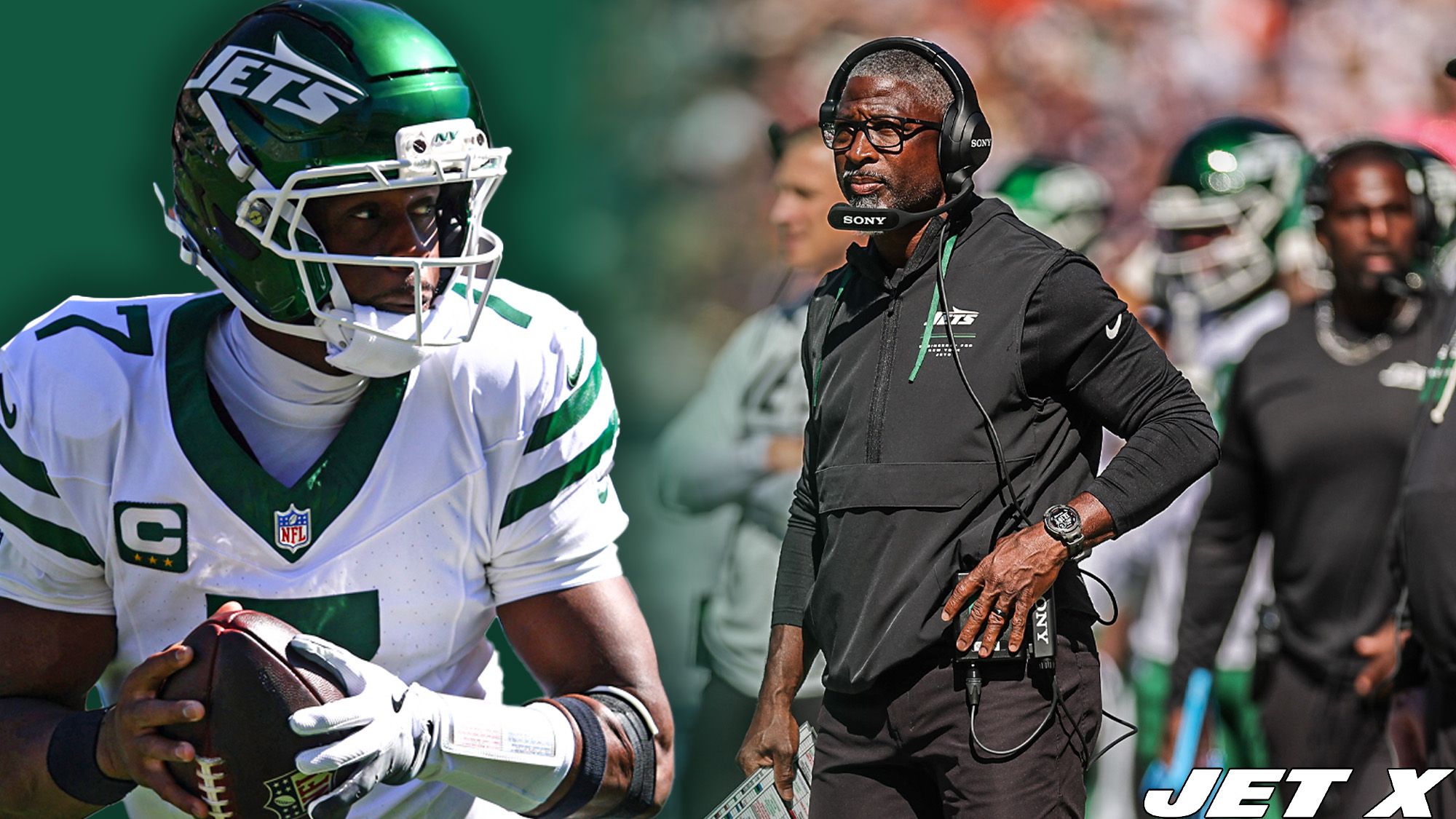
On Sunday, the New York Jets lost 23-12 to the Chicago Bears, falling to 1-3.
It was ugly and painful for the team’s fanbase. Although the final score says that the team lost by 11 points, this game is a prime example of why it’s important to look beyond the final score.
The Jets looked much uglier than the scoreboard indicates, and the ugly reality is, performances like this are starting to become too common under head coach Aaron Glenn.
Sunday was awful for New York
When you factor in everything that went down on Sunday, the final score looks incredibly generous for the Jets. The NFL is funky that way.
In reality, this was one of the most inept performances in Jets history.
Chicago finished with 492 yards of offense compared to New York’s 157, a margin of -335, the seventh-worst margin in Jets history and the second-worst of the past 40 seasons.
The Bears also held the ball for 42:45, ran 89 offensive plays, and collected 34 first downs. The Jets, meanwhile, held possession for just 17:15 and ran 32 plays.
Yes, the Bears had more first downs than the Jets had offensive plays. It’s only the second time this has happened in NFL history. The other time was in Week 1 of the 1999 season, when the expansion Cleveland Browns lost 43-0 to the Pittsburgh Steelers in their first game.
New York’s -27 margin in total first downs is the worst in franchise history by a large margin.
It doesn’t stop there. The Jets failed to convert on all seven of their third-down opportunities. Chicago also didn’t punt once, marking the fourth time in the Super Bowl era the Bears have done that, while the Jets were forced to punt five times.
The Jets had very little sustained offense, and their defense kept shooting itself in the foot and couldn’t get off the field. That cannot happen against an offensive mastermind like Ben Johnson, especially with a backup quarterback in the game.
It’s easy to point at the Jets’ lack of possession and place a large portion of the blame on New York’s defense. That’s fair, to a degree. However, you can’t ignore that the Jets’ offense didn’t convert a single third-down chance while collecting just seven first downs.
Both units played a huge role in this mess.
On defense, the biggest issue was stopping the run. The Bears ran the ball 54 times for 232 yards (4.2 yards per carry), with Kyle Monangai accounting for 146 of those yards and 30 of those touches. In the passing attack, Tyson Bagent completed 73.5% of his passes for 268 yards, zero touchdowns, and an interception.
The Jets finally broke their grueling, historic interception drought, and won the overall turnover battle 2-0. So, yes, the defense deserves blame for getting beat on the ground, but they did force two takeaways, including an INT, which has become a rarity.
At the same time, though, their edge rushers generated just one pressure, coming from Will McDonald. Even a backup quarterback will take advantage of that, and Tyson Bagent certainly did. That just can’t happen.
Offensively, Geno Smith completed eight of his 15 passing attempts (53.3%) for 119 yards and a touchdown. His lone TD came on a pretty 58-yard deep bomb to Isaiah Williams in the fourth quarter, cutting their deficit to 11.
While it was an excellent play, that context matters because it accounted for nearly half of his total passing yards and roughly 37% of the Jets’ total offense.
Entering Sunday, Smith had been off to an excellent start. His performance in Chicago does not negate his first three games, but it certainly wasn’t encouraging. If the Jets’ record through the first three games was based on his play, they should be 3-0, or at the bare minimum, 2-1. He just didn’t play well enough for New York to win on Sunday.
Outside of the deep TD, the Jets generated just 99 yards across their other 31 offensive plays. That’s about 3.2 yards per play.
Despite that, Gang Green won the turnover battle, and Chicago scored a touchdown on just two trips to the red zone. The offense had chances to capitalize, but it stalled too often.
Both of the Jets’ offensive possessions after forcing turnovers gave the team short fields. However, they were forced to settle for field goals in both situations. Those need to be touchdown drives. If both possessions had ended with TDs, Sunday would be a much different game, even with all the massive discrepancies.
There were also the penalties. The Jets committed 12 penalties and gave the Bears 76 yards, with flags wiping out a whopping three potential interceptions, though one was after an offsides call. The Jets went over 20 games without an interception, and they could have had four on Sunday, at the very least, three.
Anyone who watched Sunday’s game knows how ugly it really was. It looked like a game straight out of New York’s 2025 season. They struggled to consistently move the ball offensively, while self-inflicted mistakes and the rushing game killed them on defense.
Everyone seemed to think those “Same Old Jets” were non-existent after a Week 1 win over the Tennessee Titans and two competitive losses in Weeks 2 and 3, including a game that they mostly controlled against the Green Bay Packers in Week 2.
When the schedule first came out, the Jets’ first four games were tabbed as one of the team’s most difficult stretches. After a game in Tennessee, they were forced to face the Green Bay Packers, Detroit Lions, and the Chicago Bears in three straight weeks. All three organizations held a winning record last season.
However, the beauty of the NFL is that it’s ever-changing. The Jets had most of the off-field bounces go their way throughout that stretch. Green Bay was without Micah Parsons and Josh Jacobs and also finished the game with just two of their two starters on the offensive line. Detroit was without their stud safety combination of Kerby Joseph and Brian Branch, while the Bears had no Caleb Williams.
Yet, the Jets didn’t win one of those three games.
After the debates in Jetland about whether fans should be encouraged about the team’s play in Weeks 2-3, there’s no debating whether Sunday’s loss was another meaningless “moral victory” for the Jets. It was a historic beatdown, even if the final score doesn’t fully indicate it.
And those are becoming all too common under Aaron Glenn, who has allowed the issues of his debut season to leak into his second year. Over the last 10 months, Glenn is responsible for two of the seven worst performances in Jets history, according to total yards margin.
Reality has set in for the Jets: The moral victories are over with. It’s put up or shut up time.
