
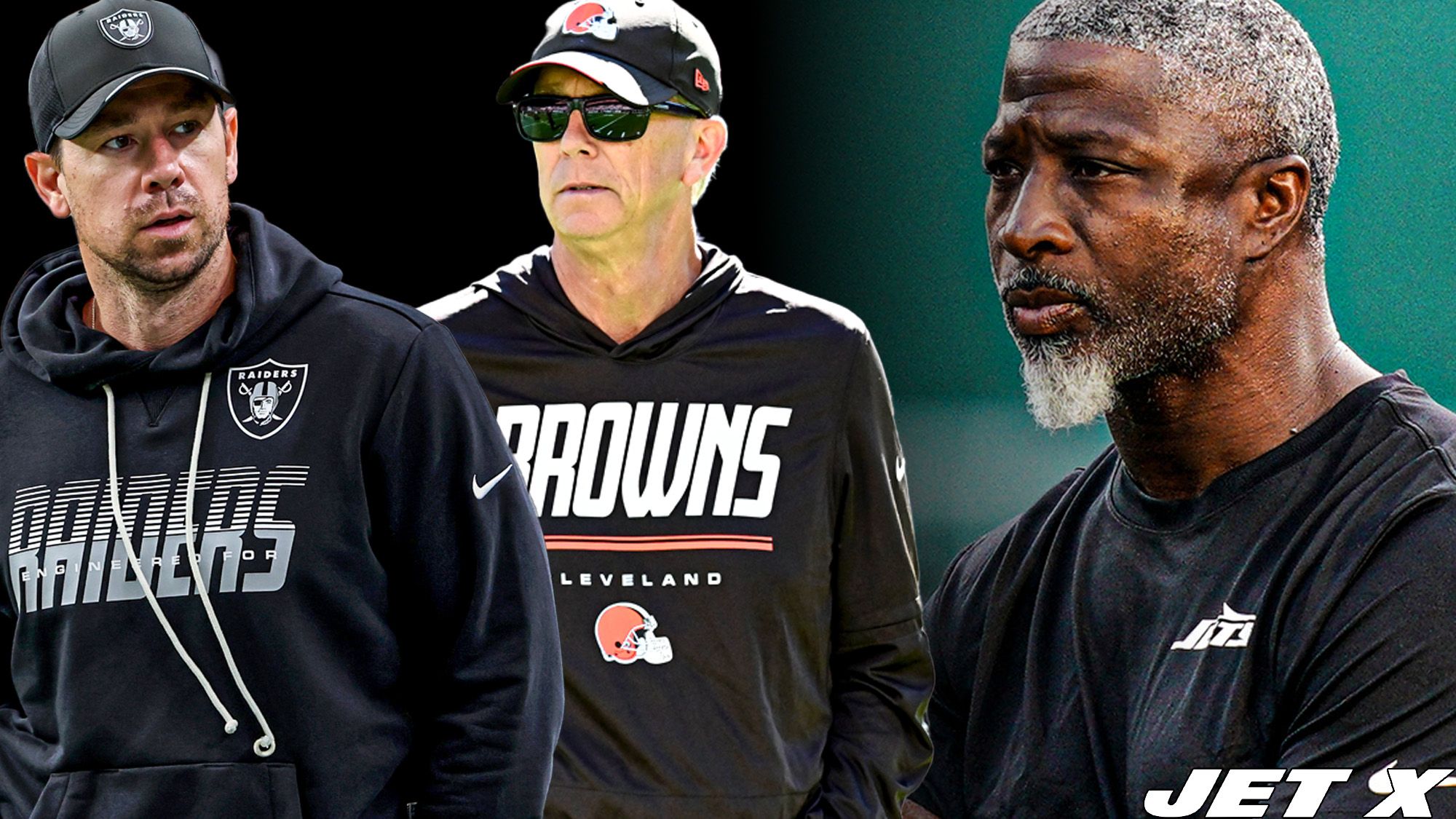
After an offseason filled with heated conversations about Aaron Glenn’s job status, those conversations cooled off within the New York Jets’ fanbase for the first three weeks of the 2026 regular season.
New York secured a convincing Week 1 victory over the Tennessee Titans right out of the gate, which excited the fanbase. In Week 2, the team held a double-digit lead over the Green Bay Packers in the fourth quarter before falling in overtime. In the following game against the Detroit Lions, the Jets erased a 14-point deficit in the fourth quarter, but still fell short.
Week 4, though, against the Chicago Bears, didn’t have the same fight or competitiveness. The final score, 23-12, was actually very generous to the Jets when you peel back the curtain and look at what really went down.
And just like that, the conversations around Glenn’s job security are back. After a 1-3 start to the season, he is now 4-17 in his career as the Jets’ head coach. Among the Jets’ 19 full-time HCs in franchise history, only Rich Kotite had a worse record throughout his first 21 games.
To prove he deserves a third year, Glenn will need to do a lot in the season’s final 13 games.
Did Glenn even earn a second season?
A large portion of the Jets’ fanbase had seen enough of Glenn after one season. Here at Jets X-Factor, Michael Nania and I strongly endorsed the idea of New York moving on.
By bringing Glenn back for a second season, the Jets were betting he’d be a historic outlier. Since 1980, just four of 17 coaches who started 0-6 eventually led that same team to the playoffs. Those coaches include Hall of Famer Jimmy Johnson (Dallas Cowboys), Zac Taylor (Cincinnati Bengals), Kyle Shanahan (San Francisco 49ers), and Dan Campbell (Detroit Lions).
Campbell and Shanahan finished their first year with encouraging results, despite disappointing final records. Glenn didn’t have that. In 2025, his squad had the worst December point differential in NFL history (-107).
Taylor, meanwhile, was handed Joe Burrow with the No. 1 overall pick. Lastly, Johnson, whose first year in Dallas was in 1989, is a Hall of Fame coach. Comparing him to Glenn would be unfair. He also accomplished it over three decades ago.
So, history suggested that firing Glenn after Year 1 was most likely the best course of action for New York. Another question is: what did he really prove during his first year in the role? Not much. His game management was subpar, and that has carried into his second year as an HC. Furthermore, all three of his 2025 wins came against backup-level quarterbacks.
Really, what was there to cling to? He is a defensive head coach; although he didn’t call plays last year, the Jets’ defense was among the worst in the NFL by pretty much every metric. He also had to fire his defensive coordinator, Steve Wilks, mid-season.
Although Glenn wasn’t calling the defense, he is still responsible for the unit’s atrocious season and the decision to hire Wilks in the first place, who already had a questionable recent track record in the league. Glenn also fired his offensive coordinator, Tanner Engstrand, following the year, which was puzzling. Engstrand flashed as a play-caller and innovator. He just didn’t have a quarterback who could throw the football at a competent level.
Beyond that, he also canned seven assistants. At the end of the day, one common denominator remains: Glenn.
Without the Jets’ historic special teams play in 2025, you could argue that the team may have gone winless. Yes, Glenn deserves some credit for that and for hiring Chris Banjo, but that’s just about all he can be credited for.
The main reason Glenn’s supporters gave to justify a second season was, “Well, rebuilds take time in the NFL.” Not only is that ridiculous reasoning, but it is also simply not true.
Rebuilds in the NFL don’t take long
Anyone who believes multi-year rebuilds are common in the NFL just hasn’t kept up with the rapid changes over the past few years. Glenn arguing that “big ships turn slow” is really just a ploy by struggling HCs to buy more time, whether intentionally or not.
Teams going one-and-done with coaches in recent years have actually led to more immediate success. Entering 2026, eight out of the last 10 teams that went one-and-done with their head coaches earned a playoff berth the next season. That is a wildly high rate, and one that doesn’t get spoken about enough.
Just look at the coaches hired alongside Glenn last offseason. Mike Vrabel and Liam Coen are both 16-5 with their respective teams, while Vrabel’s Patriots were AFC champions in his first year. Ben Johnson, whose Bears just dominated the Jets with a backup QB, is 14-7. Even Brian Schottenheimer (9-11-1) and Kellen Moore (7-13) have won considerably more games than Glenn.
Those coaches have had the same amount of time to implement their programs and rosters as Glenn, and the results aren’t even in the same ballpark. When you look at the top hires this year, the results become even uglier for Glenn. Joe Brady, Todd Monken, John Harbaugh, Jeese Minter, and Klint Kubiak have all started 3-1.
Monken and Kubiak have done that with the Cleveland Browns and the Las Vegas Raiders. Yes, the Browns, who some even consider historically more laughable than the Jets, and the Raiders, who earned the first overall pick last year.
Five newly hired coaches this year already have three wins in four weeks. Glenn has four in 21 games.
Not every coach inherited the same situation that Glenn did. Brady was promoted internally and has Josh Allen, while Jeese Minter was handed Lamar Jackson as a first-year HC.
That’s not everyone, though. Kubiak inherited the worst team in football while Monken’s organization won five games last year. The Raiders, in particular, have found immense success right away without even playing their No. 1 overall pick, Fernando Mendoza.
Veteran Kirk Cousins has steered the ship under Kubiak, and Mendoza hasn’t even been forced to take the field yet. Meanwhile, Monken in Cleveland is getting the best out of Deshaun Watson. Both of those starts this year are largely attributed to coaching.
The Raiders’ situation is more applicable to the Jets, though, since both teams won three games last season. Las Vegas hired Pete Carroll for the 2025 season, which was questionable to begin with, but they didn’t play the waiting game. They quickly realized that the results were lackluster and moved on after one year. Now look where they are.
In today’s NFL, proactive teams often find success. That applies in every area, from quarterback to head coach.
The Jets have 13 games left in 2026, and they will be Glenn’s last chance. He has to prove he can be trusted to work with the team’s next franchise quarterback, expected to be selected high in April’s NFL draft, along with two other first-round selections. Is he really the Jets’ long-term answer? Nothing tangible has shown that over his 21 games.
If there isn’t clear conviction that Glenn is the Jets’ guy by the end of the 2026 season, there is zero reason to bring him back for a third year. He’s lucky he even earned a second campaign, given how ugly Year 1 was.
