

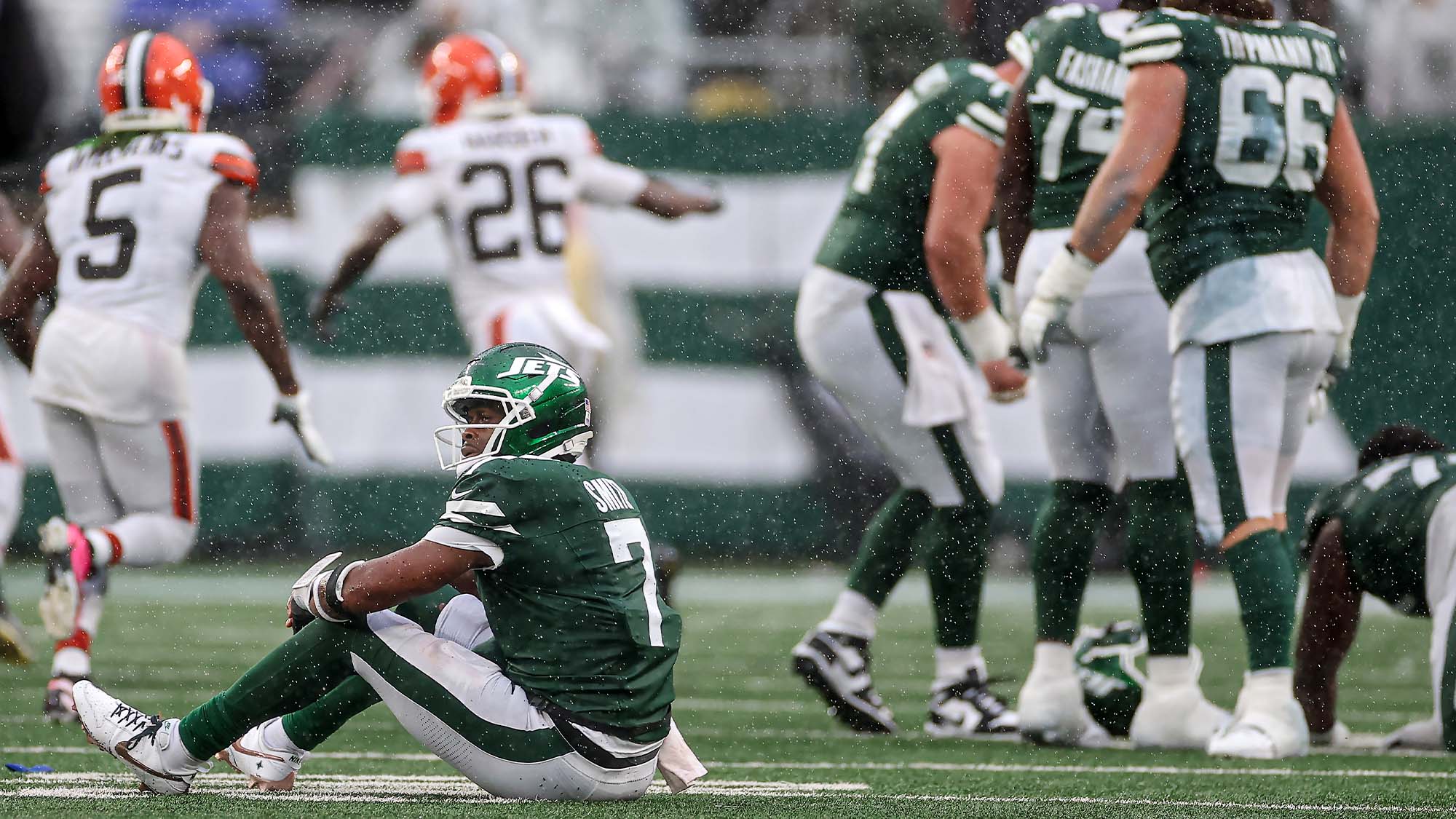
Aaron Glenn said it himself in his opening post-game statements: The New York Jets have a lot to improve upon from their 17-12 win over the Cleveland Browns.
In the NFL, wins are rarely all good, and losses are rarely all bad. It’s crucial for teams to put the final score aside and evaluate every aspect of the game from an honest lens. Fans and analysts should do the same if they want to see the sport through the coaches and general managers’ eyes.
Despite escaping a sloppy MetLife Stadium field with the victory on Sunday, the Jets allowed one of their most concerning problems to persist for a fourth straight game.
It’s now become a recurring issue that New York desperately needs to solve if they wish to defeat some of the more imposing opponents on their upcoming schedule.
The Jets have to figure this out
In the Jets’ fairly effortless season-opening victory over the now-0-5 Tennessee Titans, quarterback Geno Smith did not take any sacks. It was just one of many zeroes for Smith and the Jets’ offense in a beautifully mistake-free outing.
Since then, though, drive-killing sacks have become the Achilles heel of a Jets offense that otherwise has shown glimpses of being a solid unit.
Smith took four sacks in the win over Cleveland, and all four were costly. The first three led to punts, and the last was a strip-sack recovered by the Browns late in the fourth quarter. Fortunately, the Jets’ defense stepped up to give the offense another chance, but that could have been the Jets’ third loss of the season that was punctuated by a sack.
From Weeks 2-5, Smith took an NFL-high 16 sacks. He was also the most frequently sacked quarterback from a rate standpoint, as his 11.5% sack rate led quarterbacks with at least 70 pass attempts over that span.
So, who’s to blame?
Sacks are a complicated metric. While it’s easy to point fingers at the offensive line, they are actually a metric that every aspect of the offense could be at fault for.
There are countless variables that could go into explaining why a team struggles with allowing sacks. It absolutely could be primarily due to the offensive line. However, it is also possible that the offensive line is holding up well, but the quarterback holds the ball too long.
Then, you have to consider why he holds the ball so long. Does he progress through his reads too slowly? Does he legitimately have nowhere to throw the ball due to poor separation by the receivers? Is it by design since the play-caller rarely draws up quick passes?
The scary reality for the Jets is that their sack problem boils down to a mixture of every aforementioned variable. They are not one benching or one scheme tweak away from fixing this. There are a lot of things that need to improve.
First and foremost, let’s start with the offensive line.
Offensive line woes
The Jets’ offensive line has struggled to get all five starters thriving cohesively. Each week, a different player is the weak link.
In Week 2, right tackle Armand Membou had one of the weakest games of his career, allowing a team-high four pressures, including a sack, per Pro Football Focus.
In Week 3, left tackle Olu Fashanu bore the brunt of the criticism, allowing three sacks. Center Josh Myers was also a liability in the loss to Detroit, allowing a sack of his own and contributing to multiple other protection breakdowns.
The Jets only attempted 15 passes in their Week 4 loss to Chicago, but they still allowed three sacks, with Fashanu and left guard Jordan Meredith each allowing one.
Against Cleveland, right guard Joe Tippmann had his turn in the limelight, frequently getting manhandled by veteran defensive tackle Maliek Collins. Tippmann gave up two ugly sacks in one-on-one situations while adding in a holding flag to prevent a third.
The offensive line isn’t entirely at fault for the sack problem, as we’ll get into, but it is not off the hook, either. Offensive line coach Steve Heiden must figure out how to get all five guys on the same page. As we saw on Sunday with Tippmann’s rough performance, it does not matter if the rest of the offensive line plays well when the opponent can consistently wreak havoc by beating up on one weak link.
From an overall consistency standpoint, it can still be argued that the Jets’ offensive line has been about league-average this season in terms of the consistency at which they allow pressure. Through Week 5, the Jets rank 13th in PFF’s pass-blocking grade (67.3), and Geno Smith ranks 17th out of 31 quarterbacks in pressure rate (36.6%) while maintaining the 13th-highest time to throw (3.01).
Together, those numbers paint a picture of mid-level pass protection. The problem is that, despite average overall consistency at preventing pressure, the Jets allow too many of their protection breakdowns to be converted to sacks, and that brings us to our next concern.
Geno Smith is struggling mightily to avoid sacks
The offensive line’s job is to prevent pressure, but once the pressure gets home, it’s on the quarterback to prevent that pressure from turning into a sack—generally speaking, of course, as not all sacks are avoidable.
Over time, though, the sack stat belongs more to the quarterback than his offensive line, while the OL should be judged on its consistency at preventing pressure.
We are seeing this phenomenon with 36-year-old Geno Smith, who has looked every bit his age when it comes to avoiding sacks.
According to PFF, Smith has a pressure-to-sack rate of 25.4%, the second-highest rate among 31 qualified quarterbacks. Essentially, this means that Smith gets sacked once out of every four times a defender bears down on him.
Comparatively, the league-average pressure-to-sack rate this season is 16.5%, which is one sack out of every six pressured dropbacks.
This equates to a lofty total of surplus sacks that fall on Smith for yielding a higher pressure-to-sack rate than the average quarterback.
Let’s do some quick math: Smith has taken 16 sacks on 63 pressured dropbacks. If he were to take sacks at the league-average rate of 16.5% on the same number of pressured dropbacks, he would have only taken 10.4 sacks this season.
This means that Smith has taken about 5.6 more sacks than the average quarterback would be expected to take if pressured at the same rate.
It lines up pretty well with the eye test, especially in Sunday’s win over Cleveland. Smith was never a mobile quarterback to begin with, and now at 36 years old, he is one of the least mobile starters in the league. Smith’s escapability is about as poor as it gets among the 32 current starters, and it shows when he tries to weasel his way out of tight spaces.
The multi-year trend of Smith’s pressure-to-sack rate points to this being an issue that may be related to his athletic decline. Back in 2023, Smith’s pressure-to-sack rate was a solid 13.9%. It jumped to 19.9% in 2024 and again to 25.9% in 2025, before plateauing through the first five games of this season.
Smith is not going to get more athletic overnight. What he and the Jets must do is minimize the frequency at which his mobility is called upon.
The ball can come out quicker
While Smith’s inability to avoid defenders has been problematic, the Jets can also reduce the number of times he is placed in those situations by getting the ball out quicker. That falls not just on Smith, but multiple other facets of the offense as well.
Smith’s average time to throw is currently 3.01 seconds, ranking 13th out of 31 quarterbacks, which seems fairly normal. However, that number is misleading as it pertains to the topic of whether the Jets’ play-calling is helping to negate sacks. Despite their middling TTT, the Jets rarely take the pass-rush out of the play by throwing quick passes.
Smith has gotten the ball out in under 2.5 seconds on just 33.3% of his dropbacks, the second-lowest rate in the league ahead of only Drake Maye of the New England Patriots.
Across the NFL, sacks that occur in under 2.5 seconds are extremely rare. Only 35 of the league’s 357 sacks this season—less than one out of every 10—occurred in under 2.5 seconds.
Quite obviously, the best way to reduce the chances of a sack is to throw the ball before the defense has enough time to reach the quarterback. The Jets do this less often than all but one team, so it is certainly a big reason why they have allowed so many sacks. It’s something that the Patriots can get away with because Maye is one of the league’s most athletic quarterbacks, but if you have an immobile veteran under center, the lack of quick passes will exacerbate the problem.
Offensive coordinator Frank Reich should look to cook up more quick passes for Smith, especially in high-leverage situations where the Jets cannot afford to allow a sack. Too often this season, Reich’s offense has leaned heavily on traditional dropbacks that take a long time to develop. His play-calling has maximized opportunities for sacks to happen.
In fairness to Reich, though, the Jets’ wide receiver situation complicates matters.
For the majority of the season, the wide receiver lineup has been Garrett Wilson and a bunch of dudes. During Sunday’s win, the Browns could be seen throwing blatant double-teams at Wilson for much of the afternoon after Wilson shredded them up on the opening drive. It put pressure on players like Tim Patrick and Isaiah Williams to win one-on-one, and that just isn’t going to happen very often.
Certainly, some of the sacks allowed by New York this season could be primarily blamed on the lack of separation from the receivers. You would still like to see Smith find a way to get rid of the ball on some of those sacks, and for Reich to call some more quick passes, but the Jets’ injuries at wide receiver have made it harder to get the ball out fast.
This is especially true because the Jets are using their best receiver, Wilson, in a vertical-threat role.
As opposed to earlier in his career, the Jets are rarely peppering Wilson with quick throws just to get him the ball in space. Reich is using Wilson in a vertical role that allows him to feast in the intermediate-to-deep range. It’s working beautifully, as Wilson is having the best season of his career. However, while players like Adonai Mitchell and Omar Cooper Jr. are sidelined, Wilson’s new role means that the Jets lack a reliable underneath target to help Smith get the ball out quickly.
Getting Mitchell and Cooper back should be beneficial for helping the Jets reduce their sack numbers.
Many things are going wrong
When you lead the NFL in sacks allowed over a four-week span, it is rarely the fault of one or two people. Many facets of the Jets organization need to be better.
The offensive line has to get on the same page and help each other out, eliminating the weekly weak-link issue that continues to bleed sacks.
Smith has to find ways to reduce the percentage of pressures that turn into sacks, whether it means having a quicker trigger to throw the ball away or getting through his progressions a bit quicker.
Reich can afford to call more designed quick throws to help reduce the number of long-developing plays that Smith and the offensive line must deal with.
The separation at wide receiver exacerbates all of these problems, and there isn’t much the Jets can do about that but wait for Mitchell and Cooper to return.
One way or another, the sacks must go if the Jets want to beat better quarterbacks than the likes of Cam Ward and Deshaun Watson.
