

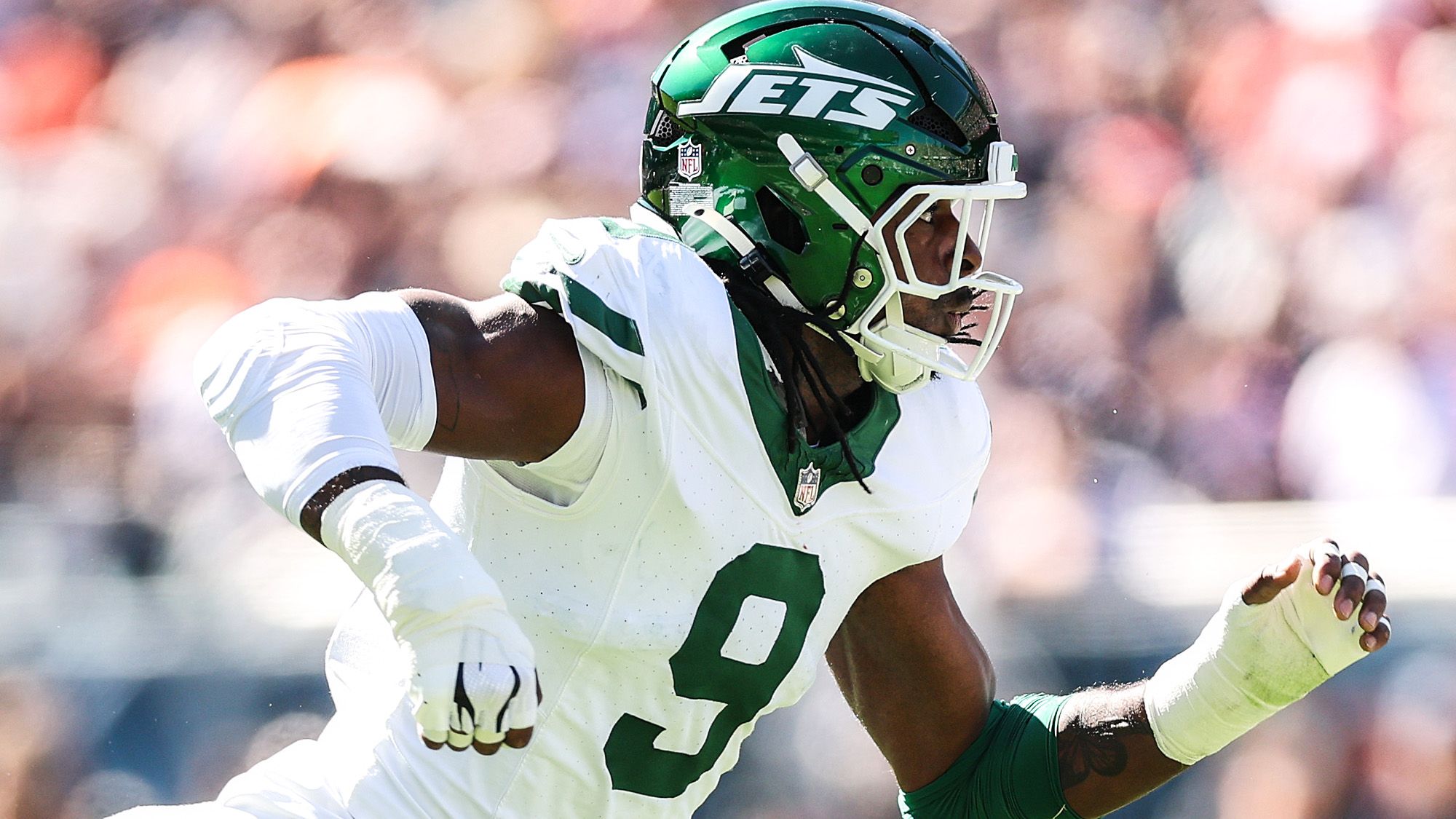
New York Jets edge rusher Will McDonald has flashed elite pass-rushing tools over his four-year NFL career.
However, consistency has been his biggest problem. That trend has carried into this season.
Five games into the 2026 season, McDonald has tallied 12 pressures and two sacks throughout 85 pass-rushing snaps. Five of those 12 pressures and one sack came on 18 pass-rush snaps in Week 1. Since then, however, he has just seven pressures and one sack throughout 67 pass-rush reps.
Are the surface-level numbers doing the pass-rusher a disservice, though? Has he actually been impacting the game more than those numbers indicate?
NFL analyst Judah Fortgang shared a chart on X that highlighted how often edge rushers have been double-teamed this year, and their grade on those plays. McDonald’s placement is fascinating.
McDonald falls in the top-right quadrant, meaning he faces double teams at a higher rate than the league average, but he also performs at an above-average clip in those situations. Per the chart, his double-team rate is around 41.2%, yet he ranks around the 75th percentile in his grade on those plays.

Consider some of the top edge rushers that McDonald has performed better than in this metric. T.J. Watt, for example, has been double-teamed at roughly the same rate as McDonald, yet the former ranks around the 22nd percentile for grade, while McDonald falls around the 74th percentile.
This is a pretty revealing metric, because it shows that McDonald has clearly demanded a high level of double teams from opposing offensive linemen. On top of that, he has performed pretty well in those situations.
Yes, folks should expect more consistent pressure and sack totals from McDonald. At the end of the day, he is expected to be the Jets’ top pass-rusher. David Bailey is still just a rookie and deserves more slack.
The high double-team rates don’t excuse inconsistent production. After all, that’s part of being a team’s top pass-rusher. Opponents are focusing on stopping him, especially when he doesn’t have many proven pass-rushing threats alongside him.
The encouraging part, though, is that McDonald isn’t getting taken out of plays when he is doubled. If he found himself down in the dumps on this chart, that would be a completely different story.
Once again, the biggest problem with McDonald is generating sacks and pressures consistently on a game-to-game basis. Overall, his production has been solid. His 12 pressures on 85 pass-rush snaps give him a 14.1% pressure rate. That’s by no means a bad number; it ranks 25th out of 80 qualified edge rushers (min. 70 pass-rush snaps).
However, nearly half of McDonald’s pressures came in Week 1, when he posted a 27.8% pressure rate, while that clip has fallen to a below-average 10.4% since then. Maintaining a 27.8% mark over multiple weeks is unheard of, but the significant drop-off is rough for a defense to deal with.
Because of his inconsistency, I wouldn’t go so far as to claim McDonald has been a strong pass rusher this year. However, his high double-team rate and his effectiveness in those situations adds some perspective to his start.
The Jets have seen the impact that their pass rush can have on winning and losing. Two weeks ago, when the team had just four pressures and zero sacks, they were carved up by Chicago Bears backup QB Tyson Bagent, who got benched the following week. In Week 5, the Jets snuck out with a win against the Cleveland Browns behind their eight sacks, the most by any NFL team this year.
Pressure is critical in today’s game. The Jets have had excellent coverage; they just need more consistency up front, and McDonald is at the forefront of that.
