
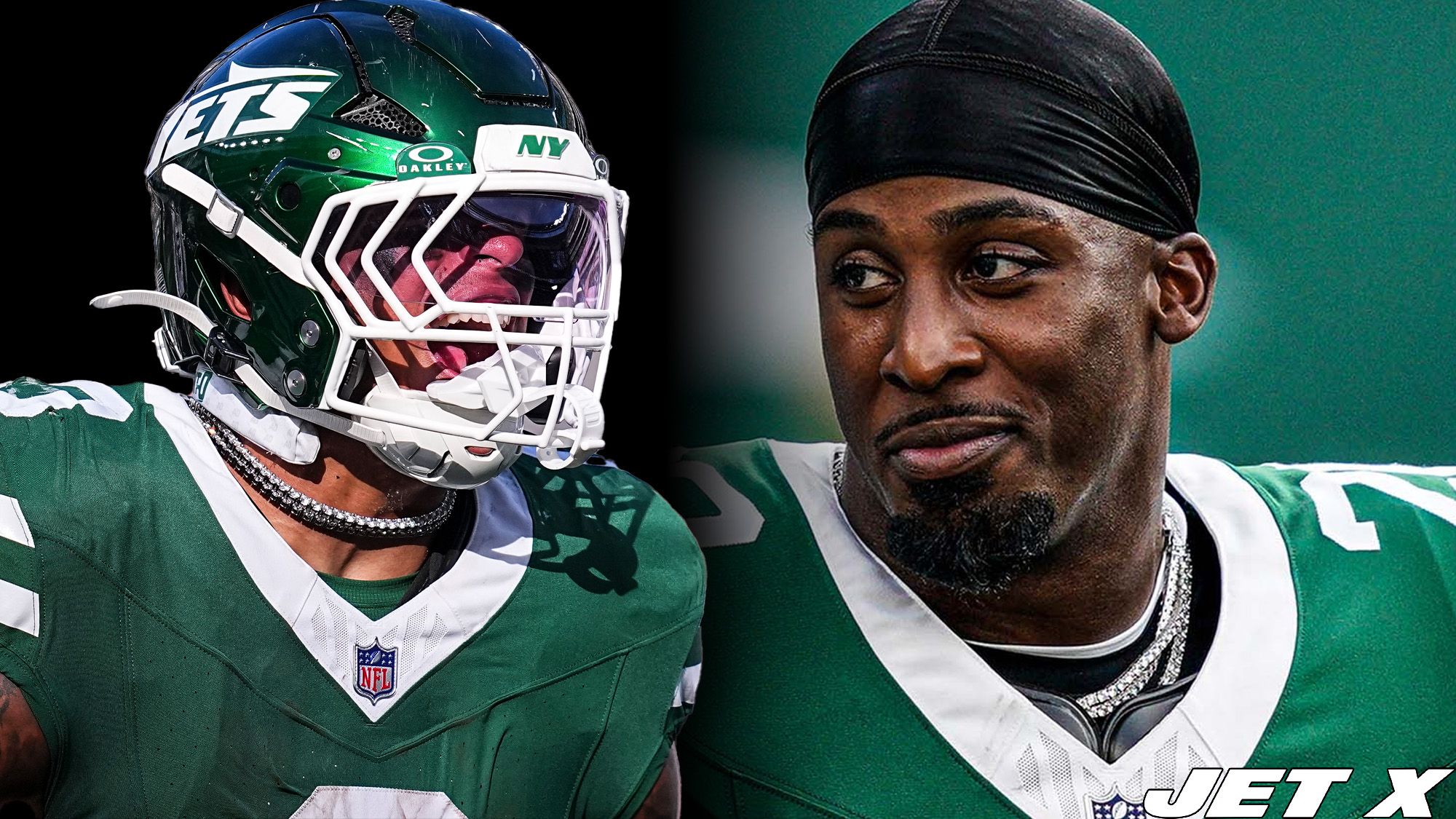
One of the New York Jets’ bright spots this season has been Braelon Allen’s emergence.
If you told me before the season started that people would be talking about whether he’s earned the Jets’ starting running back job over Breece Hall, I would have said you were crazy.
But yes, that’s where we are today. Has Allen really leapfrogged Hall over the past few weeks while Hall has missed the past five games with a quad injury?
Allen over Hall?
Since Allen stepped in for Hall as the starter, he has received most of the team’s workload out of the backfield, and he’s clearly capitalized.
Since Week 4, here is where Allen ranks among 40 qualified running backs in several key categories (minimum 30 carries over that span):
- 5.4 yards per attempt (T-3rd)
- 3.92 yards after contact per attempt (5th)
- 23 missed tackles forced (T-3rd)
- 19 10+ yard runs (1st)
That’s over a five-game stretch, too, at a key moment in the season. These aren’t numbers put together while the Jets are tanking the final three weeks of the year; this is legitimate production over a significant five-game sample size.
In Hall’s absence, Allen has not only stepped up, but he’s also been one of the league’s best running backs over that span. That’s not hyperbole; the numbers back it up.
So, what does this mean for Hall? Well, Aaron Glenn told reporters on Monday that he will remain with the team and won’t be dealt at the trade deadline, despite some chatter in the rumor mill.
At the end of the day, that seems to be the right decision for the Jets. It’s great to see Allen’s emergence, but why should that force the team to move on from one of their most established playmakers?
Unless the team gets Day 2 capital for Hall, which seems unlikely, holding on to him looks like the right choice.
Here’s the thing: why does it have to be an either-or conversation? The Jets don’t need it to be one RB over the other. Hall and Allen are obviously very different players, and there’s no reason they can’t both have significant roles in this offense.
There is no debating that this stretch has earned Allen far more opportunities, even when Hall re-enters the fold. It would be ridiculous to shrink his workload back into an RB2 role when Hall returns from injury, completely ignoring this scorching-hot stretch.
Let’s also not forget what Hall brings to the table. He is a legitimate dual-threat back when you add in his receiving ability, and he earned every bit of his three-year, $43.5 million extension this offseason. He and Garrett Wilson have been the lone mainstays within the Jets’ offense over the past few seasons.
Right now, the conversation should be more about how the Jets can get the most out of both players. If anything, this stretch could open up more chances for Hall as a pass-catcher, which has been one of the most promising facets of his game.
There will be situations where each player is better suited. Allen’s physicality gives him an advantage rushing between the tackles or wearing down a defense with his bruising power and improved breakaway ability, which has been a huge part of his emergence.
At times, it could be even simpler. If Allen has the hot hand, keep feeding him, and the same goes for Hall. The Jets shouldn’t feel obligated to stick to some predetermined split. They can feel things out as games progress.
Heck, there could even be opportunites to get both players on the field together. It’s on Frank Reich to explore that wrinkle, especially given Hall’s receiving ability.
Under Glenn, the Jets have been burned too many times by preconceived notions, whether that’s personnel decisions or the head coach speaking on his team’s identity. The offenses that succeed most today are the ones that can consistently adapt to the flow of things.
Once Hall returns to the lineup, the spotlight will be right on Reich. How does he handle it? His work as the play-caller has been up-and-down this season. Dividing up the RB opportunities will be his next challenge.
Altogether, the bottom line is that the Jets are not forced to choose between Hall and Allen.
