
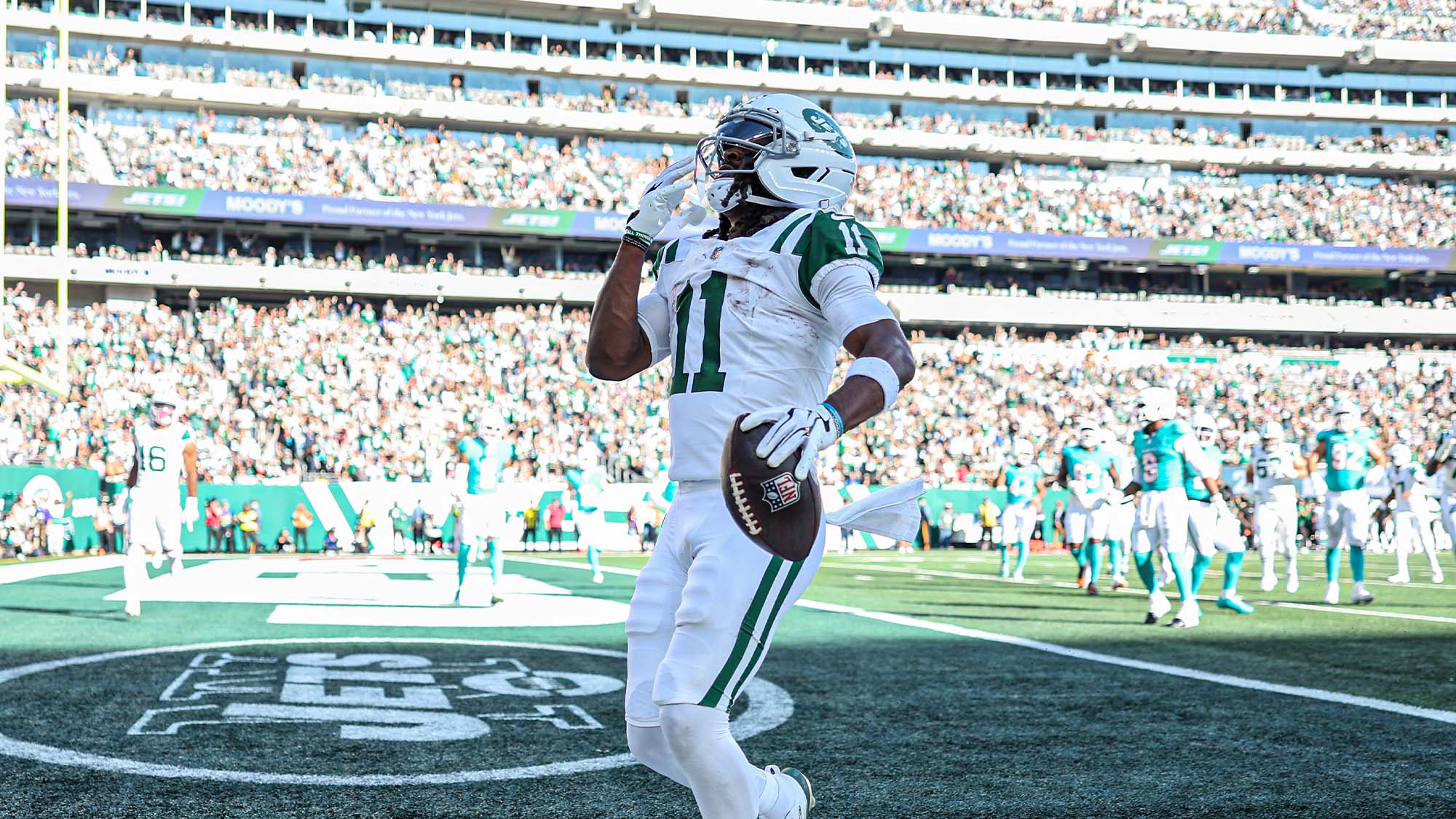
Nobody is arguing that New York Jets rookie wide receiver Omar Cooper Jr. is the best thing since sliced bread, or even the slightly lesser accomplishment of being the best wide receiver since Jerry Rice. Let’s chill out: He’s played five NFL games.
But in those five games… Cooper arguably has yet to show a single flaw.
It’s a question worth asking: What, exactly, has Cooper done at a less-than-stellar level thus far? The 22-year-old has put on a darn-near flawless performance over his first five NFL appearances.
That doesn’t mean he will remain flawless throughout his career, but it’s one heck of a promising sign for his future in the NFL.
When you unpack the various aspects of Cooper’s game over his first five appearances with the Jets, it’s startling just how many areas he is thriving in.
Omar Cooper Jr.’s early prowess
Per-target efficiency
Let’s start with Cooper’s incredible efficiency in the box score.
The Jets have only thrown 24 passes Cooper’s way, and this is what he has turned them into: 20 receptions, 306 yards, two touchdowns, and 11 first downs. Here’s where that places his efficiency among the 95 wide receivers with at least 20 targets:
- Yards per target: 12.8 (2nd)
- Catch rate: 83.3% (1st)
- Percentage of targets for first down: 45.8% (15th)
- Passer rating when targeted: 146.5 (3rd)
- EPA per target: 0.865 (2nd)
So, from a pure productivity-per-target standpoint, Cooper has capitalized on his targets with downright absurd efficiency. Of course, the caveat is that he only has 24 targets, a small sample size, so we have to see if he can maintain numbers anywhere close to this efficient as his target count stockpiles.
It’s worth noting, though, that these numbers don’t even tell the whole story. Cooper also had a 14-yard touchdown reception in Week 6 that was wiped out by an unrelated penalty. Add that to his pie, and the numbers would look even more mind-boggling.
Okay, so we know that Cooper is maximizing his targets. But a big part of the wide receiver position is generating targets. Some receivers are efficient on a per-target basis, but rarely get open, so they are generally only targeted when they’re wide-open, making them a limited overall weapon despite efficient per-target numbers.
This is not the case with Cooper.
Per-route efficiency
Even if you evaluate Cooper on a per-route basis (rather than per-target)—a method of analysis that dings receivers for routes where they do not get targeted, as opposed to per-target analysis, which only accounts for targeted plays—his efficiency is still elite.
Cooper is averaging 2.73 yards per route run, placing him seventh among wide receivers with at least 20 targets. Look at the company he joins in the top eight:
- Jaxon Smith-Njigba (3.49)
- Mike Evans (3.41)
- Christian Watson (2.98)
- CeeDee Lamb (2.91)
- Zay Flowers (2.90)
- Puka Nacua (2.86)
- Omar Cooper Jr. (2.73)
- Tee Higgins (2.65)
Again, though, it must be noted that all of those players have at least 15 more targets than Cooper, so it’s apples-to-oranges in that way, but it still exemplifies just how dominant Cooper has been within his sample of opportunities thus far, even on a per-route basis (rather than only looking at his targeted plays).
Cooper has looked sublime in our analysis thus far. But we’ve only looked at production-based metrics, not metrics that evaluate the controllable, individual aspects of a receiver’s play. You can rack up gaudy numbers through busted coverages, great play-calling, ballooned stats from a couple of home runs, and so forth; great production on its own does not necessarily indicate great play.
Even when you zoom in and focus on Cooper’s controllables, he still looks like a standout in nearly every area. He has earned every bit of his flashy production.
Hands
It starts in the hands department, where Cooper has been tremendously reliable with his targets so far.
Catching 20 of 24 targets (83.3%) is impressive enough, but the quality of Cooper’s pass-catching holds up even when you look at other metrics.
On top of having no drops, he has a catch rate over expected (CROE) of 8.6%, per NFL Pro. That ranks 12th among wide receivers with at least 20 targets, narrowly trailing Garrett Wilson’s 11th-ranked 9.2%.
CROE uses GPS tracking to estimate the catch probability of each target. Cooper’s success in this metric shows that his high catch rate is not just a product of the type of targets he gets; he is exceeding the expectations of his situation. He is both securing the freebies and hauling in difficult grabs.
Separation
Cooper isn’t just getting schemed open, benefiting from busted coverages, or living off tremendous catching skills in contested windows. He is consistently creating opportunities for big plays through his ability to separate.
According to Fantasy Points Data, Cooper has the second-best average separation score among wide receivers, trailing only Garrett Wilson.
This shows that Cooper’s per-route production is completely earned. It’d be one thing if, over a small five-game sample, he averaged a high yards-per-route-run mark because of a few busted coverages or unsustainable success on contested targets. But since Cooper also thrives in metrics intended to capture receivers’ individual separation skills, it shows that he is creating that per-route production by way of his own ability to generate playmaking chances.
Cooper is doing it at all levels of the field, too. He’s already secured three deep receptions (20+ air yards) with one touchdown, an intermediate reception (10-19 air yards), and nine short receptions (0-9 air yards) with one touchdown. The called-back touchdown against New England would have added to his intermediate total, giving him one touchdown in all three of the deep, intermediate, and short ranges.
The most exciting part of this for the Jets and their fans is that Cooper isn’t merely justifying the production he does have by showing off excellent separation on the plays where he is targeted; his film is littered with moments where he separated for potential big plays and was not targeted.
You can toss those two missed touchdown opportunities on top of the called-back touchdown in Week 6, and that’s three potential touchdowns that Cooper could have added to his total, on top of other moments that can be found scattered throughout his film.
As productive as Cooper already is, his effectiveness as a separator (through both the stats and the film) shows that not only is his production valid, but he should have even more of it.
YAC
Coming out of college, Cooper’s playmaking with the ball in his hands was arguably his most touted trait, and it has translated to the league so far.
According to PFF, Cooper ranks fourth among wide receivers (min. 20 receptions) in missed tackles forced per reception at 0.250, making five men miss on 20 receptions. He is also second in YAC per reception at 8.5, trailing only Khalil Shakir.
Sometimes, players can rack up gaudy after-the-catch numbers by design; a receiver will naturally gain more YAC and force more missed tackles if he is fed more screens and checkdowns than most of his peers. Once again, the deeper metrics prove that Cooper’s production in this area is no fluke.
Per NFL Pro, Cooper has racked up 41 YAC over expected (YACOE) on 20 receptions. His 2.05 YACOE per reception ranks fourth among wide receivers with at least 20 receptions, trailing only Zay Flowers, Luther Burden III, and Denzel Boston.
Like CROE, YACOE uses GPS tracking to estimate the expected YAC that should be gained on each play. Cooper’s success here validates that his raw YAC and missed tackle forced totals are, once again, not a product of scheme, but a legitimate indicator of his individual skill and ability to make more of a play than he is expected to.
Omar Cooper Jr. is doing everything right
His box-score totals are gaudy.
His per-target efficiency backs up the box-score totals.
His per-route efficiency backs up the per-target efficiency.
He backs up the production with high-level individual execution in all three phases of the wide receiver position: separation, pass-catching, and YAC.
Omar Cooper Jr. is legitimately thriving in every aspect of being an NFL wide receiver.
The only question now is what portion of these insane numbers he can maintain over the long haul. I’ll tell you right now: He will not average 12.8 yards per target over the course of his career. There will be some degree of a drop-off from an efficiency standpoint.
Additionally, some of these strengths in Cooper’s game may end up being slightly less strong as time goes on. Some may even reveal themselves to be weaknesses. An extended sample size can change a lot about the perception of a player. There is plenty of evaluating left to be done for a player with under 200 career snaps.
For now, though, Cooper should be celebrated for his unfathomably masterful play at the wide receiver position just five games into his pro career. He is separating an elite level at every depth of the field, catching passes at an elite level, and making plays after the catch at an elite level.
What can’t he do?
I suppose we’ll have to find out if there is an answer to that question.
