

“Protect the ball!”
It’s one of the core fundamentals coached into every football player, starting the first day they step onto a pee-wee field. From tucking the ball with two hands as a runner to avoiding dangerous throws at the quarterback position, football players are taught to treat the rock as if it were their own child.
The value placed on ball security trickles into coaching. Teams lean on the run when they don’t want to risk turning the ball over. Every pass concept is designed to create answers that can be found without risking a turnover. Sometimes, teams will even let the clock run to halftime or the end of regulation to avoid the risk of a turnover.
But what if protecting the ball isn’t as important as everyone thinks?
The 2026 New York Jets may be learning that lesson firsthand.
Your team. Your decisions.
Jet X Game Simulator
Win a lifetime membership
Beat any of the five Legend challenges without simulating.
Play the weekly matchup or relive a classic. Choose a current matchup or classic game, and log in to save Coach Points.
Explore Game SimulatorChoose your mode on the Game Simulator page. Full games · Weekly prep · Classic challenges.
Does protecting the ball really help you score points?
It seems like a silly question to ask on the surface, but does avoiding turnovers really help an NFL offense that much?
“Of course it does,” you’re probably thinking. And, yeah, you’re right; in a vacuum, it absolutely helps. If turning the ball over means your drive ends with no points, then turning the ball over less often probably helps you score points.
In practice, though, there isn’t a strong correlation between turnover avoidance and offensive efficiency.
Take the Jets, for instance. This is a franchise more well-known for its turnover woes than any other, and here they are in 2026, finally protecting the ball for once. Through nine games, they have turned the ball over just seven times; they rank seventh-best in the NFL with a turnover on 7.4% of their drives.
Despite keeping the ball safe, the Jets are 2-7. Their offense ranks just 18th in offensive DVOA (an all-encompassing offensive efficiency metric), a whopping 11 spots lower than their ranking in turnover rate.
The Jets are not an exception; this type of disparity is common around the NFL. League-wide, turnover rate and offensive DVOA have a weak correlation.
Take a look at all 32 NFL teams plotted according to their turnover rate and offensive DVOA, through Thursday Night Football of Week 10:
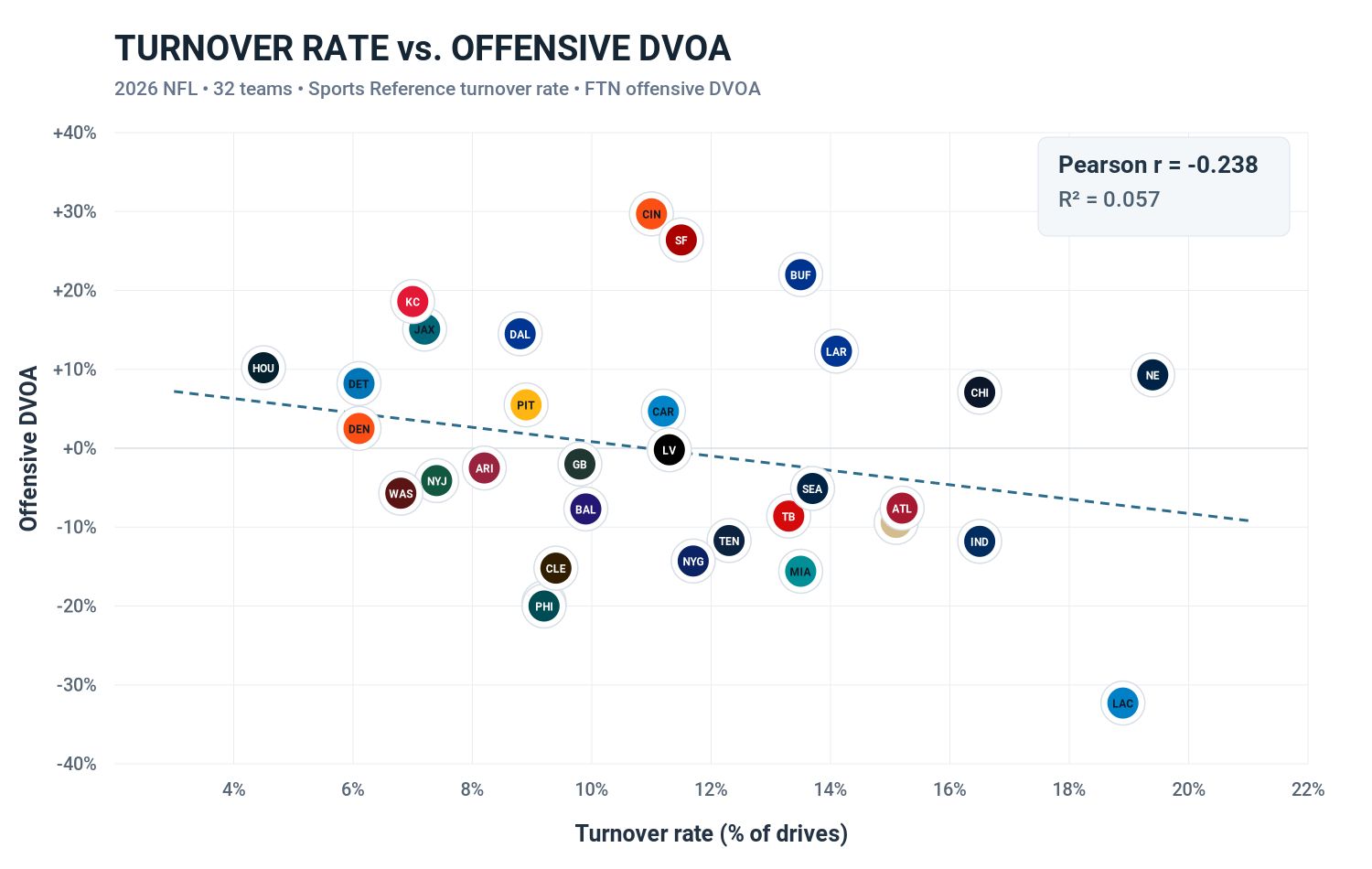
There are plenty of offenses who turn the ball over frequently and thrive, along with plenty of offenses who rarely turn the ball over but struggle.
Each of the league’s three best offenses, Cincinnati, San Francisco, and Buffalo, rank 17th or higher in turnover rate. New England, Chicago, and the L.A. Rams also have top-12 offenses despite top-seven turnover rates; New England even has the highest turnover rate in the NFL, while Chicago is third.
Meanwhile, Washington has an even lower turnover rate than the Jets, and they rank two spots worse in offensive DVOA. Altogether, of the 14 teams with a turnover rate below 10%, eight have below-average offenses based on DVOA: the Jets, Washington, Philadelphia, Minnesota (whose dot is covered by Philly’s on the chart), Green Bay, Baltimore, Arizona, and Cleveland.
As they say… “scared money don’t make no money.”
While minimizing turnovers is an obvious positive without context, it would seem that deliberately avoiding turnovers is actually a net-negative in the long run. If you can only avoid turnovers by avoiding risk-taking, you’re capping your offensive ceiling.
Offenses like Cincinnati, San Francisco, and Buffalo prove that a few extra turnovers can be survived just fine if the risk-taking is rewarded by a massive uptick in explosiveness. These are three of the top five offenses in net yards per pass attempt. So, even if their aggressiveness costs them a pick here or there, they generate more than enough yards to make up for it.
Meanwhile, offenses like the Jets, Cleveland, and Minnesota prove that a low turnover number doesn’t mean a darn thing if it is only achieved through scared play. All three of those aforementioned teams rank among the bottom six clubs in sack rate allowed. So, sure, they don’t turn the ball over much, but it’s because they often go backwards (or nowhere) instead of taking chances, which makes the turnover column look nice, but doesn’t put points on the board.
These differences in mentality help explain why Cincinnati, San Francisco, and Buffalo are all top-seven in red zone offense, while New York, Cleveland, and Minnesota are all bottom-10. Chance-taking is required to score points; even if it leads to a handful of extra turnovers, it will be worth it.
This is something worth keeping in mind for the Jets as they build their team moving forward. As important as turnovers can seem at times, it isn’t worthwhile to chase a positive turnover differential. Good ball security has to occur naturally. If it is forced, there will probably be a cost to it.
Thus, the Jets should prioritize calculated aggressiveness as they search for their prospective franchise quarterback and, presumably, new head coach and offensive coordinator. Under the old-school trio of Aaron Glenn, Frank Reich, and Geno Smith, the Jets have built an offensive identity around protecting the ball but not scoring any points.
Ball security definitely isn’t meaningless, but ball security for the sake of ball security (hello, Jacoby Brissett) does not help you win football games. You or I could throw zero interceptions in an NFL game if we wanted to; we would likely perish after eating a sack or two, but we would have one hell of an interception rate. Perhaps we could just kneel after every snap to avoid any trouble.
The whole point of ball security is to keep it secure while actively attempting to make explosive plays. If you have to avoid explosive plays to secure the ball, your only victories will be in the turnover column, not the scoreboard.
