
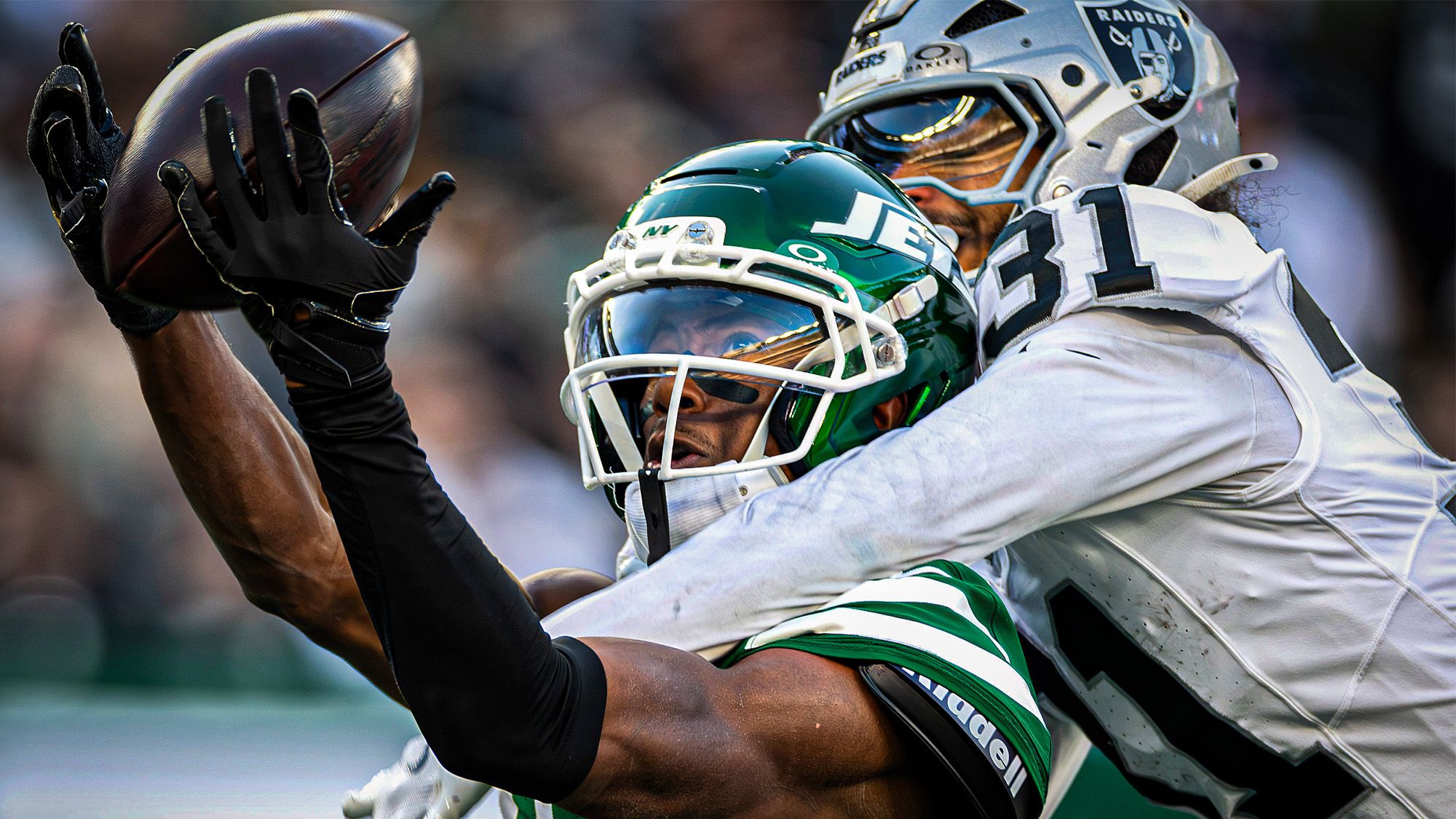
Adonai Mitchell is one of the New York Jets’ fascinating young players. Entering the season, the question was whether he would establish himself as the Jets’ WR2 alongside Garrett Wilson.
So far, it would probably be a reach to say he’s taken that next step. The talent and the upside are certainly there, but why hasn’t the 24-year-old been able to leap into WR2 territory?
What’s holding Mitchell back?
The biggest area of promise throughout Mitchell’s career has been his ability to generate separation at a high level. Getting open has always been his calling card, and that was the biggest indicator of upside.
According to ESPN Analytics, Mitchell has recorded an “open score” of 80 across 2024-25, ranking seventh among qualified wide receivers.
This season, his separation numbers haven’t been as encouraging, though. He ranks 25th in Open Score (62) and has created separation on 33.3% of his routes, per FTN Fantasy, which ranks 57th among WRs.
It hasn’t been an issue, but not at the same level as during his first two years in the league. That’s nowhere near the biggest concern, however.
Mitchell’s biggest enemy has been himself. This season, he has dropped five of his 42 targets, the third-most in the league. Mitchell also leads the league in drop rate (20.8%). For context, the gap between him and the second-place Matthew Golden is 4.9 percentage points. That’s a larger discrepancy than between Golden and the 11th-ranked Jameson Williams.
Keep in mind, this is nothing new for the former Indianapolis Colt. On 161 career targets, he has dropped 15 passes, contributing to a staggering 16.7% career drop rate. He has already dropped five passes this season. Last year, he had six drops after four in his rookie campaign. His highest drop rate, though, was 15.4% a year ago.
Hands have always been Mitchell’s biggest issue. He has also come down with just 33.3% of his contested targets in his career, while hauling in only 48.7% of his career targets. For a 6-foot-2 outside receiver, it’s a component of his game that needs to improve drastically.
Right now, Mitchell profiles as a serviceable WR3, but putting him in WR2 conversations just doesn’t make sense. Rookie Omar Cooper Jr. has already shown more promise of fulfilling that role next season than Mitchell.
There are still seven games left in the season, and Mitchell will get opportunities. Also, it hasn’t particularly helped him that he’s missed four games due to injury. However, the Jets also have to ask themselves how much more growth they can expect from Mitchell.
His ability to separate and all of that is encouraging, but when you look at the other areas of his game, how much growth has there really been since his rookie season? He continues to garner more targets, which is expected, but his hands remain a glaring issue.
Gang Green has to start looking not only at Mitchell, but also at other younger, experienced players, and focus more on proven ability. Nothing suggests Mitchell can’t have a role in the Jets’ offense, but him being the WR2 moving forward seems like wishful thinking based on his 2026 campaign so far.
Nevertheless, the trio of Mitchell, Garrett Wilson, and Cooper provides plenty of hope for the organization moving forward.
