
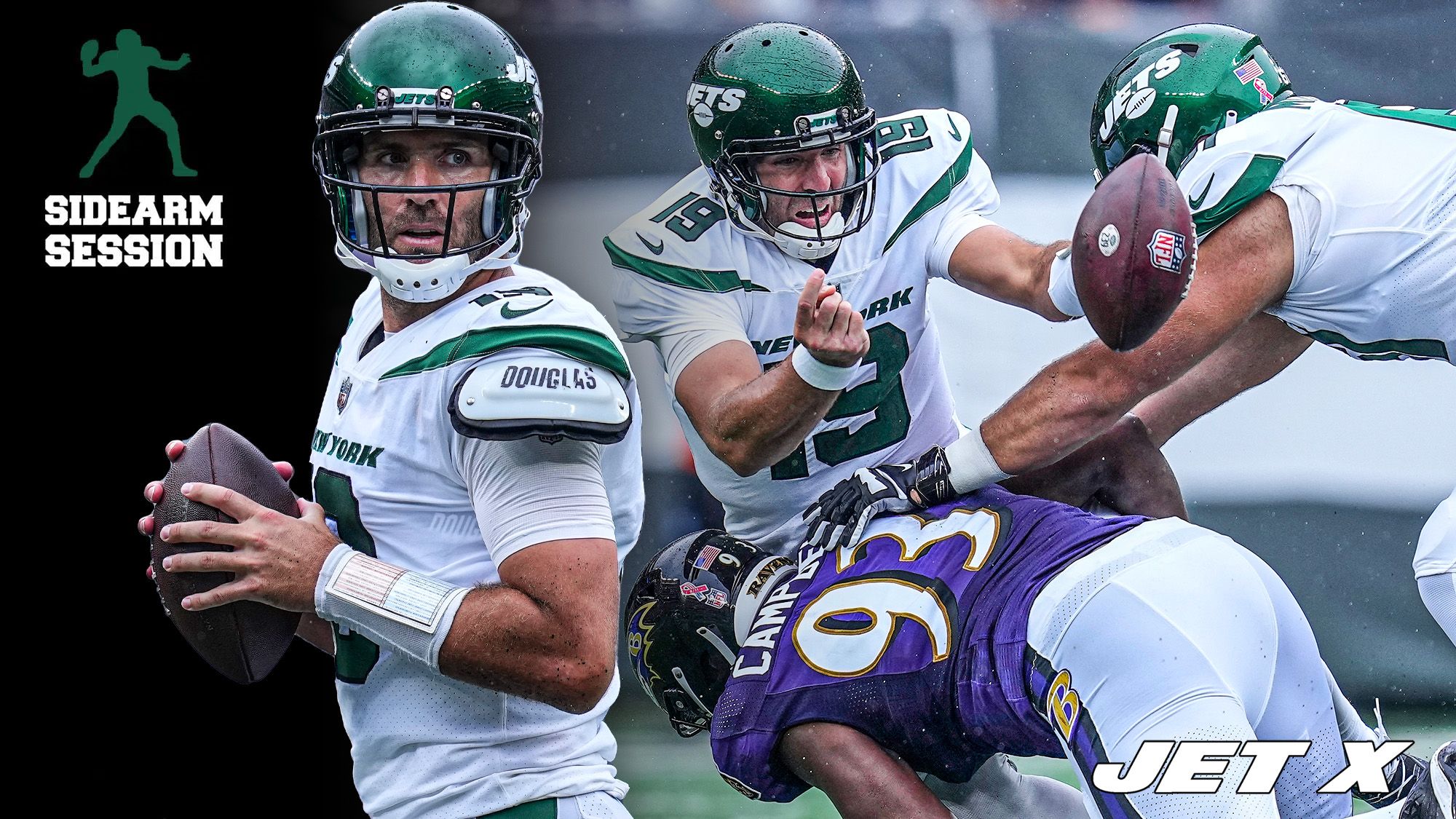
The New York Jets’ defense did more than enough to beat Lamar Jackson and the Ravens, but Joe Flacco and Co. offered no help until it was too late
The Jets’ offense couldn’t get anything going until the fourth quarter. Why?
There are many angles to approach the New York Jets’ first game of the season. Obviously, it was a loss, and a double-digit one at that; which is becoming common in the Robert Saleh era (it’s his 9th double-digit loss in 18 games).
As hard as it is to think right now, it’s not all doom and gloom.
Despite facing a winning, proven team like the Ravens, the Jets didn’t seem outmatched from a talent standpoint for the first time in a long time. And that’s a great sign for this team’s chances of success this season.
Despite losing 24-9, the Jets outgained the Ravens in yards (378-274), and first downs (24-13). I know: garbage time has to be considered. But those stats show, in a way, what many could see while watching what happened at MetLife: There wasn’t a talent difference between the New York Jets and the Baltimore Ravens.
That is easily identifiable with how the Jets played defense: knowing they were more talented in the secondary than the Ravens were at wide receiver, New York opted to stack the box and dare the Ravens’ wide receivers to beat Gang Green’s DBs one-on-one.
It was a good strategy that probably would’ve worked out better if the offense sustained drives more often.
Still, it was clear: the Jets’ defense played up well against the tough Ravens’ offense, which is the result of the talent improvement on this side of the ball.
Nonetheless, the Jets lost the game by 15 points, trailing by 21 with less than two minutes left on the clock in the fourth quarter. The scoreboard indicates a beatdown.
But it wasn’t. How did that happen? How did a game that felt like a 50/50 split up until the middle of the third quarter end up so badly for the New York Jets? Was it all on Joe Flacco? Is Robert Saleh to blame? Was the offensive line that bad?
The answers are multiple, which is both alarming and encouraging at the same time.
It’s alarming because no one wants to have multiple problems. It’s encouraging because none of them are unsolvable.
Defensive recap
Starting with the defense, it was a good day overall. My few (personal) complaints – John Franklin-Myers playing on the EDGE too much and Bryce Huff being inactive – weren’t game changers.
In fact, Jeff Ulbrich’s squad seemed like a much-improved unit, playing faster than years past.
Since the Jets play a zone-heavy scheme, the reaction speed is crucial for everything else to unfold. And the lack of it was arguably the team’s biggest issue in 2021. It’s safe to say that this matter, at least, is much improved.
To be honest, the defense as a whole is a silver lining. They stopped the run and forced Lamar Jackson to the outside, which is the go-to against the former MVP.
In today’s NFL, defenses won’t hold up forever if the offense can’t sustain drives. And, as we all know, the Jets couldn’t.
Offensive recap
Coaching staff
The issues in the Jets’ offense are just like every other issue in life: There’s never one major culprit. The blame is spread around.
Starting with the coaching staff, Mike LaFleur could have approached the game differently, which also could have yielded better results.
Sure, there’s logic to what he was trying to do (catch the Ravens off guard by running the ball with the unicorn Lawrence Cager in 13 personnel – which is 1 RB and 3 TE), but it is worth questioning the effectiveness of using a run-heavy approach early in the game in today’s league.
This was worth questioning not only for practical reasons (is running the ball to a fault the most effective way to attack a defense today?) but also because it seemed like the Jets’ offensive players could never get into a groove.
And it is LaFleur’s job to identify what can jumpstart his unit. He didn’t do it against Baltimore.
Take his heavy 13 personnel approach for example. Does it make more good than harm?
First, since you can not simply trot out 13 personnel on every down because of its limitations, the Jets kept switching their personnel at the beginning of the game.
In the first half, for example, the Jets used 12 personnel (1 RB/2 TE) on 14 plays, 11 personnel (1 RB/1 TE) on 16 plays, and 21 personnel (2 RB/1 TE) on 4 plays. That’s a lot of switching, especially for a young team (Michael Carter, Breece Hall, Elijah Moore and Garrett Wilson kept coming in and out of the game).
Is it more helpful for your team to possibly catch the defense off-guard by switching personnel and running heavy than keeping it simple for your players in Week 1?
It’s hard to know for sure, but Mike LaFleur’s approach sure can be questioned.
While it’s difficult to affirm, my impression from the first half was that the Jets’ offense couldn’t get into a flow. It was more than a rhythm issue. Players were thinking too much. And that’s never good.
I wonder if the consistent personnel switches played a role. That, combined from the expected rust in the first game of the season, might have hindered the Jets to start.
Nonetheless, the main point regarding LaFleur is this: There are other ways to start the game besides establishing your ground-game identity.
Obviously, the Jets need to run the ball (especially in this scheme that they insist on running in its purest form), but the offensive coordinator has to know what’s the path to take his players to a scenario where they are at their best.
Flacco and the receivers only got into a groove late in the third quarter when the team stopped playing the sticks and the downs and started playing the field.
Freedom, playing with nothing to lose: That mentality usually comes before good results. It’s something to reflect on for the Jets offensive staff.
What’s the best way to get these guys going? It might be running the ball, but with the same personnel. It might be throwing the ball.
No matter how, the Jets need to find a way to start fast.
Players
Before talking about Joe Flacco, who will be the main character in the film review below, here are some quick thoughts on the pass catchers and the offensive line (whom I will also talk about in my review):
- The Jets receivers are not as good as the fan base currently thinks. There’s a lot of juice needed there, making that extra effort to separate vs. physicality and making tough catches. Props to Garrett Wilson, who runs fantastic routes. He needs more playing time.
- The tight ends didn’t have a great game, but they weren’t much involved in passing concepts, either. Conklin ran a lot of “bait” routes on the hi-lo concepts, which weren’t where Flacco wanted to go after the Ravens established a lead.
- It was not a communication issue with the offensive line, which is what Jets fans got used to seeing over the past few years. George Fant and Laken Tomlinson were simply beaten by Justin Houston and Justin Madubuike, who was the best player on the field for Baltimore’s defense. Got to hope Fant has a bounce-back game against Myles Garrett. Tomlinson performance was worrisome.
As for Flacco, well, he didn’t play well.
Considering his 2020 and 2021 performances, I honestly thought Flacco could keep the Jets’ offense on schedule with rhythm and decisiveness. Despite the undeniable pressure, the word to describe Flacco’s performance is, curiously, “indecisive”.
Game film
In the video below, I selected a few plays that help illustrate what went wrong with the Jets’ offense, always coming from the quarterback’s perspective.

Looking ahead: the Cleveland Browns
A few thoughts on the game against the Browns:
- The Browns held the Panthers to 54 yards on the ground in Week 1, allowing under 3 YPC despite playing with 7 defenders or less in the box on 77.3% of the snaps, per NextGen Stats.
That’s a worrisome stat, but New York’s offensive line has much more talent than Carolina’s crew. That must show because a ground game threat is crucial for the Jets’ hopes of slowing down Myles Garrett. - On the other hand, the Browns ran for more than 200 yards against the Panthers, which is their only path towards winning without Deshaun Watson. Jacoby Brissett lined up under center on 72.7% of those runs, per NGS.
- If the Jets’ defensive line can stop the run like they did vs. Baltimore, they are in good shape. The problem is that, just like New York’s OL is better than the Panthers’, Cleveland’s big guys are more talented than what the Ravens had last Sunday.
- Long story short: It will be all about who controls the line of scrimmage. It doesn’t mean that the Jets need to run the ball all the time, but they must have that threat in their pockets (hello, Braxton Berrios jet-motion package…)
- Nice wrinkle: Browns defensive coordinator Joe Woods coached under Jets’ HC Robert Saleh in 2019, serving as the defensive backs coach and passing game coordinator with the San Francisco 49ers. The Jets could, for a change, use the opposing team’s defensive tendencies against them.
