
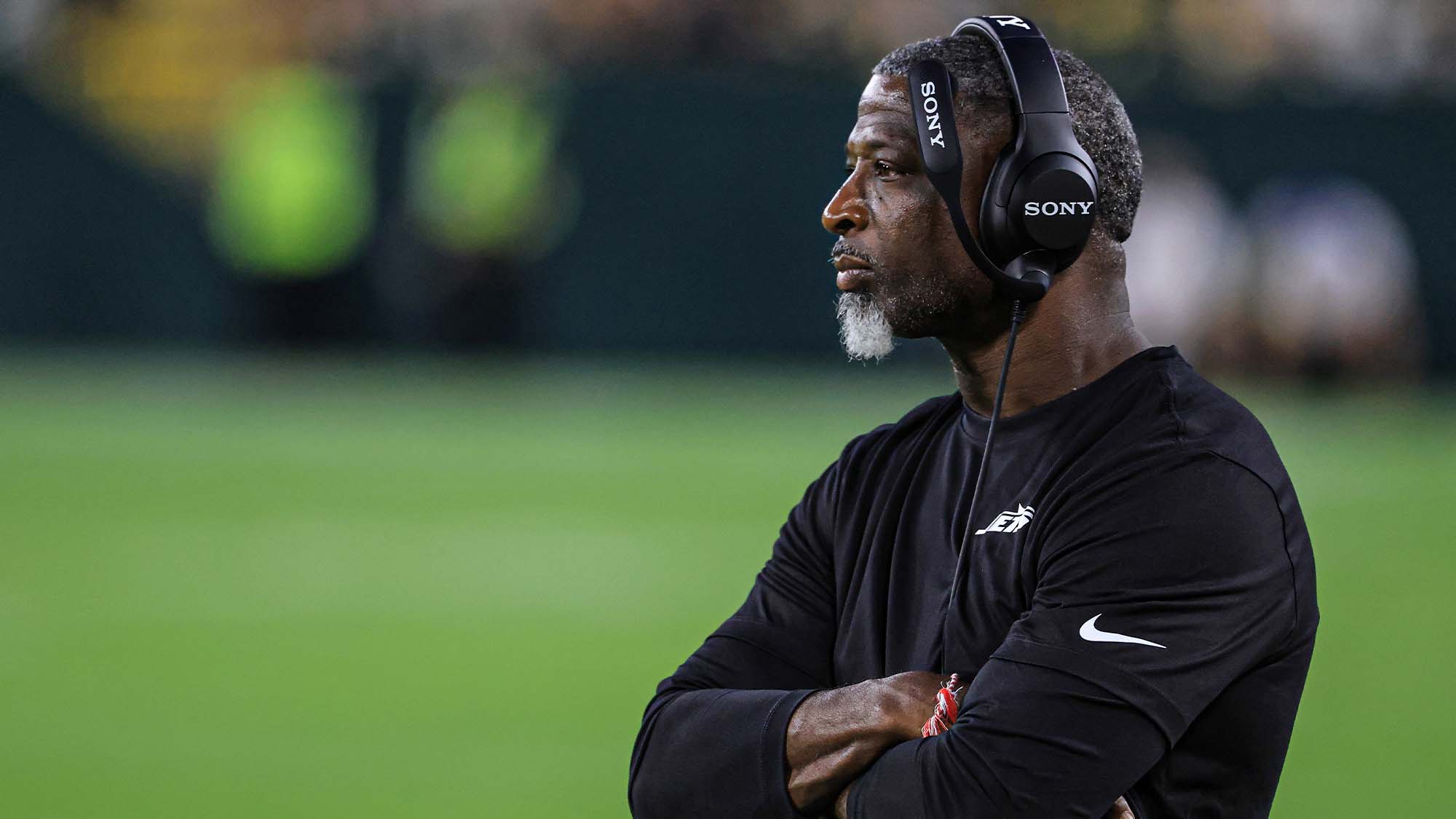
“Remember that word: Discipline.”
James Strickland would be proud. A conversation about the Aaron Glenn-led New York Jets cannot be had without mentioning “discipline” and the first-year head coach’s quest to re-instill it within a culture on the mend.
It’s a natural topic to bring up. Robert Saleh’s iteration of the team struggled mightily with discipline. This showed up in many areas, but none more glaring than the team’s reigning back-to-back penalty titles. New York led the NFL in flags in both 2024 (137) and 2023 (124).
Penalties annoy everyone involved, whether you’re a coach, player, or fan at home. They come at the worst times and kill momentum. Jets fans are tired of seeing them, and justifiably so. They want Glenn to stomp them out, believing not only that it would improve the team’s odds of winning, but that it would prove Glenn is changing the culture and making the team more “disciplined.”
Are either of those things actually true?
Common sense would seem to suggest that, yes, of course reducing penalties would make the team better at football and indicate that the culture is improving from a discipline standpoint.
The cold-hard evidence doesn’t agree, though.
Avoiding penalties is an extremely overrated skill in the NFL
Committing fewer penalties does not correlate with a higher win percentage.
The following chart displays all 96 teams over the past three seasons (2022-24), plotted based on their penalty and win totals. As the red trend line shows, there was almost zero correlation between penalties and wins (r=-0.065).

In the long run, a team’s penalty total does not significantly affect its final win-loss record.
Consider: Of the 36 teams to win 10+ games since 2022, more than half of them (19) committed 100+ penalties.
Of the 18 teams to win 12+ games, 10 of them committed 100+ penalties.
Meanwhile, these were the six best teams at avoiding penalties over the past three seasons:
- 2022 Falcons (68): 7-10 (Missed playoffs)
- 2023 Raiders (75): 8-9 (Missed playoffs)
- 2023 Bengals (76): 9-8 (Missed playoffs)
- 2022 Los Angeles Rams (76): 5-12 (Missed playoffs)
- 2023 Los Angeles Chargers (79): 5-12 (Missed playoffs)
- 2022 Chicago Bears (80): 3-14 (Missed playoffs)
Were any of these teams being praised for having elite coaching and rock-hard discipline?
Didn’t think so.
Plenty of great teams have high penalty totals. Plenty of awful teams have low penalty totals.
Cutting down penalties is not a guaranteed path to success, nor an indicator of how strong a team’s culture is.
How is this possible?
It doesn’t seem to add up.
A penalty is a negative outcome in any situation. So, how is it possible that committing fewer of them does not produce a better chance of winning?
It’s an open-ended question that could produce several theories.
Most likely, though, it comes down to this: Committing more penalties can be a byproduct of positive tendences, and vice versa.
Here are the teams with the five best records over the past five seasons (2020-24), and where they rank in penalties over that span.
- Kansas City Chiefs (66-18): 493 penalties (16th-most)
- Buffalo Bills (61-22): 525 penalties (7th)
- Baltimore Ravens (54-30): 522 penalties (8th)
- Green Bay Packers (54-30): 459 penalties (26th)
- Philadelphia Eagles (52-31-1): 502 penalties (12th)
Four of the five ranked in the top half of the league in penalties, including top-eight finishes for the Bills and Ravens.
Would anyone accuse Andy Reid, Sean McDermott, John Harbaugh, and Nick Sirianni of leading undisciplined teams?
No. All four of these coaches lead hard-nosed, aggressive teams that play with four quarters of intensity and know how to close out games in the clutch.
Committing a few more penalties can be a byproduct of playing that brand of football. In the end, it’s worthwhile for the reward of building a team with more physical and mental toughness than most of their opponents.
Meanwhile, here are the five worst teams in the NFL over the past five seasons, and where they ranked in penalties.
- Carolina Panthers (24-60): 527 penalties (6th-most)
- New York Jets (25-59): 556 penalties (2nd)
- Jacksonville Jaguars (26-58): 483 penalties (21st)
- New York Giants (28-55-1): 476 penalties (23rd)
- Chicago Bears (29-55): 483 penalties (20th)
Three of the five teams ranked 20th or lower in penalties. Yet, I don’t hear any praise for the remarkable discipline that Doug Pederson, Brian Daboll, or Matt Eberflus instilled within their teams. Two of those coaches were canned.
The Jets were an exception. They are one of the few bad teams with a directly correlated penalty total. It’s why Jets fans take this issue a little more seriously than they should – but it’s understandable. The team has lost a ton of games and committed a ton of penalties along the way. Why shouldn’t fans call for fewer penalties?
It is a completely justified outcry. But as history shows, it doesn’t demand as much energy as Jets fans put into it.
Because if Glenn is going to build the Jets into the culture that fans clamor for – one modeled after the likes of Buffalo, Baltimore, Philadelphia, and Kansas City – committing more penalties might be a part of it.
More flags could indicate Glenn’s message is working
Coaches always teach their players to “play through the whistle.” Guess what? That will cause some penalties. Thus, the teams that are the best at playing through the whistle will probably commit more penalties. But in the end, they will play better football and win more games.
The only way to truly “avoid” penalties is to take your foot off the gas pedal. It would require a player to go less than 110%.
Got beat vertically on a go route? Don’t get physical and stay with the play, which at worst would create a penalty to save a touchdown. Just let him go. You gave up six points, but you didn’t commit a penalty! Excellent discipline!
Quarterback in your sights? Don’t pursue him to the ground, just ease off to avoid a potential roughing the passer call. Oops, we let Josh Allen escape the pocket and scramble for a touchdown.
Blocking a star edge rusher? Just try to mirror him and don’t get too handsy – we cannot afford a hold. Oh no! T.J. Watt just beat us around the corner for a strip-sack because our left tackle was afraid to use his hands and grab him.
These are exaggerated examples, but do you see the potential risk of playing to avoid penalties?
In order for a player to actively avoid penalty flags in the heat of a battle, he would need to have the mindset that he is open to giving a less-than-maximum effort to make it happen. While it might help him avoid some flags here and there, he is also going to give some plays back as a result of his overly safe approach to the game.
The Cincinnati Bengals committed the third-fewest penalties over the past two seasons (177). Yet, they were arguably one of the softer teams in the NFL. They won games off the sheer talent of their quarterback and receivers, but they got physically bullied in terms of defense and trench play.
In just about any category that one would connect to physicality and toughness, the Bengals were poor. Over the same span when they had the third-fewest penalties, the Bengals allowed the seventh-most points (818), while their offensive line allowed the 10th-highest pressure rate (29.4%) and led the run game to the ninth-fewest yards per carry (4.1).
For another example of low penalty totals indicating soft play as opposed to discipline, look no further than the team with the fewest penalties over the last two seasons. Any guess as to who it is?
The culturally advanced Las Vegas Raiders.
Despite committing an NFL-low 171 penalties from 2023 to 2024, the Raiders went 12-22 and got two coaches fired. Nobody would ever confuse the 2023-24 Raiders for a tough and disciplined team; they got outscored by 124 points, ranked last in yards per carry (3.7), and had the sixth-most missed tackles (238).
Glenn wants the Jets to rank highly in many of the aforementioned categories – points allowed, yards per carry, missed tackles, pressure rate allowed by the offensive line, and so on. Thriving in those facets of the game requires a high level of physicality. It is tough to succeed in any of those areas if the players are scared to commit penalties.
More flags do not mean Aaron Glenn is doing a bad job
In a perfect world, the Jets can have their cake and eat it too. It is possible to be a great team and commit penalties at a low rate.
It is not easy to pull off, though. That is especially true for a team built like the 2025 Jets – one that is predicated upon physicality and brute force rather than skill and finesse.
As we saw, four of the five best NFL teams over the past half-decade committed more penalties than at least half the league. Oftentimes, the style of football that correlates with winning games will also correlate with more penalties.
Jets fans will have to live with that. That does not mean they should not hold the team to a certain standard, though.
After leading the league in each of the past two seasons, it is fair to expect Glenn to at least pull the Jets out of the top five. After all, while four of the five best teams from 2020 to 2024 ranked in the top half of penalties, none ranked higher than Buffalo’s seventh.
Committing a boatload of penalties is never ideal. The point of this article is that committing more penalties than the average team is acceptable in certain scenarios, and sometimes even ideal.
But the Jets will struggle to win games if they lead the league in penalties again. They must improve to some degree. The key is pulling it off without sacrificing Glenn’s vision of a physical play style. To do it, they must focus on eliminating the foolish, avoidable penalties that are entirely within their control.
Pre-snap and operational penalties must be squashed. Those are a product of attention to detail and have nothing to do with playing hard.
New York can also work to eliminate silly unsportsmanlike conduct penalties, such as late hits that happen with ample time to ease up, post-play fights, and outlawed celebrations.
But if the Jets play Aaron Glenn Football® as intended, they might commit a few roughing the passer penalties that make you throw your remote. They might have a few holding flags that cause you to stomp out of the room.
As long as it does not go overboard and comes alongside a renewed brand of intense, physical football, the Jets can live with it.
Do not use penalty totals as a barometer to judge Glenn’s progress with the Jets’ culture.
